Find source of coolant all over the engine
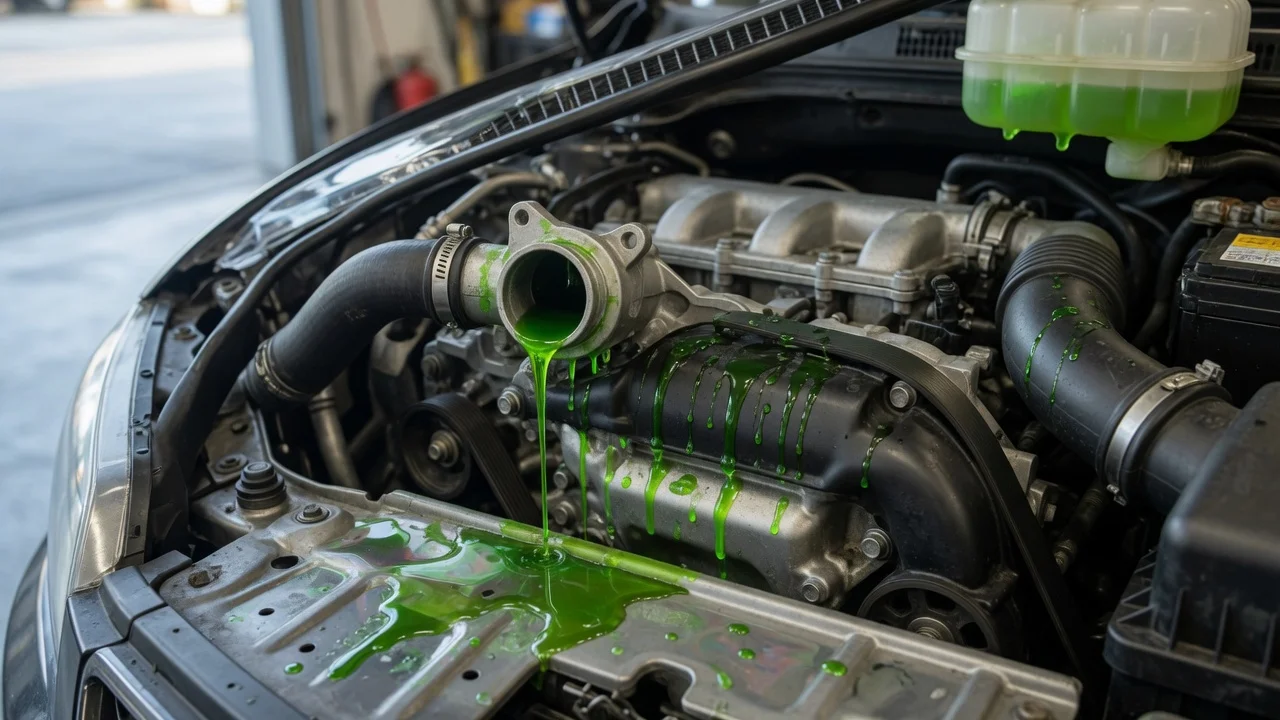
Coolant spread across the engine bay usually means a leak in the pressurized part of the cooling system. A small hole, loose clamp or failing seal can push coolant out as a fine spray or mist, and the radiator fan and airflow then scatter it across nearby surfaces. Coolant can also escape from the reservoir or pressure cap. Because of this, the wettest spot is often not where the leak starts. The reliable way to find the source is to clean the area, pressurize the cold system, and watch where fresh coolant first appears. Component layouts vary by make, model year, engine and drivetrain, so check any location cues below against service documentation for your vehicle.
Safety before you look
Let the engine cool fully before opening the radiator cap or reservoir cap. A hot cooling system is under pressure and can spray scalding coolant. Keep hands, hair and loose clothing away from the radiator fan. On many vehicles an electric fan can switch on even with the engine off. Coolant is toxic and tastes sweet, which attracts pets and children. Wipe up drips and puddles, and store or dispose of used coolant according to local rules. If the temperature gauge reads high, a warning light is on, or the coolant level is very low, stop driving. Overheating can damage the engine.
Confirm the fluid is coolant
Coolant color depends on the coolant type and the manufacturer. Green, orange, pink, red, blue and yellow are all in common use, so color alone does not prove a fluid is coolant. Two traits are more telling. Coolant usually smells sweet, and when it dries it leaves a crusty, powdery or chalky deposit. That deposit may be white or a pale version of the coolant's color, and it is often what owners notice first as dried coolant on the engine. Other engine-bay fluids look and behave differently.
Fluid | Typical feel and appearance | What it leaves behind; Engine coolant | Thin and watery, often bright in color, sweet smell | Crusty or powdery deposits that may be white, green, pink or orange; Engine oil | Slick and oily, amber to dark brown or black | Greasy film that collects dirt; does not dry to a crust; Automatic transmission fluid | Oily, often red or pink, may darken with age | Oily film; can look like pink coolant but feels slick, not watery; Windshield washer fluid | Very thin, often blue, may smell of alcohol | Usually little or no residue; Brake fluid | Thin, slightly oily, clear to amber | Can damage paint; is found near the master cylinder or at the wheels
Pink coolant and transmission fluid are easy to confuse. Rub a drop between your fingers: coolant feels watery, while transmission fluid feels slippery like oil. Clear water dripping under the car near the firewall is often normal air-conditioning condensation, not a leak.
Read the residue pattern
Where the coolant lands tells you how it escaped. Use the pattern to choose where to look first, then confirm the source with the steps further down.
Fine spray across the underside of the hood, the fan shroud or the front of the engine: often a pinhole or seeping seam in a pressurized part near the fan, such as the radiator, an upper hose or the water pump. The fan scatters the mist. Crust gathered at a hose end, clamp or joint: often a loose or weakened clamp, a hardened hose end, or a failing gasket at that connection. Residue around the reservoir, its cap or its overflow tube: may mean a faulty pressure cap, an overfilled reservoir pushing coolant out as it expands, or a cracked reservoir. A failing cap can also be the reason coolant leaves the system through the overflow. Wet streaks or crust running down the front of the engine, or a drip from a small hole on the water pump body: often a failing water pump seal. Many pumps have a weep hole that is meant to show this. Residue where the cylinder head meets the block, or around the intake manifold: may point to an external gasket leak, or a coolant passage or crossover leak on engines that route coolant through the intake manifold. This depends on the engine design. Dampness or a sweet smell near the firewall where the heater hoses pass through: may be the heater hoses or their connections. A sweet smell inside the cabin, a damp passenger floor or a film on the inside of the windshield points instead toward the heater core.
Where common coolant leak sources are usually found
The table gives general location cues. Exact positions, hose routing and which parts exist at all vary by vehicle, engine and model year. Some engines put the water pump or thermostat behind covers or deep in the engine valley. Use your vehicle's service documentation to confirm where each part sits.
Component | Where it is typically found | Signs to look for; Radiator | At the front of the engine bay, behind the grille, with the fan behind or in front of it | Crust or wetness on the core fins, at the side tanks or at the seams where tanks join the core; Upper and lower radiator hoses | Running from the radiator to the engine, the upper usually near the thermostat housing | Wet or crusty clamps, cracked, swollen or overly soft hose ends; Coolant reservoir and pressure cap | A translucent plastic tank, often near the radiator or at the side of the engine bay; the pressure cap may be on the radiator or the reservoir depending on design | Residue around the cap, cracks in the tank, wetness at the overflow tube; Thermostat housing | Where the upper radiator hose meets the engine, on many layouts | Crust around the housing's gasket line; Water pump | Usually at the front or side of the engine, often driven by the accessory belt or timing belt, though some are electric or mounted elsewhere | Drips or streaks from the weep hole, residue on nearby pulleys or the belt area; Heater hoses | Running from the engine toward the firewall at the back of the engine bay | Wet connections at the engine or the firewall, cracked hose surfaces; Intake manifold and head gasket area | Along the top or sides of the engine, depending on layout | Crust along gasket lines; on some engines coolant passes through the intake manifold
How to pinpoint the leak
1) Let the engine cool, then check the coolant level in the reservoir against its marks, and in the radiator if your vehicle has a radiator cap. Note how low it is. 2) Clean off old residue and wetness so that any new leak stands out. Old crust can hide the real source and point you to the wrong part. 3) Inspect with a bright light, working from the highest likely source downward. Coolant runs downhill and gets blown backward by airflow, so the true source is often above or in front of the wettest area. 4) Pressure test the cold system with a cooling system pressure tester. These are often available for rent from parts retailers. Pump only to the pressure rating specified for your vehicle, which is usually stamped on the pressure cap or listed in service documentation, then watch for drips, seepage or a falling gauge. Many testers can also check the cap itself. 5) If the leak is slow or only shows when the engine is hot, add an ultraviolet leak-detection dye that is compatible with your coolant, drive normally, then look for glowing traces with a UV light. 6) Watching a running engine as it warms can also reveal leaks that open up with heat and pressure. Keep clear of the fan and belts and never open the cap while it is hot.
When the coolant is not leaking outside
If coolant keeps disappearing but you cannot find an external leak, it may be leaking internally. Warning signs include persistent white exhaust smoke with a sweet smell, oil that looks milky or light brown on the dipstick or under the oil filler cap, bubbles in the reservoir while the engine runs, or repeated overheating. These can indicate a failing head gasket or a related internal fault. A shop can confirm this with tests such as a combustion leak test. Avoid driving in the meantime, because continued overheating can cause further damage.
What this guide cannot tell you
Some details depend on your exact vehicle and are not covered here: where each cooling component sits, the correct coolant type, the cap and test pressure ratings, and the refill and bleeding procedure. Some systems need a specific procedure to remove trapped air after a repair. Use the owner's manual or service documentation for your make, model year and engine for these details. Topping up with the wrong coolant type or mixing incompatible coolants can cause problems, so confirm the specification before adding fluid.