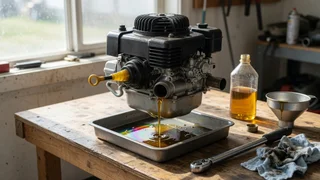
Find Briggs & Stratton 10 hp oil capacity
Small engines often hide their service details behind model, type, and date codes, which makes a simple oil change feel uncertain. The Briggs & Stratton 10 hp label can apply to several flathead and overhead-valve designs produced across different equipment generations, so one universal fill quantity does not fit every machine. Approaching the question correctly means identifying the specific engine family and then confirming the lubricant specification, fill quantity, level check procedure, and service interval for that configuration instead of relying on a horsepower rating alone.
Essential answer
A 10 horsepower rating alone is not enough to establish oil capacity for a Briggs & Stratton engine. Several engine families have been marketed near that output, including older cast-iron blocks and later aluminum-bore singles, and their crankcase shapes, dipstick lengths, and oil fill tube heights can differ. The practical answer is that many air-cooled single-cylinder engines in this general class require roughly one and a half to two quarts when the oil is drained and the filter, if fitted, is replaced.
That range is a planning guide rather than a service specification. The reliable procedure is to locate the engine model, type, and code stamped into the metal housing or valve cover, then use that identification to find the manufacturer approval for the exact engine. Once the correct fill quantity is known, the final check should always be the dipstick reading after the engine has been briefly run, shut down, and allowed to settle on level ground.
Identification and location
Finding the identification marks is usually easier on the metal blower housing, a flat area near the spark plug, or a stamped plate above the muffler. The model number often begins with a numeric series such as 19, 20, 25, or 28, while the type and trim digits further narrow the configuration. On a vertical-shaft engine used in a riding mower, the oil fill and dipstick are commonly located on the side of the block or through a tube extending upward near the starter.
Horizontal-shaft engines found on generators, tillers, or pressure washers may place the dipstick low on the side cover or behind a small access panel. If the original dipstick is missing, a replacement must match the specific engine series because dipstick length and the full mark position are calibrated to that crankcase. The oil fill cap itself often carries a short instruction such as checking the level before each use, but the cap is not a substitute for confirming the equipment identification.