Changing the Oil on a Ferrari: What Owners Need to Know
The Short Answer
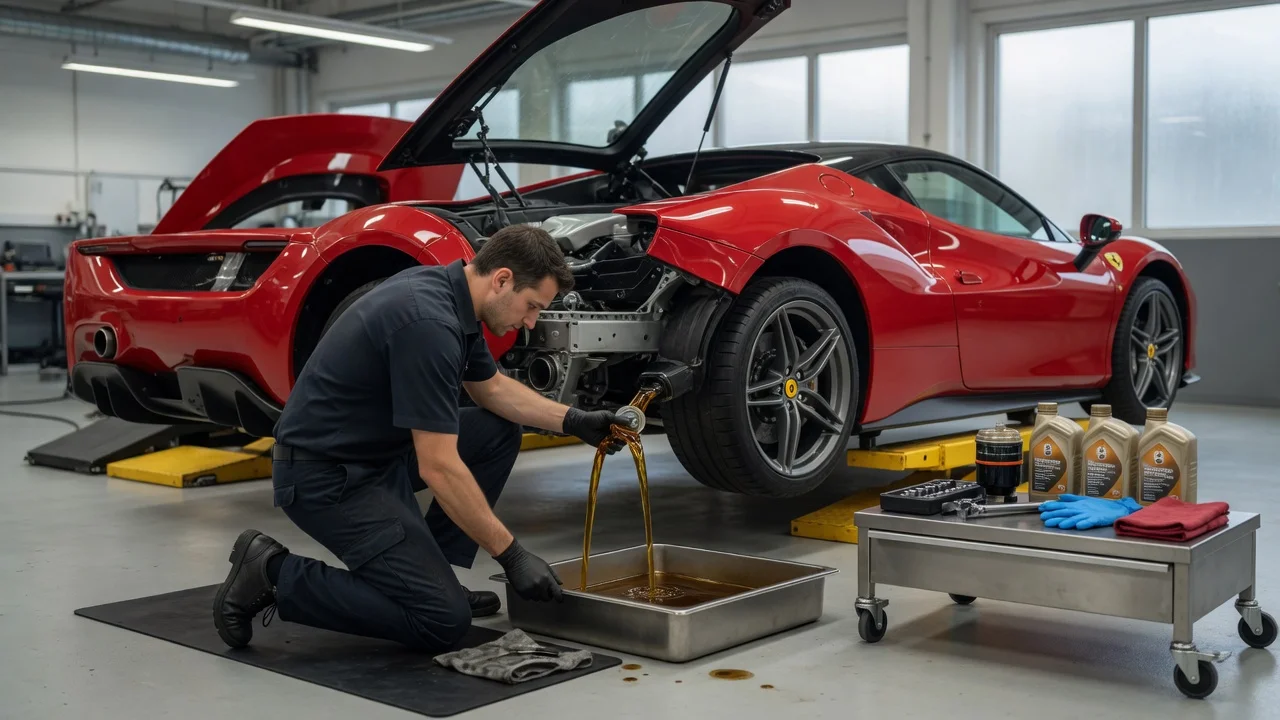
An oil change on a Ferrari follows the same basic idea as on any car: drain the old oil, replace the filter and refill with the correct oil to the correct level. What changes the answer is the specific car. The oil specification, capacity, service interval, filter part and level-check procedure all vary by model, model year and engine. The owner's manual and service documentation for your exact car are the authoritative sources. This guide does not supply those figures, because no verified model-specific data was available for it.
Why the Specific Model Changes the Job
Many high-performance engines, including many Ferrari engines, use dry-sump lubrication. In a dry-sump system, oil is stored in a separate tank instead of in a pan under the engine. Compared with the more common wet-sump layout, this can mean more than one drain point and a different way of checking the oil level. On some dry-sump cars, the level is checked with the engine warm or running rather than cold and off. Whether your car uses this system, and exactly how the manufacturer specifies the drain, refill and level check, depends on the model. Confirm it for your car rather than assuming.
Access also differs between models. Mid-engine and front-engine layouts place the drain plugs and filter in different positions, and underbody panels may have to come off first. The time and tools needed can therefore differ a great deal from one Ferrari to another.
What to Confirm Before Starting
The oil grade and manufacturer approval specified for your model and engine; The total oil capacity and the refill quantity for an oil-and-filter change; The correct oil filter part and any seals or crush washers to replace; The number and location of drain points, including any separate oil tank; The required oil temperature and engine state for an accurate level check; Torque values for the drain plugs and filter housing; The service interval by distance and by time, whichever comes first; Whether doing the work yourself affects any warranty, maintenance program or service-history requirement for your car
Doing It Yourself or Using a Dealer or Specialist
Doing the job yourself is realistic for an owner who has the correct documentation, a safe way to lift the car, the right tools and the parts specified for that model. A dealer or an independent Ferrari specialist is the more cautious choice in three situations: when the level-check procedure is unfamiliar, when the car is still under warranty or a manufacturer maintenance program, or when a documented service history matters for resale. That last point is an editorial judgment, not a manufacturer rule. Check your own warranty and program terms before deciding.
Gaps in This Guide
This guide does not state oil capacities, viscosity grades, service intervals or torque figures for any Ferrari. Those values are specific to each model and year, and no verified source data was supplied for them. It also does not describe step-by-step procedures for individual models. Use the owner's manual, official service information or a qualified Ferrari technician to get those details for your car.