Ferrari Gated Manual Transmissions: 360, F430, and Collectibility
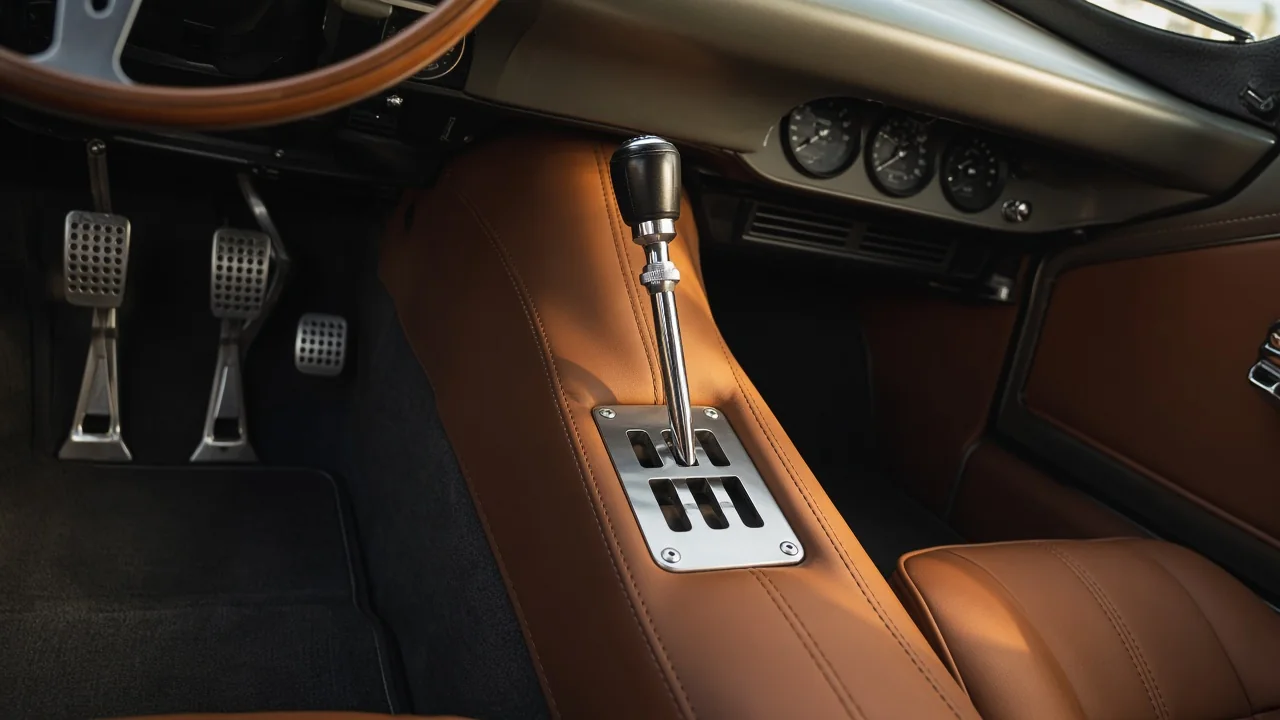
Buyers looking for a Ferrari with manual transmission often start with the F430 and 360, two later mid-engine road cars still offered with a gated six-speed. A gated manual transmission uses an exposed metal pattern to guide the lever, and that hardware is only part of what collectors mean by a three-pedal Ferrari. Factory manual specification, conversion history, and documentation determine whether an advertised car is the original article.
How Ferrari’s Gated Manual Shifter Works
On a gated Ferrari, the exposed shift gate is a metal plate with slots that correspond to the H-pattern of the six-speed manual. The lever must travel through those slots to reach each ratio, so the gate physically limits the path rather than hiding it under a leather boot. That visible metalwork is what listings mean by a gated manual transmission. The slots do not select gears by themselves; they only constrain the lever as the driver moves it from one ratio to another.
Driving a three-pedal Ferrari still requires a clutch pedal and a conventional gear lever. The driver depresses the clutch, moves the lever through the gate into the desired slot, and releases the clutch as the driveline takes up. Because the gate is only the visible portion of the shift mechanism, a clean exposed gate does not prove the gearbox is healthy or that the car left Maranello as a factory manual. Linkage wear, clutch condition, and original build specification are separate questions from how the metal slots look.
Where Gated Manuals Fit in Ferrari’s Road-Car History
Ferrari road cars with a gated shifter include well-known examples such as the 308, 328, 348, F355, and 550 Maranello, along with later cars that still offered a conventional gearbox. Manual availability always depends on the exact model and derivative rather than on the family name alone. Coupes, spiders, special series, and racing-inspired variants can differ, so a familiar chassis name is not enough to assume a clutch pedal was offered. Confirming the specific version and market specification is the only reliable way to know whether a gated six-speed was available.
Listings mix labels that sound similar. Factory manual specification means the car was built with a gated gearbox. A three-pedal Ferrari describes the same layout in driver language: clutch, brake, and throttle. The F1 electrohydraulic transmission is a different system that uses paddles and an automated clutch rather than a conventional lever and pedal. A car advertised as a manual transmission Ferrari may still be an F1 car, a later conversion, or an original gated example, so listing language must be matched to the hardware and paperwork.
Identifying a Factory Manual Ferrari 360
The Ferrari 360 manual transmission was a factory option on the 360 Modena coupe and the 360 Spider. Those road cars could be specified with a gated six-speed rather than the paddle-shift F1 unit. Visible clues include a clutch pedal, a gated lever, and the absence of steering-wheel paddles, but those controls can be fitted later. Appearance alone cannot prove original build specification. The Challenge Stradale is a separate 360 derivative and should not be treated as if it shared the same regular-model manual offering.
Build documentation is the practical way to separate a factory three-pedal 360 from a car that looks the part. Original sales paperwork, factory build sheets, and a continuous service history can show whether the gearbox was specified at delivery and whether it has been changed. A specialist can also compare chassis records against the hardware in the car. Without that paper trail, a gated shifter is only evidence of the current controls, not of how the Ferrari left the factory.
Understanding Ferrari F430 Manual Availability
The F430 coupe and Spider could be ordered with a gated six-speed, the combination people mean by a Ferrari F430 manual transmission. Those two road-car versions are the ones that could leave the factory with a clutch pedal. The 430 Scuderia and Scuderia Spider 16M should not be assumed to have been built with a gated gearbox. Treating every F430-family nameplate as a three-pedal candidate is how buyers misread listings that use a familiar model number without stating the exact derivative.
Because an F430 can be converted, a gated lever in photographs is not enough to call the car factory original. Ask for build documentation that names the transmission, then compare that record with the hardware, service history, and any invoices for gearbox work. If the paper trail is incomplete or contradictory, the car should be described as having a gated six-speed of unknown originality until a specialist can reconcile the records. Frequency of sale, regional allocation, and production totals cannot be read from one advertisement and should remain unverified until factory records support them.
What Rarity and Provenance Mean for Collectibility
Collector interest in a gated-manual Ferrari often starts with the exposed shift gate, the mechanical feel of the lever, and a driver-operated clutch. Those traits explain why some buyers prefer a three-pedal car over an F1 electrohydraulic transmission, but they do not guarantee rising values. Factory-manual 360 and F430 cars are discussed as a limited population, yet any numerical rarity claim needs documents rather than folklore. Without substantiated counts, it is safer to treat an individual car on its paperwork than to assume a specific production figure.
Provenance for these cars is built from original specification, documented history, condition, mileage, and modifications, not from the shifter alone. A car that still matches its factory manual specification and has a coherent service history is evaluated differently from one with gaps or later mechanical changes. A documented manual conversion should be disclosed as conversion work and judged on invoices, installation quality, and subsequent use, not presented as a factory-built three-pedal car. Asking prices advertise a seller's target; they do not establish what comparable cars actually sold for or what a future buyer will pay.
What to Check Before Buying a Gated-Manual Ferrari
Before buying, have a Ferrari-experienced specialist inspect transmission operation, clutch behavior, shift linkage, leaks, and the documents that claim factory originality. During an authorized, normal test drive, note difficult engagement, grinding, unusual noises, or inconsistent clutch feel without forcing the lever or repeating a suspected fault to make it worse. Those observations are clues for diagnosis, not proof that a particular part has failed. A noisy shift or a heavy pedal can come from linkage, hydraulics, mounts, or the gearbox itself, and only inspection can sort the cause.
If the car is a manual conversion, request invoices, a written description of the work, and a specialist's view of installation quality and how the clutch, linkage, and electronics were integrated. Budget from that inspection and from written estimates for the work the car actually needs, rather than from generic interval charts or advertised asking prices. Match the gated hardware to build documentation before treating the car as factory original. A clean shift during a short drive does not replace a full mechanical inspection or a coherent service history.