Exhaust Leak Repair: Repair Options by Leak Location
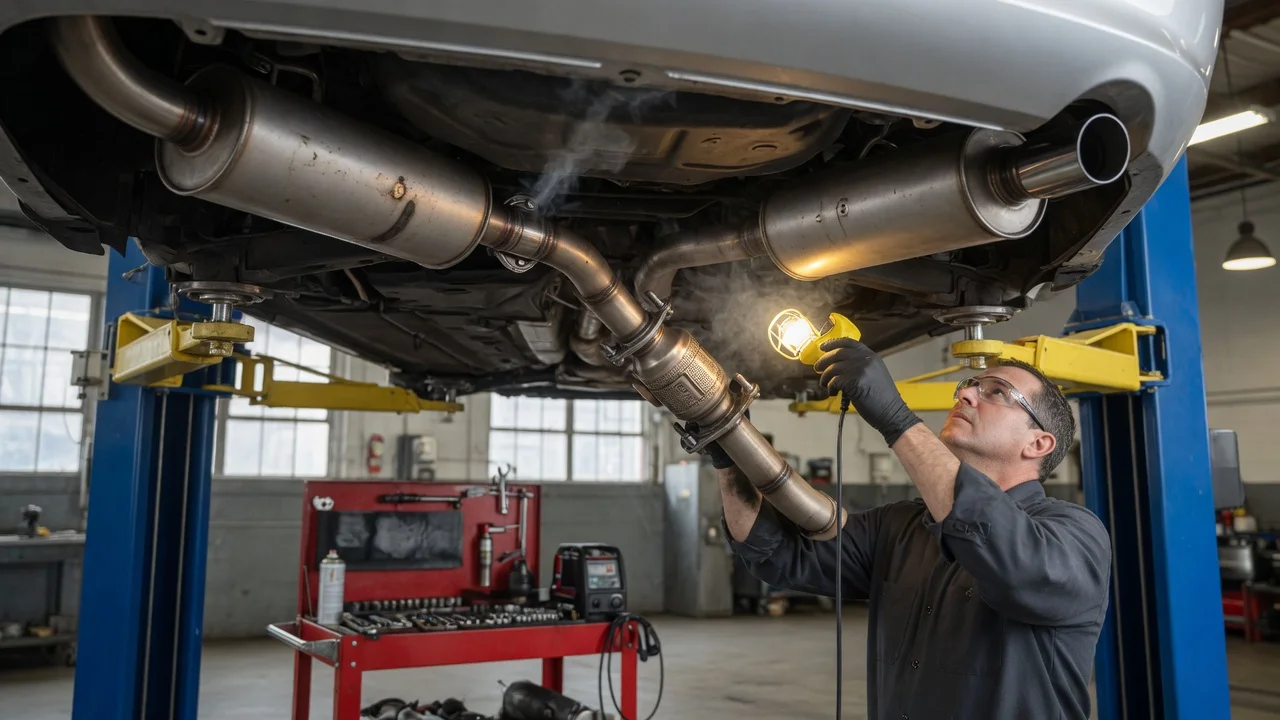
What actually fixes an exhaust leak
The lasting repair is chosen by leak location. A leaking joint or gasket is usually corrected by replacing the gasket and the fasteners that hold the joint, then confirming the mating faces are flat and intact. A crack or hole in a pipe, muffler, or catalytic-converter shell is corrected by replacing that section. A torn flex pipe is replaced as an assembly because that part is meant to move. Paste, tape, and wrap products can slow a small hole for a short time; they rarely hold on a hot, vibrating exhaust.
Layout is vehicle-specific. Whether a given car or truck uses a manifold gasket, a donut gasket, a ball-and-socket flange, an integrated flex-downpipe, or a manifold-mounted converter depends on model year, engine, drivetrain, and market. Confirm the parts against the service information for that vehicle before buying or cutting pipe. Fastener sizes, clamp styles, and oxygen-sensor (O2 sensor) bung positions are not universal, and those details are not listed here.
Where to look and what the leak looks like
Inspect a cold system. Hot exhaust can burn skin, and some manifold leaks tick loudly only at cold start, then quiet as metal expands. Work from the cylinder head toward the tailpipe. Soot streaks, a sharp ticking that tracks engine speed, a raw exhaust smell in the cabin or engine bay, and a change in note under load are typical of a leak. A rattling heat shield, a loose hanger, an intake vacuum leak, and valvetrain tick can sound similar; soot at a joint and a pulsing stream of gas at that joint point to the exhaust.
Useful physical landmarks, engine to tail:
Exhaust manifold or header at the cylinder head: gasket face, runner cracks, and warped flanges, often under a heat shield. Manifold-to-downpipe joint: flat gasket, crushed donut (ring) gasket, or ball flange. Soot collecting at the clamp or studs is a common tell. Downpipe and catalytic converter: flange welds, converter inlet and outlet, and the converter shell. A converter may sit on the manifold or under the floor. Flex pipe: a short braided or bellowed section that absorbs engine movement. Torn braid, a collapsed bellows, or a cracked weld at either end is the leak. Mid-pipe, resonator, muffler, and tailpipe: rust holes, split seams, and joints pulled apart by broken hangers. O2 sensor bungs: threaded bosses in the pipe. Disturbed threads or a cracked bung can leak; a heat shield around a sensor can rattle without leaking.
Access is often the hard part. Manifold and close-coupled converter leaks sit behind shields and may need the vehicle raised or an engine cover removed. Underbody leaks are visible from below once hangers and shields are not blocking the joint. A length of hose used as a listening tube, a film of soapy water on a cool pipe, or soot wipe-off can help pinpoint a joint. Keep clear of cooling fans and do not spray electrical connectors or a hot converter. Exact shield clips, stud locations, and sensor assignments belong in that vehicle’s documentation; they are not the same across engines.
Repair options that matter by location
Match the method to the failed part. Joint leaks and hole-in-the-pipe leaks are different jobs, and a product that covers a rust hole will not restore a flex pipe or a warped manifold flange.
Location Lasting repair Limitation or better choice; Manifold gasket at the head Replace the gasket; clean both faces; use new hardware if studs are stretched or corroded A cracked or warped manifold will still leak after a gasket change; Manifold-to-pipe flange, donut, or ball joint Replace the gasket or donut; renew nuts and studs; clean the seats Do not reuse a crushed donut; a warped flange or broken stud needs pipe or flange repair; Flex pipe or bellows Replace the flex section or the pipe assembly that contains it Wraps and clamps fail quickly because the part flexes in service; Catalytic converter joint Treat as a flange or weld repair at the inlet or outlet A hole in the shell, a rattling substrate, or a failed emissions test points to converter replacement; Converter shell or body Replace the converter with a unit that matches pipe diameter, bung count, and bung location Universal units still have to fit physically and meet the emissions rules that apply to that vehicle; Muffler, resonator, or rusted pipe Replace the box or that pipe section; a welded patch holds only on remaining thick metal Thin, scaly rust will not support a lasting weld; Slip joint or band clamp Reseat the joint, replace the clamp, and correct hanger height so the joint is not in tension If the pipe end is rusted away, cut back to sound metal or replace the section; O2 sensor bung Restore threads or replace the pipe section that carries the bung Sealant does not fix stripped threads or a cracked boss
Manifold, gasket, and flange work
If soot is at the head or at the downpipe flange, start with the gasket and hardware. Cast manifolds can crack at a runner or warp at the flange after heat cycling; in that case the manifold itself is the repair, by replacement. Welding a cracked manifold is a specialist job and may not last if the casting keeps moving. Aftermarket headers need the gasket style they were designed for at the head and at the collector; mixing a donut, a flat gasket, and a ball flange will not seal.
Flex pipe
A flex pipe is the designed moving joint between the engine and the underbody. Once the braid is torn or the bellows is split, replacement is the repair. Length, inlet and outlet diameter, and whether the flex is built into the downpipe or converter must match the vehicle. Cutting in a short flex of the wrong length can put the next flange in a bind and create a new leak.
Catalytic converter
A leak at a converter flange is a gasket or weld problem. A hole in the shell, a collapsed or rattling brick inside, or an emissions failure is a converter problem. Replacement parts must preserve O2 sensor bung count and position. Whether a direct-fit or universal converter is legal and compatible depends on the vehicle’s year, engine, and market rules; that cannot be stated as a single global choice here.
Pipes, muffler, and clamps
Holes from rust are repaired by replacing the weak section. Welding is durable when the surrounding metal is still thick; clamping a new sleeve or muffler is serviceable when the pipe ends are round and solid. Broken hangers pull joints apart, so hanger repair belongs with the leak repair or the joint will open again. Exhaust putty, tape, and clamp-on patches are short-term measures on a small hole in a cool, low-stress area. They are a poor choice on a manifold, a flex pipe, or a converter.
How to choose among the options
If the leak is at a joint and the pipe is otherwise sound, replace the gasket or donut and the fasteners. If the leak is in a flex section, replace that assembly. If the leak is a hole in a muffler or pipe and the rest of the shell is thin, replace the section rather than patching. Welding is reasonable only on remaining sound metal. Converter replacement is the path when the shell or substrate is damaged, with fit and emissions compatibility confirmed for that vehicle. A stored fault that names an O2 sensor is not, by itself, proof the sensor must be replaced; a leak upstream of the sensor can disturb the reading. Sensor, converter, and leak checks still have to be separated using the test conditions in the service information for that system.
Torque values, pipe diameters, stud sizes, and which engines use which joint type are not given here because they vary by vehicle. Raise and support the vehicle if you work from below, and avoid running the engine in a closed space: exhaust contains carbon monoxide. After the repair, recheck the joint for soot and noise once the system has gone through a heat cycle.