Electric vehicle inspection before purchase
The short answer
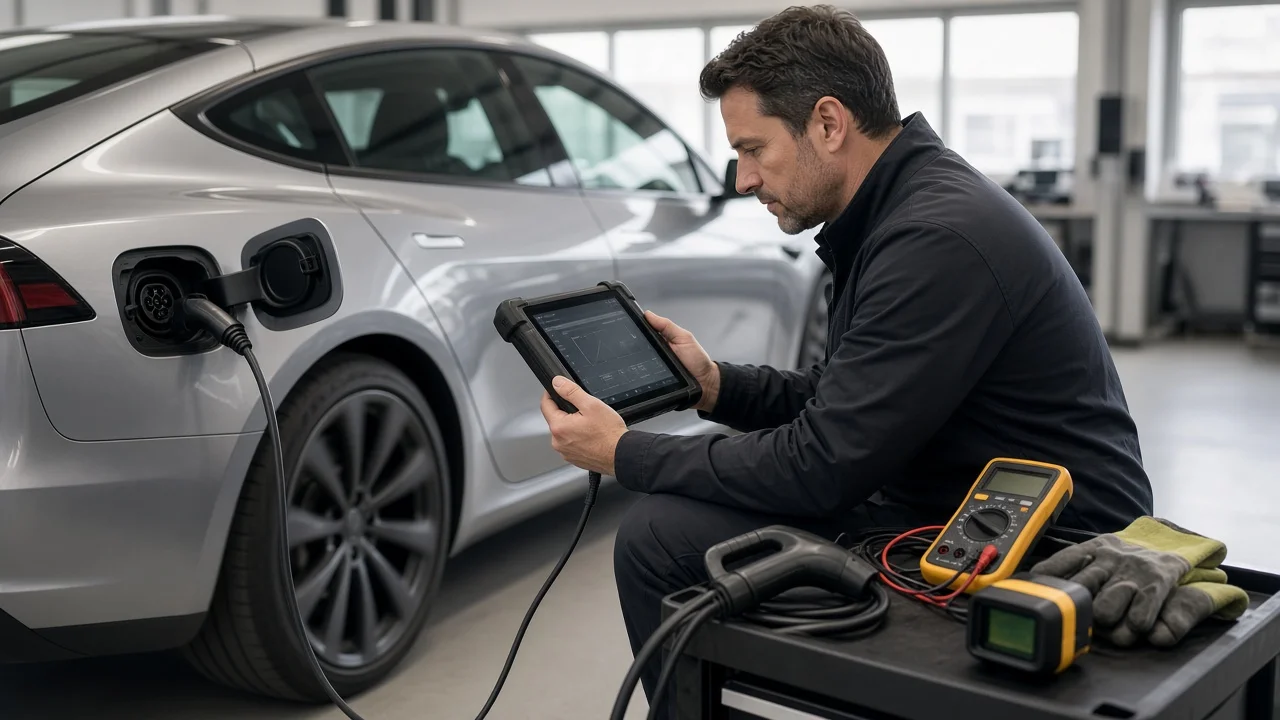
A pre-purchase inspection of an electric vehicle is an independent check of a used EV's condition before you commit to buying it. It covers the same basics as any used-car inspection, including body, suspension, steering, tires, brakes and interior. The main difference is where the risk sits. Instead of focusing on an engine and transmission, an EV inspection concentrates on the high-voltage battery, the charging system, thermal management, the electric drive unit and the vehicle's software.
One qualification changes how much an inspection can tell you. What an inspector can measure depends on the make, model year and generation of the vehicle and on the inspector's diagnostic tools. Some battery health data can be read with widely available scan tools. Other data requires manufacturer-level software or a dealer report. Before you book, find out what the inspector can actually access for the specific vehicle you are considering.
How an EV inspection differs from a conventional pre-purchase check
Area | Gasoline vehicle focus | Electric vehicle focus; Powertrain | Engine condition, oil leaks, timing components, transmission behavior | High-voltage battery condition, drive motor or motors, inverter, reduction gear; Energy and fueling | Fuel system, exhaust, emissions components | Charge port, onboard charger, AC charging and DC fast-charging behavior; Cooling | Engine radiator and coolant system | Battery and power-electronics thermal management, which varies by model and may use liquid cooling, a heat pump or air cooling; Low-voltage system | Starter battery, alternator | Low-voltage auxiliary battery, typically 12 volts on most current EVs, and the DC-DC converter that charges it; Braking | Pad and rotor wear | Regenerative braking function; friction brakes may be used less, so check for corrosion and sticking components; Electronics and software | Engine and transmission fault codes | Fault codes across many control modules, software version, connected-service and feature status
What a thorough EV inspection should cover
Battery state of health
State of health (SOH) is an estimate of how much usable capacity the battery has left compared with when it was new. It is usually the most important single finding in an EV inspection, because the battery is typically the most expensive component in the vehicle. An inspector may get an SOH figure from the battery management system through a diagnostic scan, from a manufacturer or dealer report, or from a test procedure. Methods differ in reliability, and results from different tools are not always directly comparable.
The range estimate shown on the dashboard is not a battery health measurement. It changes with recent driving, outside temperature, climate-control use and drive settings. It can hint at a problem, but it should not replace a proper SOH reading.
Charging system
The inspector should confirm that the vehicle accepts a charge on Level 2 AC equipment and, if the vehicle supports it, on a DC fast charger. They should also inspect the charge port for damage, debris and a working locking latch, and note whether the portable charging cable or adapters that came with the vehicle are included. A fast-charging test is not always possible during a mobile or shop inspection, so ask whether it will be part of the report.
Underbody and battery enclosure
On many EVs the battery pack sits under the floor. The pack enclosure should be checked for impact damage, deep scrapes, dents and corrosion. Damage here can affect the battery's sealing and long-term reliability even when no warning lights are on.
Drive unit, thermal system and low-voltage battery
Road test for unusual whine, clunks or vibration from the drive unit under acceleration and regenerative braking. Check for coolant leaks and thermal-system warnings on vehicles with liquid-cooled batteries. Test the low-voltage auxiliary battery. A weak one can cause warning messages or prevent the vehicle from powering up, even when the high-voltage battery is healthy.
Tires, brakes and suspension
EVs are often heavier than comparable gasoline vehicles and deliver torque immediately, which can affect tire wear. The inspector should check tread depth, uneven wear and whether the fitted tires meet the vehicle's specified load rating. Because regenerative braking reduces how often the friction brakes are used, rotors and calipers can corrode or stick. Visual and functional brake checks remain important.
Software, fault codes and recalls
A full diagnostic scan should read stored fault codes across the vehicle's control modules, not just the powertrain. Separately, check the vehicle identification number (VIN) for open safety recalls using the National Highway Traffic Safety Administration's recall lookup or a manufacturer dealer. Also confirm whether connected services, app access and any paid software features will remain with the vehicle after the sale. On some models these are tied to an owner account rather than the car.
Accident and flood history
A vehicle history report and a physical inspection together give the best picture of past damage. Signs of flood exposure deserve particular attention in an EV because water intrusion can damage high-voltage components and connectors in ways that may not show up immediately.
Questions to ask before booking an inspection
Can you read battery state-of-health data for this make, model and model year, and with what tool? Will the written report include battery data, or only a visual and road-test assessment? Do your technicians have training and equipment for working around high-voltage systems? Can you test both AC charging and DC fast charging? Will you scan all control modules for fault codes? Will the seller allow the vehicle to be inspected at a third-party shop, or does it need to be a mobile inspection?
Paperwork that complements the physical check
Many manufacturers cover the high-voltage battery under a separate warranty with its own time, mileage and capacity terms. These terms vary by brand, model year and market, and coverage for later owners can differ from coverage for the original buyer. Confirm with the manufacturer how much battery and powertrain warranty remains for the specific VIN and whether it transfers to you. Service records, documented software updates and any prior battery or drive-unit repairs are also worth requesting from the seller.
How to use the results
An inspection report is a decision tool, not a pass-or-fail verdict. It can support negotiating on price, asking the seller to fix specific issues, or walking away. A battery with reduced state of health is not automatically a reason to reject a vehicle. It may be acceptable if the remaining range fits your daily driving and the price reflects the condition. Unexplained fault codes, signs of battery enclosure damage or evidence of flooding are stronger reasons for caution.
Gaps in this guide
No verified information was available on inspection service prices, specific inspection providers, or model-specific battery degradation figures and acceptable SOH thresholds. Request written quotes and a sample report from inspectors you are considering, and look for model-specific guidance on what battery health readings are typical for the vehicle's age and mileage.