Diagnosing a Check Engine Light on a Subaru WRX
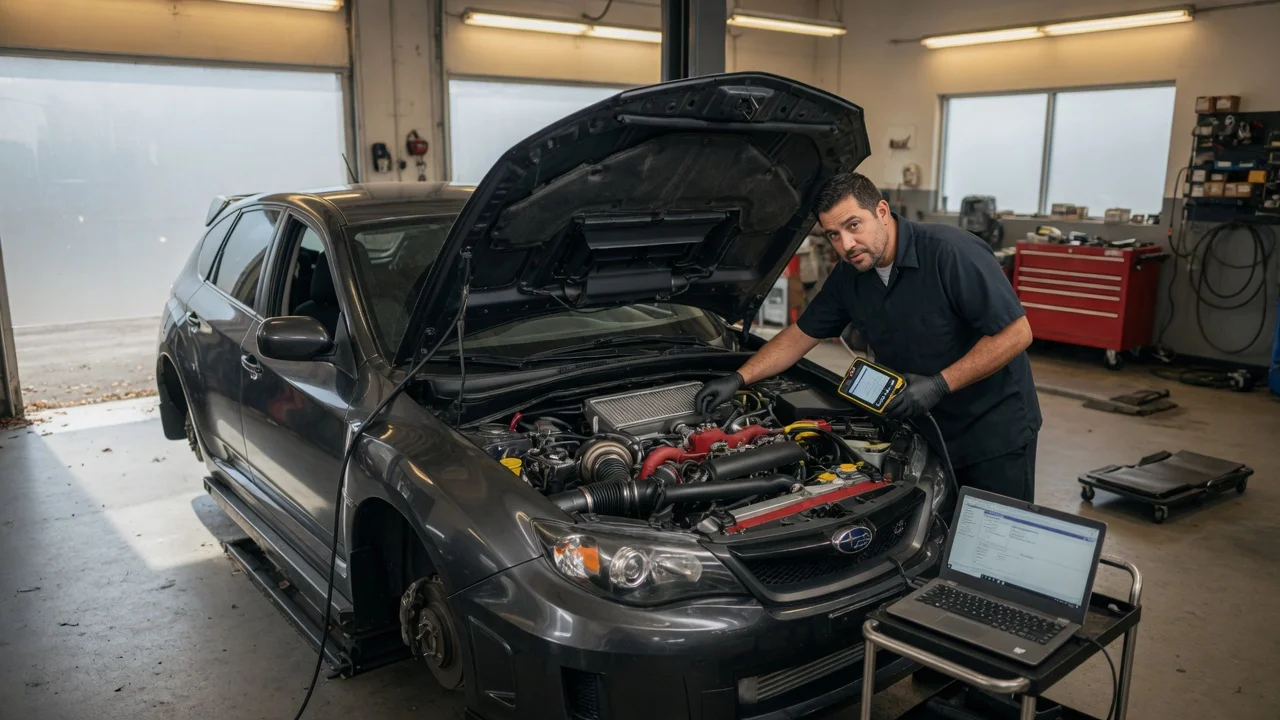
The Short Answer
A check engine light on a Subaru WRX means the engine control unit has detected a fault in a monitored engine, emissions or related system and stored a diagnostic trouble code. The light alone does not tell you what is wrong. The first step is to read the stored code with an OBD-II scanner. Then treat that code as a starting point for investigation, not as proof that a particular part has failed.
The most important distinction is whether the light is steady or flashing. A steady light usually means you can drive carefully to a place where the car can be diagnosed. A flashing light generally indicates an active misfire that is severe enough to damage the catalytic converter. If the light flashes, reduce load right away and avoid continued driving.
Scope and Important Qualifications
The WRX has been sold across several generations with different turbocharged engines, transmissions and control systems. Market availability has also varied. Some fault behaviour, component locations and model-specific codes therefore depend on the model year, the generation and the engine.
This guide covers general diagnostic logic that applies to OBD-II equipped vehicles. It does not include model-year-specific specifications, known-issue lists or factory test values, because no such data was supplied. For those details, use the factory service information for your exact vehicle or a Subaru technician.
Modified cars need extra caution. Aftermarket engine tunes, intakes, exhausts and boost changes are common on WRX models. Any of these can set codes or change how the ECU responds to a fault. If the car is modified, tell whoever diagnoses it.
Step One: Note How the Light Behaves
Flashing light: Treat this as an active, serious misfire. Reduce speed and load, and stop when it is safe. Do not keep driving under boost. Steady light, car drives normally: The fault is usually not immediately dangerous. Read the code soon and avoid hard driving until you understand it. Steady light with obvious symptoms: Examples include rough running, loss of power, hesitation, unusual noises, smoke or a burning smell. Treat these as signs of a fault that could worsen. Limit driving and arrange a diagnosis. Other warning lights at the same time: Oil pressure, coolant temperature and charging warnings each indicate a separate problem that can call for stopping immediately, whatever the check engine light is doing.
On many Subaru models, an engine fault can also turn on stability-control or traction indicators and can disable cruise control. Extra lights appearing at the same moment as the check engine light do not necessarily mean several separate failures. Confirm how your specific model behaves in the owner's manual.
Step Two: Read the Stored Code
Plug an OBD-II scan tool into the diagnostic connector under the dashboard on the driver's side. Many auto parts retailers will read codes for you, and inexpensive handheld or Bluetooth readers are also widely available.
Write down every code, including any pending codes. If your tool shows freeze-frame data, record that too. Freeze-frame data is a snapshot of conditions when the fault was logged, such as engine speed, load and temperature, and it can help narrow down the cause.
Do not clear the codes before you have recorded them. Clearing erases this evidence. It also resets the emissions readiness monitors, which some inspection programs check.
Generic codes start with P0 and have standardised meanings across manufacturers. Codes starting with P1 or other manufacturer-specific ranges need Subaru-specific definitions. A basic reader may not describe these accurately.
Step Three: Interpret the Code as Evidence
A trouble code identifies the condition the ECU detected, not necessarily the part that failed. For example, an oxygen sensor code can come from a faulty sensor. It can also come from a wiring fault, an exhaust leak or a real fuel-mixture problem that the sensor is accurately reporting. Replacing the named part without checking the surrounding system is a common way to spend money without fixing the fault.
The table below lists broad generic code families, plausible explanations and sensible next checks. It is a general framework for investigation. It is not a WRX-specific failure list.
Code family | What it indicates | Plausible causes to investigate | Sensible next checks; P0455, P0456, P0457 (evaporative system leak) | The ECU detected a leak in the fuel vapour system | Loose, damaged or missing fuel cap; cracked hose; faulty purge or vent valve | Check that the fuel cap seals and clicks shut, inspect the cap seal, then have the system smoke-tested if the code returns; P0300 to P0304 (misfire, random or by cylinder) | Combustion is not happening properly in one or more cylinders | Worn spark plugs, failing ignition coil, injector fault, vacuum or boost leak, low compression | Note whether one cylinder or many are affected; inspect plugs and coils; seek diagnosis promptly, especially if the light flashed; P0171, P0174 (system lean) | The engine is getting too much air or too little fuel for the fuel mixture | Intake or vacuum leak, boost leak, dirty or faulty airflow sensor, weak fuel delivery | Inspect intake piping and couplers for splits or loose clamps; review fuel trim data with a capable scanner; P0420 (catalyst efficiency below threshold) | Downstream oxygen sensor readings suggest reduced catalytic converter performance | Aging or damaged converter, exhaust leak, sensor fault, aftermarket exhaust components | Rule out exhaust leaks and sensor faults before condemning the converter; consider whether earlier misfires damaged it; P0130 to P0167 range (oxygen or air-fuel sensor circuit) | A sensor signal or heater circuit is out of expected range | Sensor failure, damaged wiring or connector, exhaust leak near the sensor | Inspect wiring and connectors near the exhaust; check for leaks; confirm with live sensor data; P0234, P0299 (overboost or underboost) | Turbocharger boost is outside the expected range | Boost leak, wastegate or boost control fault, sensor fault, tune-related issue | Inspect intercooler and charge piping; check for recent modifications; get professional diagnosis if power loss is significant
Simple Checks You Can Do First
Fuel cap: If the light came on soon after refuelling and the code points to an evaporative leak, reseat the cap or inspect its seal. The light may take several drive cycles to turn off after the fix. Visible intake and boost plumbing: With the engine off and cool, look for disconnected, split or loose hoses and couplers between the air filter, turbocharger, intercooler and throttle body. Wiring and connectors: Look for damaged, chafed or unplugged connectors near the sensor or component the code names. Recent work or modifications: Consider anything that was recently changed, disturbed or installed, including tunes, intake parts and exhaust parts. Fluid levels: Check engine oil and coolant levels. Low levels do not usually set a check engine code directly, but they matter for safe operation while you diagnose the fault.
When to Stop Driving or Get Professional Diagnosis
The check engine light is flashing. The engine runs roughly, loses significant power or stalls. You notice smoke, a fuel smell, a burning smell or unusual knocking or metallic noises. Oil pressure, coolant temperature or charging warnings appear. The code is manufacturer-specific, or there are several related codes you cannot interpret with confidence. The light returns after a simple fix, or the code involves internal engine, turbocharger or transmission systems. The car is still under warranty. Unauthorised repairs or modifications may affect coverage, so check your warranty terms before making changes.
A professional technician with Subaru-capable diagnostic equipment can read manufacturer-specific codes and view live data. They can also run tests that a basic code reader cannot, such as smoke tests for leaks, compression or leak-down tests, and evaluation of the boost control system.
What This Guide Cannot Tell You
Several points need information specific to your car that was not supplied for this guide: • which faults are most common on a particular WRX generation; • factory test specifications; • recall or technical service bulletin coverage; • exact connector and component locations; For those, consult the factory service information for your model year and engine, check recall status with a Subaru dealer using your vehicle identification number, or work with a qualified technician.