Diagnose Check Engine Light on Kia Sedona
The short answer
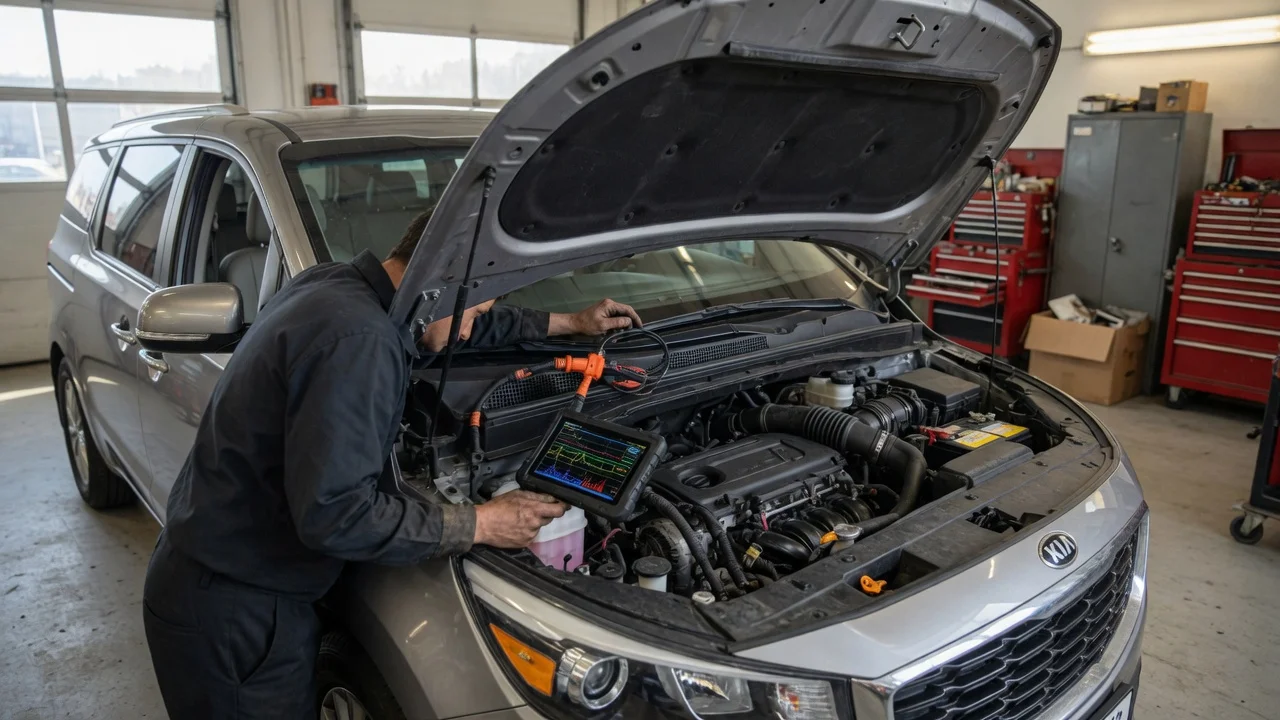
A check engine light on a Kia Sedona means the engine control module has detected a fault in an emissions-related or engine-management system and stored a diagnostic trouble code (DTC). The light does not name a part. To find out what triggered it, read the stored code with an OBD-II scan tool, then confirm the cause with physical checks before replacing anything.
One qualification changes the answer: a steady light usually allows careful driving to a place where the code can be read, while a flashing light generally indicates an active misfire that can damage the catalytic converter. If the light flashes, reduce load and stop driving as soon as it is safe.
Scope of this guide
The Sedona was sold across several generations before Kia replaced it with the Carnival nameplate in markets such as North America. Most Sedonas sold in North America use gasoline V6 engines, and some other markets offered diesel versions. Engines, emissions hardware and diagnostic details differ by model year, generation, powertrain and market, so the steps below are general OBD-II diagnostic practice rather than a model-specific repair procedure. For any specific code, check the factory service information, technical service bulletins and open recalls that apply to your vehicle identification number (VIN).
Evidence gap: no model-year-specific fault patterns, bulletins or recall data were supplied for this article. It does not identify which faults are most common on a particular Sedona generation.
Step 1: Note how the light behaves
Steady light, vehicle drives normally: a fault has been stored, but it is usually not an immediate emergency. Read the code soon. Steady light with rough running, hesitation, stalling or reduced power: drive gently and only as far as necessary, then diagnose promptly. Flashing light: usually an active misfire severe enough to risk catalytic converter damage. Avoid hard acceleration and heavy loads, and stop when safe. Check engine light together with a red warning such as low oil pressure or engine overheating: stop the engine as soon as it is safe. Those warnings point to conditions that can damage the engine quickly.
Step 2: Check the fuel cap
The evaporative emissions (EVAP) system traps fuel vapor and tests itself for leaks. A cap that is loose, cross-threaded or has a damaged seal can register as a leak. Check that the cap is fully tightened and inspect the seal for cracks.
After a cap fix, the light does not go off immediately. The system must rerun its leak test, which can take several drive cycles. If the light returns or a leak code persists, the leak may be elsewhere in the EVAP system, such as a hose, purge valve or vent valve. A smoke test is the usual professional method for finding these leaks.
Step 3: Read the stored code
Kia Sedonas sold in markets with OBD-II requirements have a standardized diagnostic port. It is typically located under the dashboard on the driver's side, though the exact position can vary by generation. An inexpensive code reader will show the generic powertrain codes, which begin with P. Many auto parts retailers also read codes. A professional scan tool can access manufacturer-specific codes, freeze-frame data (engine conditions recorded when the fault was set) and live sensor data.
Write down every code, including any listed as pending, before clearing anything. Clearing codes also erases freeze-frame data and resets the readiness monitors, which can make diagnosis harder and can cause the vehicle to fail an emissions inspection until the monitors complete again.
Step 4: Treat the code as a lead, not a verdict
A trouble code tells you which system or circuit failed a test. It does not prove which part has failed. For example, an oxygen sensor code can result from a wiring fault, an exhaust leak or an engine running condition rather than a bad sensor. The generic code families below show what each group usually points to and what to check next. Exact code definitions and test procedures for a given Sedona should be confirmed in its service information.
Misfire codes (P0300 to P0306)
P0300 indicates a random or multiple-cylinder misfire. P0301 to P0306 identify a specific cylinder on a six-cylinder engine. With a single-cylinder code, inspect that cylinder's spark plug, ignition coil and fuel injector connector. A common technique is to swap the coil with another cylinder and see whether the misfire code moves with it. If it moves, the coil is implicated. If it stays, look at the plug, injector or mechanical condition.
A random misfire across several cylinders more often points to something shared, such as fuel delivery, a vacuum leak or a sensor input. A misfire that persists after ignition parts check out may need a compression or leak-down test, which is professional territory. Any misfire severe enough to flash the light calls for stopping use as described above.
Fuel trim lean or rich codes (P0171 to P0175)
These codes mean the engine control module had to correct the fuel mixture beyond its normal range on one or both cylinder banks. Lean codes (P0171 for bank 1, P0174 for bank 2) often trace to unmetered air from a vacuum or intake leak. Other possible causes include a contaminated or faulty mass airflow sensor and low fuel pressure. Listen for hissing near the intake with the engine running, and inspect vacuum hoses and the intake ducting after the air filter. If both banks show the same condition, look for a shared cause. If only one bank is affected, look for a problem specific to that side.
Oxygen sensor codes
Oxygen sensor codes cover heater circuits, slow response and signal range problems. Heater circuit codes often point to wiring, connectors or a fuse as well as the sensor itself. Inspect the sensor's wiring for heat damage or chafing, and check for exhaust leaks ahead of the sensor, which can distort its readings. Live data from a scan tool helps show whether the sensor is switching normally.
Catalyst efficiency codes (P0420, P0430)
These codes mean the downstream oxygen sensor shows the catalytic converter is not storing oxygen as expected. A worn converter is one possibility. Before replacing an expensive converter, rule out exhaust leaks, a faulty downstream sensor and any misfire or fuel trim fault. Those conditions can trigger the code, and an untreated misfire can damage a new converter.
EVAP system codes
Codes in the P0440 to P0457 range relate to the evaporative emissions system. Depending on the definition, they include small leaks, large leaks and valve circuit faults. Start with the fuel cap, then inspect visible hoses and connectors. EVAP faults usually do not affect how the vehicle drives, but they can cause an emissions inspection failure.
Other codes
Other codes cover areas such as camshaft and crankshaft position sensors, variable valve timing, throttle control, coolant temperature and the transmission. These systems vary more by engine and model year. Diagnosis often needs live data or manufacturer-specific procedures, so the service information for your exact Sedona is the right reference.
Step 5: Verify the repair
After a repair, clear the codes and drive the vehicle under varied conditions. Then confirm that the code does not return and that the readiness monitors complete. If the same code comes back, the original cause was not resolved, and the diagnosis should continue rather than more parts being replaced.
When to stop driving or get professional diagnosis
Stop driving when safe: the light is flashing, the engine runs severely rough or stalls, there is a smell of fuel or burning, smoke appears, or a red oil pressure or overheating warning appears. Get professional diagnosis: a misfire persists after the ignition parts check out, multiple unrelated codes appear together, the code involves the transmission or a manufacturer-specific system, or the same code returns after a repair. Check recall and warranty status: ask a Kia dealer to look up your VIN for open recalls or service campaigns, especially if the code involves the engine. Emissions components may also have extended warranty coverage depending on market and model year.
Bottom line
On a Kia Sedona, the check engine light is a prompt to read the stored code, not a diagnosis in itself. Note whether the light is steady or flashing, check the fuel cap, record the codes and freeze-frame data, and test the system the code points to before buying parts. Use service information for your specific model year and engine, and stop driving if the light flashes or a serious warning accompanies it.