Diagnose a Brake Booster Fault
The short answer
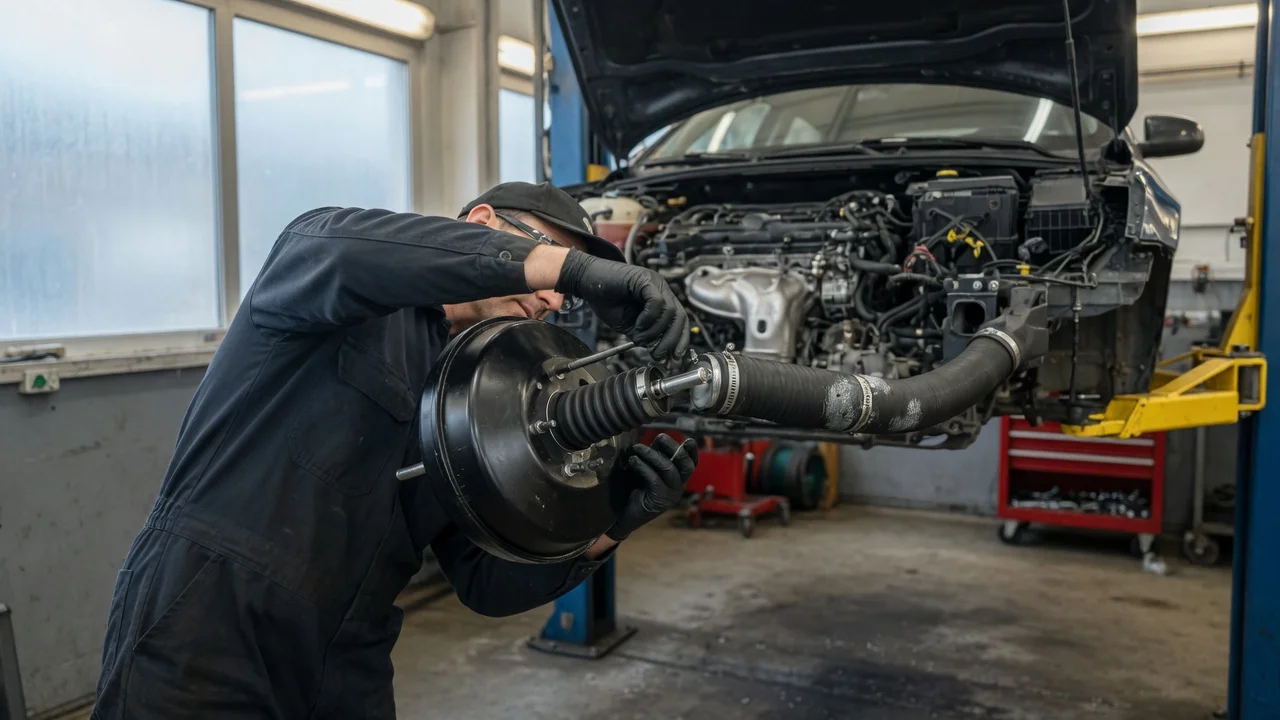
A brake booster multiplies the force from your foot so the brakes need less effort. When it fails, the brakes still work, but the pedal feels hard and stopping takes noticeably more force. To diagnose a suspected booster fault, first confirm that the problem really is a loss of assist rather than a hydraulic or friction problem. Then check the source that powers the booster before condemning the booster itself.
A hard pedal that needs much more effort than normal is the classic sign of lost assist. A pedal that sinks slowly toward the floor, or feels soft and spongy, usually points to the hydraulic side of the system instead. That side includes the master cylinder, the brake lines, the fluid and any air in the system.
A hard pedal makes the car take more distance and effort to stop. Have the system repaired promptly. If the pedal sinks, the brake warning light is on, or the fluid level is low, treat the car as unsafe to drive until it has been inspected.
Which type of booster does your vehicle have?
The right checks depend on how the booster is powered. This varies by model, model year, engine and market, so confirm the type in the service information for your exact vehicle.
Booster type | What powers it | Where it is commonly found; Vacuum booster | Engine intake vacuum, or a separate vacuum pump on some engines | Many petrol cars and light trucks; diesel and some turbocharged or direct-injection petrol engines use a mechanical or electric vacuum pump; Hydraulic booster (often called hydro-boost) | Pressure from the power steering pump | Some trucks, vans and diesel applications; Electromechanical or integrated electric booster | An electric motor controlled by a module | Many hybrid and electric vehicles and some newer conventional vehicles
The rest of this guide focuses mainly on vacuum boosters, which are the most common type. Hydraulic and electric systems are covered briefly where their diagnosis differs.
Separate the symptom from the possible causes
Write down exactly what you notice before you test anything. Each observation narrows the list of likely causes in a different way.
What you notice | Possible causes to consider; Hard pedal that needs much more effort | Booster not assisting; weak vacuum supply; leaking vacuum hose; faulty check valve; failed vacuum pump on engines that use one; Hissing noise when the pedal is pressed or held | Torn booster diaphragm; leaking internal air valve; leak at the booster's hose connection or grommet; Engine idle dips or stumbles when braking | Vacuum leak through the booster or its hose; Brakes are hard only on the first press after the car has been parked | Check valve not holding vacuum; slow leak in the booster or hose; Pedal sinks slowly under steady pressure | Usually hydraulic: internal master cylinder leak or external fluid leak, not the booster; Soft or spongy pedal | Air in the brake fluid or a hydraulic problem, not usually the booster; Brakes drag, or the pedal returns slowly | Sticking booster valve or incorrect pushrod adjustment; sticking calipers should also be ruled out
Checks in a sensible order
These checks run from simple and non-invasive to more involved. Do them with the vehicle parked on level ground, the parking brake on, and the transmission in park or neutral. The exact procedure and acceptance criteria for your vehicle are in its service information.
1) Basic assist test
With the engine off, press the brake pedal several times to use up any stored vacuum. Hold the pedal down with light, steady pressure. Start the engine while still holding the pedal. If the booster is working, the pedal should move down slightly as assist comes in. If it does not move at all, assist is not reaching the pedal. The cause could be the booster, the vacuum supply or the check valve.
2) Vacuum hold test
Run the engine for a short time, then switch it off. Wait a short while, then press the pedal several times. A healthy system usually gives at least one or two assisted applications before the pedal goes hard. If the pedal is hard on the first press, the booster, check valve or hose is not holding vacuum.
3) Engine-running leak test
With the engine running, press the pedal and hold it steady. Switch off the engine while keeping the same pressure on the pedal. If the pedal pushes back up against your foot, vacuum is leaking from the booster. While holding the pedal, listen near the pedal and at the booster for hissing, and note any change in idle when the brakes are applied.
4) Inspect the vacuum hose and check valve
The hose runs from the intake manifold or vacuum pump to the booster. Look for cracks, softness, collapse, oil contamination and loose connections. Most systems have a one-way check valve in the hose or at the booster grommet. It should allow air to flow only away from the booster. A valve that flows both ways, or not at all, can cause hard-pedal symptoms that look like booster failure. The hose and valve are much cheaper to replace than the booster, so rule them out first.
5) Confirm the vacuum supply
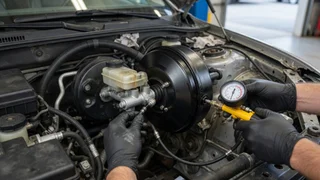
A booster cannot assist without enough vacuum. On engines that rely on intake vacuum, a vacuum gauge connected to the booster supply shows whether enough vacuum is reaching it. Engine faults, such as large intake leaks or valve and timing problems, can lower that vacuum. On engines with a vacuum pump, the pump itself may be weak or failed. The required vacuum level depends on the vehicle, so use the figure in its service information.
6) Rule out the hydraulic side
Check the brake fluid level and look for leaks at the master cylinder, lines, hoses and calipers. Assess pedal feel with the engine running. A firm, high pedal that needs heavy effort fits a booster or vacuum fault. A pedal that sinks or feels spongy points to hydraulic causes. Worn or contaminated brake pads and glazed rotors can also make braking feel weak, but they usually do not change how assist feels at the pedal.
What each result supports or leaves unresolved
Result | What it supports | What remains unresolved; No pedal drop in the basic assist test, but good vacuum at the booster | The booster is not converting vacuum into assist, which strongly suggests an internal booster fault | Pushrod adjustment and internal valve condition may still need checking; No pedal drop, and low or no vacuum at the booster | A supply problem: hose, check valve, intake leak, engine condition or vacuum pump | The booster itself may still be fine; Assist works with the engine running but is lost quickly after shutdown | Check valve or a slow leak in the booster or hose | Which part is leaking; isolate the check valve and hose first; Hissing and pedal rise in the leak test | Leaking diaphragm or internal valve in the booster | A leaking grommet or hose connection can mimic this, so inspect them before replacing the booster; All booster tests pass, but the pedal sinks or feels soft | The fault is hydraulic, not the booster | The cause within the hydraulic system needs separate diagnosis
Fault codes and warning lights
Many vacuum boosters have no sensor and set no fault code. Some vehicles monitor booster vacuum with a pressure sensor, and many electric boosters are monitored by a control module. On these vehicles, a diagnostic trouble code (DTC) may be stored. A DTC is a code the vehicle's computer records when a monitored value falls outside expected limits. A warning light may also come on. This can be the general brake warning light, or on some vehicles the ABS (anti-lock braking system) light or a message about reduced brake assist.
A code describes what the computer detected. It does not identify which part has failed. For example, a booster pressure sensor code can result from a faulty sensor, damaged wiring or connectors, a leaking hose or check valve, low engine vacuum, or a genuine booster leak. Before replacing parts, confirm the following:
The exact code definition for your make, model, model year and engine, since manufacturer-specific codes vary. The operating conditions under which the code sets, such as engine running, idle or a particular temperature. Whether a live reading of the sensor agrees with a mechanical vacuum gauge reading at the same point. The condition of the wiring, connectors, hose and check valve. Whether the mechanical tests above confirm a loss of assist.
This guide does not include specific code definitions, vacuum values or test limits. Those depend on the vehicle and must come from its service information or a qualified technician's diagnostic equipment.
Notes for hydraulic and electric boosters
A hydraulic booster shares its fluid supply with the power steering. Heavy steering together with a hard brake pedal points toward the pump, the drive belt or low fluid rather than the booster. Many hydraulic boosters also have a stored-pressure reserve, called an accumulator, for a few assisted stops if the pump stops working. Testing that reserve, and measuring system pressure, requires the manufacturer's procedure.
Electric and integrated brake systems are controlled by a module and often store detailed codes. Their diagnosis usually needs a scan tool that can read manufacturer-specific data. Some systems have service modes that must be activated before any brake work. Follow the manufacturer's procedures on these vehicles rather than relying on the vacuum tests above.
When to stop and get professional help
Brakes are safety-critical. If the checks do not clearly point to a cause, or the repair involves the master cylinder, the brake lines or an electronically controlled brake system, have the vehicle diagnosed by a qualified technician. Get help immediately if the pedal sinks, the fluid level drops or a red brake warning appears.