Compress a Brake Cylinder That Will Not Retract
The short answer
When a brake cylinder will not compress, the cause is usually one of four things. The piston may be designed to screw in rather than push in. An electronic parking brake may be holding it. Fluid may have no easy path back. Or the piston may be seized from corrosion or a damaged seal. Identify which case applies before adding force. Pushing harder on a piston that is meant to be rotated, or one held by an electric motor, can damage the caliper.
In this guide, "brake cylinder" means the hydraulic piston inside a disc brake caliper, which is what most people are trying to retract when fitting new pads. Drum brake wheel cylinders and the master cylinder are different parts and are not covered here.
Scope and important qualification
The correct method depends on the specific vehicle. Model year, axle (front or rear), and parking brake type (cable or electronic) all change the procedure. No model-specific procedures, specifications or torque values were supplied for this article. Confirm the exact method for your vehicle in its service information before you start.
Check which type of piston you have
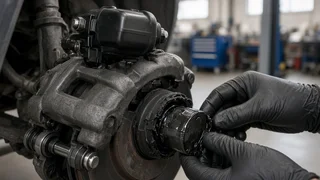
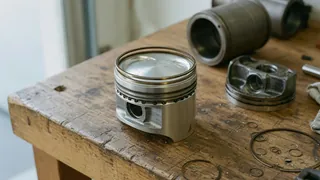
Front calipers: on most vehicles the piston pushes straight back into its bore. Rear calipers with a mechanical parking brake built into the caliper: the piston often has notches or slots on its face. It must be turned, usually clockwise, while pressure is applied, so that it threads back in. A straight push will not move it. Rear calipers with an electronic parking brake: an electric motor on the caliper holds the piston's position. The system usually has to be put into a service or maintenance mode with a scan tool or a vehicle-specific procedure first. Otherwise the piston will not retract, and forcing it risks damaging the actuator.
Common reasons a piston will not move
Wrong technique: a screw-in rear piston is being pushed instead of rotated. Electronic parking brake still engaged or not in service mode. Parking brake applied: on cable-operated integrated calipers, the parking brake lever should be released. Restricted fluid return: a collapsed flexible brake hose can act like a one-way valve and stop fluid flowing back. Seized piston: corrosion on the piston or in the bore, or a swollen or damaged seal, can lock it in place. Worn-pad overextension: if the pads are very worn, the piston may have extended far enough to expose corroded surface that binds as it returns.
A practical sequence
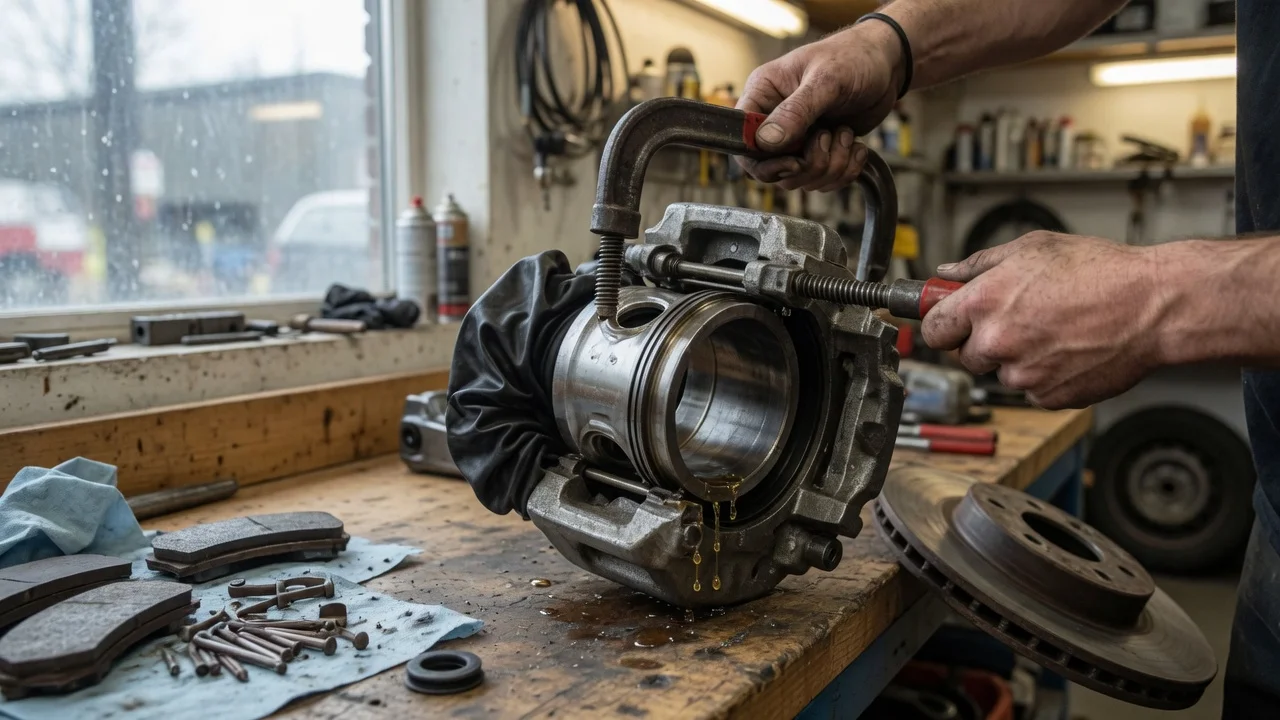
Make sure the vehicle is safely supported and the parking brake is released, or in service mode for electronic systems. Check the brake fluid reservoir. Fluid returns there as the piston retracts, so a full reservoir can overflow. Remove excess fluid if needed, and keep fluid off painted surfaces. Use the right tool. For push-type pistons, use a caliper piston compressor or a C-clamp with the old pad across the piston face, applying even pressure. For screw-in pistons, use a caliper wind-back tool that engages the notches. If the piston still resists, consider opening the bleeder screw while retracting and closing it before releasing pressure. This gives the fluid a short path out. You will then need to bleed that brake afterward. If the piston moves only with the bleeder open, suspect a restricted brake hose. If it will not move even with the bleeder open and the correct technique, the piston or caliper is likely seized and should be rebuilt or replaced.
What to avoid
Do not press the brake pedal while a caliper is off the rotor. This can push the piston out too far. Do not pry against the piston face or seal with sharp tools. A gouged piston or torn dust boot causes leaks and future seizure. Do not force a rear piston that has slots on its face, or one fitted with an electronic parking brake actuator, by pressing straight in. Do not reuse a caliper that only retracted after extreme force. Binding often returns as dragging brakes or uneven pad wear.
When to stop and get help
Brakes are safety-critical. Get professional help if any of these apply: you cannot confirm the correct procedure for your vehicle, the piston needs a scan tool you do not have, or the caliper appears seized or is leaking. After any work that opens the hydraulic system, pump the pedal until it is firm before driving. Then bleed the system as required, and check the pedal feel and fluid level.
Information gaps
This guide is general. It does not include vehicle-specific service mode steps, wind-back direction for particular calipers, torque figures, or fluid specifications, because none were supplied. Those details vary by model and should come from the manufacturer's service information.