Choosing a Water Storage Barrel for a Motorhome
A water barrel can extend how long you stay off-grid in a motorhome, but only if it suits drinking water, fits within your vehicle's payload, and can be secured and refilled without contaminating your supply. For most owners, the best choice is a food-grade, opaque barrel or water drum sized to what the vehicle can safely carry. It should have fittings that match your hose and pump setup. One condition changes this a lot: whether the barrel travels full while the vehicle moves, or stays at camp as a refill reservoir. A barrel that rides full needs proper mounting and a payload check. A barrel that only sits at a campsite can be larger and simpler.
The Short Answer
Choose a barrel made from food-grade plastic that is rated for potable (drinkable) water. Size it by what your motorhome can carry, not by how much water you would like to have. Make sure its openings accept the hose connection, pump or tap you plan to use. If you are buying used, avoid any barrel whose previous contents you cannot confirm. If the barrel will travel full inside or on the vehicle, mount it securely to structural points and confirm the added weight stays within your rated limits.
How You Will Use the Barrel
Decide on the job before comparing products. Motorhome owners usually use a water drum in one of three ways, and each one leads to different requirements.
Auxiliary storage while driving: the barrel rides full, so weight, mounting strength, sloshing and spill resistance matter most. Camp reservoir: the barrel is filled at a water source or carried empty, then used at a fixed campsite to top up the onboard fresh tank. Capacity can be larger because it does not travel full. Non-potable utility water: water for rinsing, cleaning or flushing. Material standards matter less, but the barrel should be clearly labeled so it never gets used for drinking water.
What to Check Before You Buy
Food-Grade Material and Potable Rating
For drinking or cooking water, look for a barrel described by its seller as food-grade or suitable for potable water. In the US, many water storage containers are made from high-density polyethylene (HDPE), a common food-safe plastic. Some products also reference NSF/ANSI certification for drinking-water contact. Treat that as a useful signal when it is stated for that specific product, but do not assume it applies just because similar barrels carry it. Industrial drums, chemical drums and containers with no stated food-contact suitability are not appropriate for drinking water.
New Versus Used Barrels
Used food-grade drums are widely sold and can cost less than new ones. The risk is the previous contents. A drum that once held syrup or juice can usually be cleaned. A drum that held solvents, oils, pesticides or unknown liquids can leave residues and odors that cleaning does not reliably remove, because plastic can absorb some substances. Only buy used when the seller can identify the original contents, and still clean and sanitize the barrel thoroughly before first use.
Tank Capacity Versus Payload
Water is heavy. A US gallon weighs roughly 8.3 pounds, so even a modest barrel adds significant weight when full, before you count the barrel itself and its mounting hardware. Check your motorhome's Gross Vehicle Weight Rating (GVWR, the maximum the loaded vehicle may weigh) and its cargo carrying capacity, which is usually shown on a label in the vehicle. Remember that your onboard fresh tank, passengers, fuel, propane and gear already use part of that allowance. Axle ratings matter too. Placing a full barrel at the rear overhang or on a rear carrier can overload the rear axle even when total weight looks acceptable. A carrier or hitch-mounted rack has its own load limit, which may be far lower than the barrel's full weight.
If the numbers are tight, a smaller barrel that travels full, or a larger one carried empty and filled at camp, is usually the better compromise. Weighing the loaded motorhome at a public scale gives you real figures to work from instead of estimates.
Shape, Footprint and Mounting
Tall, round drums are space-efficient at a campsite but awkward to secure in a moving vehicle. Low, rectangular or flat-sided containers sit more stably, take straps more evenly, and keep weight lower. If the barrel will travel full, plan how it attaches before buying. It should be strapped or bracketed to structural anchor points, not to cabinetry or trim, so it cannot slide or tip under braking. Partially filled containers slosh, which shifts weight in corners. Containers with internal baffles, or several smaller containers, reduce that effect.
Openings, Fittings and Hose Connection
Look at how water gets in and out. Many plastic drums have threaded bung openings in the lid. Open-head drums have a removable lid held by a clamp ring. Bung openings seal well for transport but need adapters to accept a hose, pump intake or spigot. Thread types on drum bungs are not always the same as garden hose or plumbing threads, so confirm the exact thread before buying adapters. Open-head drums are easier to clean and fill, but the lid seal and clamp need to be in good condition if the barrel travels full.
Fill opening: wide enough for a hose or funnel, ideally with a cap that seals. Outlet: a bottom spigot allows gravity draining. A top opening needs a pump or siphon. Vent: the barrel needs air to enter as water leaves, or flow will slow and the container can deform. Some caps include a vent; otherwise one opening should be loosened or fitted with a vented cap. Adapters: confirm thread type and size so the drum connects to a drinking-water-safe hose and your pump or onboard fill inlet.
Transfer Method and Flow Rate
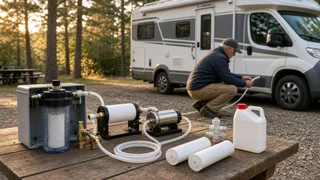
Decide how water will move from the barrel into your motorhome's fresh tank. Gravity works only if the barrel sits higher than the fill inlet, and it is slow for large volumes. A siphon is cheap but needs priming and some care to stay sanitary. A portable 12-volt transfer pump is the most convenient option. Check that its flow rate suits your patience, that its power draw suits your electrical system, and that the pump is suitable for drinking water. Match the pump's intake and outlet fittings to the barrel adapters and hose you plan to use.
Filter Specification
A filter between the barrel and the fresh tank adds a margin of safety, especially when you fill from unfamiliar sources. Inline hose filters commonly reduce sediment, chlorine taste and odor. They do not necessarily remove bacteria or viruses unless the filter is specifically rated for that. When comparing filter specifications, check what contaminants the filter is rated to reduce, how long the cartridge lasts, and whether its fittings match your hose connection. A filter also restricts flow somewhat, so consider it alongside your pump choice.
Opacity, Color and Sunlight
Translucent containers let you see the water level, but they also let light in, which encourages algae growth over time. Opaque barrels, often dark blue, limit this. If the barrel will sit outside at camp, an opaque container, a cover or a shaded spot helps keep stored water fresher. Sun exposure can also degrade some plastics over years, so UV resistance is worth considering for barrels kept outdoors.
Cold Weather
Water expands as it freezes and can split a sealed plastic container or damage fittings and pumps. If you travel in freezing conditions, plan to drain the barrel, store it inside the heated living space, or leave room for expansion. Hoses and inline filters can freeze and crack as well.
Sanitation and Maintenance
Any barrel that holds drinking water needs regular cleaning, just like your onboard fresh tank. Clean and sanitize a new or newly bought used barrel before first use. Repeat periodically and after any long period of storage. Many owners use a diluted unscented household bleach solution, followed by thorough rinsing. Use a hose kept only for drinking water, store hose ends capped, and avoid letting the barrel's openings touch the ground. Stored water should be replaced regularly rather than kept indefinitely. Choose a barrel you can actually reach inside or flush effectively, because a container that is hard to clean tends not to get cleaned.
Comparing a Barrel With Other Water Storage Options
A barrel is not the only way to extend your water supply. The right option depends on whether water travels full, how much space you have, and how you prefer to refill.
Option | Strengths | Trade-offs | Best fit; Rigid water barrel or drum | Large capacity, durable, simple to fill, can sit at camp as a reservoir | Heavy when full, bulky when empty, hard to secure while driving, often needs adapters and a pump | Extended stays at one campsite, or owners with spare payload and secure mounting space; Portable jugs or jerry cans | Easy to carry, can be filled at a tap, weight spread across several containers, partial loss if one leaks | Many trips to transfer large volumes, takes up cargo space | Small top-ups, tight payload, frequent moves; Collapsible water bladder | Folds flat when empty, low profile, some designs sit on a floor or in a truck bed | Less abrasion resistance, can be harder to clean, needs a flat, protected surface | Owners short on storage space who refill at camp; Larger or auxiliary fixed tank | Integrated plumbing, no transfer step, secured as part of the vehicle | Installation cost and complexity, permanent weight, needs proper mounting and space | Owners who regularly need more capacity and plan to keep the vehicle
Which Choice Fits Your Priorities
If you stay parked for long periods and refill from a nearby source, a food-grade barrel used as a camp reservoir with a 12-volt transfer pump is usually the most practical choice. If you move often and payload is tight, several smaller jugs or a modest container that travels securely will be easier to manage than a large drum. If storage space is your main constraint, a collapsible bladder or folding containers save room when empty. If you consistently run short of water on every trip, consider whether a larger fixed or auxiliary tank, installed within your vehicle's weight limits, is a better long-term investment than a portable barrel.
Total Cost Beyond the Barrel
The barrel itself is often only part of the cost. Budget for the full water supply setup: bung adapters or a spigot, a drinking-water-safe hose, a transfer pump and its wiring or battery, an inline filter and replacement cartridges, straps or a mounting bracket, and sanitizing supplies. When comparing listings, check whether caps, adapters and vents are included, and whether the price covers shipping, which can be significant for bulky containers. A cheaper barrel that needs several extra parts can end up costing more than a complete kit.
Quick Pre-Purchase Checklist
Is the barrel described as food-grade and suitable for drinking water? If used, are the previous contents known and food-safe? Does the full weight fit within your cargo capacity, axle ratings and any carrier limits? Can it be secured to structural points if it will travel full? Do the openings and threads match your hose connection, pump and adapters? Is there a way to vent it while draining? Is it opaque, or can you shade it from sunlight? Can you reach inside or flush it well enough to clean and sanitize it? Have you priced the pump, filter, hose, fittings and mounting hardware along with the barrel?