Choosing a Transmission Valve Body Vacuum Tester
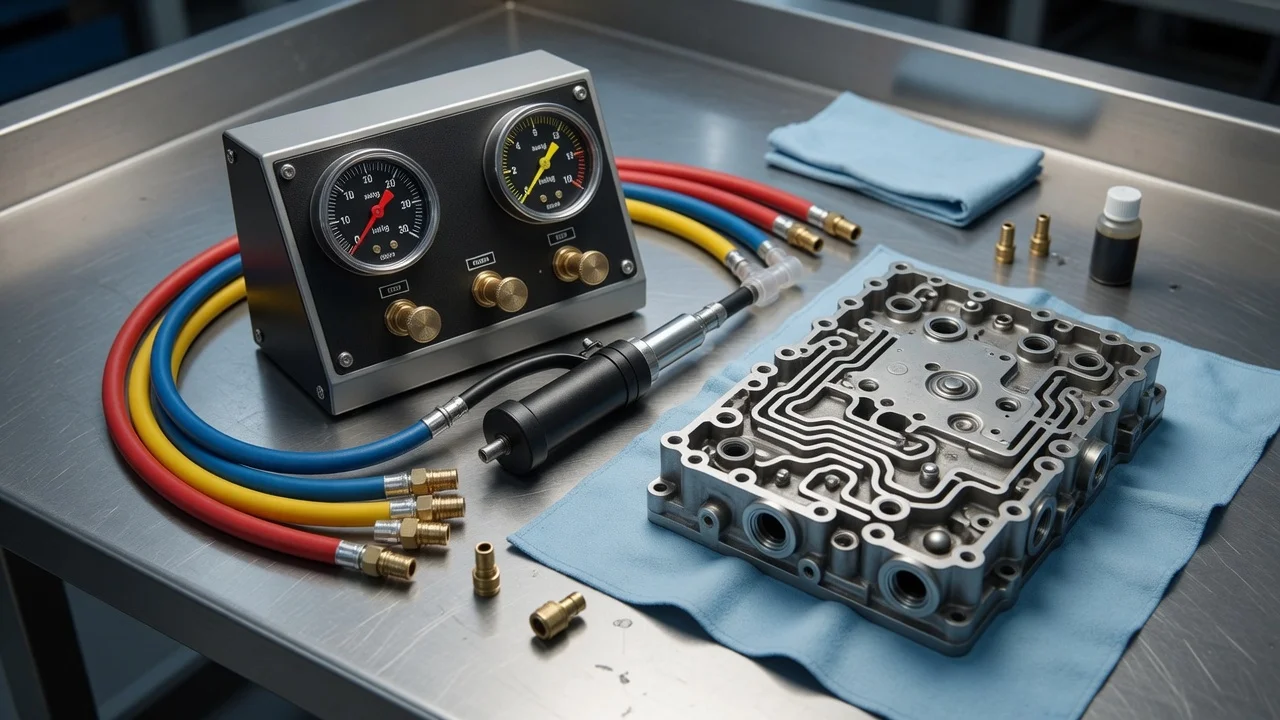
A valve body vacuum tester checks whether the valves in an automatic transmission still seal in their bores. Worn bores can cause pressure loss and erratic shifting. This is a bench tool for someone who already has the valve body out and is preparing to inspect or recondition it. Before buying one, be clear about what you are testing, which transmission you have, and what the result can and cannot tell you.
Define the job the product must do
A vacuum test answers a narrow question: does a specific valve and bore leak more than it should? That is useful when you are rebuilding a transmission, reconditioning a valve body, or deciding whether a used valve body is worth installing. It is not a first diagnostic step. Shift behavior complaints such as flares, slipping, harsh engagement or delayed shifts, along with stored diagnostic codes, can come from many sources. These include fluid level or condition, solenoids, wiring, sensors, software, clutches, the torque converter and valve body wear. A symptom points to an area to investigate; it does not confirm a failed part. Do the on-vehicle work first. Check the fluid level and confirm the fluid matches the required specification. Read codes and review live data, and run a line pressure test where the service procedure calls for one.
Then weigh your practical constraints. An owner rebuilding one transmission has different needs from a shop that reconditions the same unit repeatedly. Consider how many valve bodies you expect to test, whether you have shop air, and how much bench space and time you can give the job. Also ask whether you are comfortable disassembling a valve body with its small springs, check balls and retainers. If not, the realistic repair options are a replacement or remanufactured valve body, or a transmission shop. The money for a tester is better spent there.
Check compatibility
Fitment starts with the transmission type and its exact configuration. One transmission family can use different valve bodies depending on model year, engine, drivetrain or calibration. Manufacturers may also revise bore sizes, valve designs or separator plates during production. Confirm the transmission model from its identification tag or the vehicle's records. Also check the service history for a replaced or updated valve body, because a revised or aftermarket unit may not match the original layout.
The tester also has to physically interface with the valve body. It must seal the ports that feed the bore under test and draw vacuum through a chosen port. Some kits use universal rubber-tipped probes that you hold against a port by hand. Others use test plates or fixtures that bolt on, block the surrounding passages and provide a hose fitting. Universal probes work on more units but depend on your technique and a clean, flat surface. Dedicated fixtures give more repeatable results but fit only the valve bodies they were made for. Check three things before buying: that your exact valve body is listed, that a test map shows which bores and ports to test, and that the hose fittings match your vacuum source. Without a test map, you will have to trace passage routing yourself from the casting and separator plate.
Features that affect the choice
The vacuum source shapes the whole experience. The usual choices are a hand pump, a compressed-air venturi generator or an electric vacuum pump. A hand pump is inexpensive and portable, but it is tiring across many bores and has limited flow. With low flow, a slow leak and a pump that cannot keep up can look similar. A venturi generator is simple and has few moving parts, but it uses compressed air the whole time it runs, so your compressor's capacity matters. An electric pump is the most convenient for repeated work. Find out whether it is oil-lubricated and how it is protected from fluid and solvent residue drawn out of the valve body.
The gauge is the result, so choose one that is easy to read across the range your procedure uses. You also need a shutoff or bleed valve that isolates the gauge from the source, so you can watch whether vacuum holds or decays. Some procedures compare a reading against a stated minimum; others compare a bore with a known-good reference. The tester should support whichever method your procedure uses. Labels such as professional grade or universal tell you little. More useful evidence includes a published gauge range and units, a list of covered valve bodies, instructions that show test locations, and replaceable tips and seals.
Limitations and ownership costs
Results depend on setup. The valve body must be clean and dry enough to seal, and you must block the adjacent ports properly. Dirt, burrs or a damaged sealing surface can create a false leak. Too much hand pressure or an overtightened plate can hide a real one. Expect to spend time learning the procedure and repeating tests before you trust your readings.
Ongoing costs are modest but real. Rubber tips, O-rings and hoses harden and wear out. Cleaning solvent gets used up. An inline trap or filter keeps residue out of the pump. Oil-lubricated electric pumps need oil changes. A venturi setup adds compressor run time. Before choosing a kit, check that its wear parts are sold separately.
The tester also has firm limits. It does not test solenoids electrically, check control module software, or measure hydraulic pressure while the transmission is running. It says nothing about clutch packs, bands or the torque converter. A failed bore shows that leakage exists, but repairing it takes a replacement valve body, an oversize valve with a reamed bore, or a sleeve where a kit exists. Those repairs need their own tools and procedures, and reamers and fixtures are often sold separately. Finally, a valve body that passes does not prove the original complaint is solved.
Build a practical shortlist
Rather than hunting for a single best tester, check each candidate against the same questions. Does the seller name your transmission and valve body, or would you rely on universal probes? Is there a test procedure that shows bore and port locations for your unit? Which vacuum source does it need, and can your workspace supply it? Is the gauge readable in the range you need, with a way to isolate it? Are tips, seals and plates replaceable? Does it work with the repair parts and reaming tools you would use if a bore fails?
Then compare the total cost against the job. For a single transmission, add up the tester, any fixtures, likely repair tooling, parts and your time. Weigh that against a remanufactured valve body or a shop repair. If you expect to work on the same transmission type repeatedly, dedicated fixtures and an electric or venturi source pay off sooner. Whichever you choose, record the result for each bore so it guides the repair and becomes part of the transmission's service history.