Choosing Rubber Hose for Transmission Cooler Lines
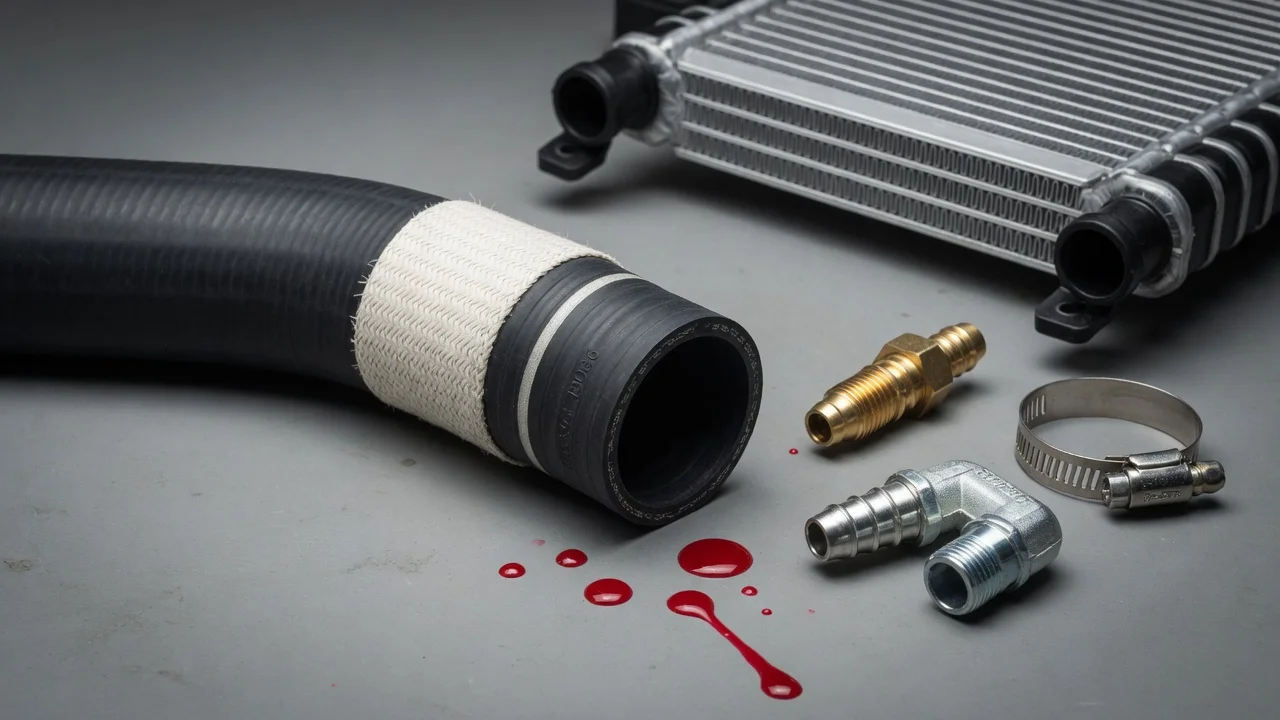
A transmission cooler hose looks like a plain length of rubber, but it carries hot fluid between the transmission and its cooler. The wrong hose can leak, swell, kink or slip off a fitting. Before buying replacement transmission cooler hoses, work out what your vehicle uses, which hose rating suits the job, and when a preformed line is the better repair. This guide covers those decisions without assuming any part has already failed.
Define the job the product must do
Transmission cooler lines send fluid from the transmission to a cooler and back. The cooler may be built into the radiator end tank, mounted separately as an auxiliary cooler, or both. Many factory systems use rigid steel or aluminum lines with short rubber sections that absorb engine and chassis movement. Aftermarket auxiliary coolers, common on towing setups, often use rubber hose for most of the run. Decide which job you are doing. You might be renewing a short factory flex section, replacing a complete line, or plumbing an added cooler. Each needs a different amount of hose, different fittings and a different level of effort.
Note the practical constraints next: heat from the exhaust or turbocharger, clearance to belts, fans and steering parts, how much the vehicle tows, and the climate it runs in. Also confirm what is actually leaking. A wet hose can be collecting fluid from a fitting, the cooler, the pan gasket or something mounted above it. Fluid on the ground, a low level, changed shift behavior or temperature-related diagnostic codes are reasons to inspect the cooling circuit. None of them proves the hose is the failed part.
Check compatibility
Start with the transmission type and the fluid specification. It may be a conventional automatic, a CVT, a dual-clutch unit or, less often, a manual gearbox with a cooler. The owner's manual or service information names the correct fluid. A hose made for transmission oil cooler service is designed to tolerate these fluids. You still need the exact fluid on hand for topping up after the repair, because mixing the wrong type can affect operation.
Size and connection type decide whether a hose will seal. The hose inside diameter must match the outside diameter of the tube or barb it slides over. Passenger cars and light trucks commonly use sizes such as 5/16, 3/8 or 1/2 inch. Measure your tube with calipers rather than guessing from the vehicle class. A hose that is too loose leaks under the clamp, while one that is too tight can split or never seat fully. Then look at each end. Barbed fittings and tubes with a raised bead are made for hose and clamp. Crimped factory sleeves and quick-connect fittings at the radiator or transmission are not. A plain tube end with no bead or barb gives the hose nothing to grip, so it can push off as the fluid heats and pressure builds.
Fitment also covers routing. Measure the run along its real path, allowing for engine movement. Check whether the hose must bend tightly anywhere. Straight bulk hose forced around a sharp curve can kink and restrict flow, which is why some vehicles use molded sections.
Features that affect the choice
The most useful evidence is the marking on the hose. Look for hose sold specifically as transmission oil cooler hose, commonly printed with the SAE J1532 standard, along with its size. That tells you it was built for this service. Heater hose and vacuum hose are not made for continuous contact with hot transmission fluid and should not be used. Fuel hose is oil resistant but is built and rated for a different job. Choose transmission cooler hose whenever it is available.
Construction matters more than branding. A typical oil cooler hose has an oil-resistant inner tube, a reinforcement layer and an outer cover meant to resist heat, ozone and abrasion. Braided stainless lines on aftermarket coolers resist rubbing damage, but they hide the condition of the hose underneath and often need specific threaded fittings rather than clamps. Labels such as heavy duty, high performance or universal mean little on their own. Rely on the manufacturer's stated size, standard, and temperature and pressure ratings, then compare those with your use, especially for towing or routing near exhaust heat.
The other big decision is a preformed line versus bulk hose. A preformed OE-style assembly comes with the correct bends and end fittings for a specific vehicle. It costs more, but it avoids guesswork at crimped or quick-connect ends. Bulk hose is inexpensive and adaptable, which suits auxiliary coolers and simple barbed connections. It does put the burden of correct sizing, clamping and routing on the installer.
Limitations and ownership costs
Budget for more than the hose. Clamps matter. Fuel-injection-style or constant-tension clamps grip evenly, while ordinary slotted worm clamps can bite into soft hose. Some fluid is lost whenever a line is opened, so buy the specified fluid and learn the correct level-check procedure first. Many current transmissions have no dipstick. They must be checked at a set fluid temperature through a fill or check plug, sometimes with a scan tool to read that temperature. A protective sleeve or loom may also be needed where the hose passes near heat or sharp edges.
A new hose cannot fix problems elsewhere in the circuit. It will not cure overheating caused by a clogged or undersized cooler, internal transmission wear, or low fluid from a different leak. If the transmission has had an internal failure, debris may be in the cooler and lines. Service information may then call for flushing or replacing the cooler rather than just the hose. Rubber also ages, so inspect it periodically for cracks, hardening, softness, swelling or seepage at the clamps. Your service history helps judge whether the hoses are original and how hard the vehicle has worked.
Repair options follow from the connections. A simple barbed joint on an auxiliary cooler is a reasonable home repair. Crimped assemblies, quick-connect fittings, or lines buried behind other components are often better handled with a complete replacement line or by a shop that has the correct tools.
Build a practical shortlist
Before comparing listings, write down a few basics. Note the transmission type and fluid specification, the measured tube or barb diameter and the connection type at each end, and the run length plus slack for movement. Mark any heat sources or tight bends along the route. Finally, check whether a preformed assembly exists for your vehicle. That record keeps you focused on parts that fit instead of whatever is labeled universal.
Compare candidates on evidence. Look for a printed rating for transmission oil cooler service, an inside diameter that matches your measurement, and published temperature and pressure ratings that cover your use. Then weigh cover or sleeve protection suited to the routing, whether suitable clamps or fittings are included or must be bought separately, and the seller's return terms in case fitment is wrong. If two options meet every requirement, the deciding factors are usually ease of installation and total cost including clamps and fluid, not marketing claims.
After installation, start the engine and check every joint for seepage. Set the fluid level using the procedure specified for your transmission, then recheck for leaks and level after a test drive. Record the repair in the service history so the next inspection starts with accurate information.