Choosing a Motorcycle Passenger Harness: What to Check Before You Buy
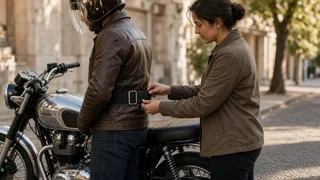
A motorcycle passenger harness gives a passenger, most often a child, something secure to hold, or connects them to the rider, so they are less likely to lose their grip or slide around. The best choice depends mainly on who is riding behind you. A confident teen or adult usually needs only a rider-worn belt with grab handles. A younger child who can reach the footpegs but tires or dozes on longer rides may be better served by a two-part system that links passenger and rider. In every case, a harness only adds to a passenger who is already ready to ride: they must be able to reach the footpegs, wear proper protective gear, and meet any age or passenger rules where you ride. If a child cannot meet those conditions, no harness makes the trip appropriate.
The main types of passenger harness
Products sold under this name fall into three broad designs. Knowing which one you are looking at matters more than brand or styling, because each solves a different problem.
Rider-worn grab-handle belt: a wide belt around the rider's waist or torso with handles on the sides or back. The passenger holds the handles instead of the rider's jacket or waist. Nothing is attached to the passenger. Passenger-worn vest or harness with handles: the passenger wears it. It is mainly useful when an adult helps a child on and off the bike, or as one half of a linked system. Linked rider-and-passenger system: the passenger wears a harness that connects to a belt or vest on the rider, usually with adjustable straps and buckles. It keeps a child close and upright even if they relax their grip.
Which type fits your situation
Situation | Usually the better fit | Main trade-off; Teen or adult passenger who just wants a secure handhold | Rider-worn grab-handle belt | Relies entirely on the passenger holding on; Occasional short rides with an older child | Grab-handle belt, possibly with a passenger vest for mounting and dismounting | Little help if the child gets tired or distracted; Younger child who can reach the footpegs but may lose focus or doze | Linked rider-and-passenger system | Rider and passenger are tied together, which affects how each moves in a fall and in emergencies; Long touring days with a child | Linked system with a quick-release buckle the rider can reach | More setup time and more straps to adjust correctly
Linked systems involve a real trade-off. They reduce the chance of a child sliding back or losing grip, but they also mean rider and passenger move as one unit if the bike goes down or the rider needs to get off quickly. That is why the quick-release mechanism, and the rider's ability to work it easily, is one of the most important features to check.
What to check before you buy
Fit and adjustment range
Check the stated size or adjustment range against both the rider and the passenger while they wear their actual riding gear, not street clothes. A harness that fits over a T-shirt may not close over a padded jacket. For children, ask whether the adjustment range leaves room to grow, but do not buy one so large that it hangs loose now. A loose passenger harness can let a child slide down or out of the straps.
Buckles, quick release and hardware
The rider should be able to undo a linked system quickly with one hand, ideally while wearing gloves. Buckles should close positively and not open from vibration or the passenger's movement. A child should not be able to release the main connection easily on their own. Metal or sturdy hardware at the main load points is generally preferable to thin, lightweight clips. Adjusters should hold their setting and not slowly let the strap lengthen during a ride.
Straps, stitching and handle design
Look closely at the webbing width, the stitching where handles and straps join the main belt, and whether the handles keep their shape or collapse under load. Handles should be easy for a gloved passenger to grip and placed where the passenger can hold them without leaning awkwardly. Loose strap ends should tuck away so they cannot flap or catch on anything.
Equipment compatibility
A harness has to work with the rest of your kit. Check how it sits over your jacket, and whether it covers vents, pockets or zippers you use. If either of you wears an airbag vest or airbag jacket, check carefully that the harness will not restrict inflation; if that cannot be established, treat the combination as unsuitable. Also consider backpacks, hydration packs and tank or tail bags, which can conflict with straps or handle positions.
The motorcycle itself
A harness does not change what the motorcycle is designed to carry. Confirm the bike has proper passenger footpegs and a passenger seat, and check its rated load capacity for your model year and trim in the owner's documentation, counting both riders and any luggage. Two people change the bike's braking, handling and suspension behavior, so tire pressure and preload settings may need adjusting to the service specification for carrying a passenger. Also check that the harness and the passenger's position will not interfere with your riding controls or your ability to shift your weight and turn your head.
Child passenger rules
In the US, rules on motorcycle passengers vary by state. Some states set minimum passenger ages or require that passengers can reach the footpegs, and helmet requirements also differ. Check the current rules for every state you plan to ride in. A harness does not satisfy a footpeg or age requirement.
Cost and value
Prices vary with design, materials and whether you buy a single belt or a linked system. When comparing listings, make sure you are comparing like with like: some prices cover only the rider belt, while others include both rider and passenger pieces. Factor in any extra you may need, such as a passenger-sized helmet, gloves and jacket, or a passenger backrest, because these often matter more to a child's comfort and security than the harness itself. Paying a little more for better hardware and a reliable quick release is usually money well spent, because those are the parts you depend on most.
Using the harness well
Fit and adjust the harness with both riders in full gear before the first ride. Practice mounting, dismounting and releasing the connection while stationary. Start with short, low-speed rides so the passenger learns to lean with the bike and stay still. Agree on simple signals for 'stop', 'tired' or 'uncomfortable'. Inspect straps, stitching and buckles regularly, and replace the harness if anything is frayed, cracked or slipping. Plan more frequent breaks with children, since fatigue is often what a harness is compensating for.
Bottom line
For an older, attentive passenger, a well-made grab-handle belt is usually enough. For a younger child who meets the footpeg and local legal requirements but may lose focus, a linked system with a rider-accessible quick release offers more security, with the trade-off of tying the two of you together. Whichever you choose, put fit over both riders' gear, buckle and stitching quality, compatibility with any airbag equipment, and the motorcycle's own passenger capacity ahead of price or appearance.