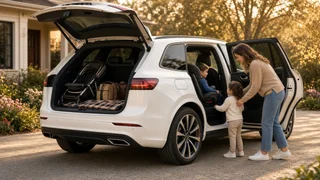
Choosing an SUV for Family Use

The short answer
The best family SUV is the one that fits your real seating and cargo needs, installs your child seats easily, has strong safety ratings for the exact model year and trim you are considering, and has running costs you can sustain. Two factors change the answer most. First, how many people you regularly carry: if you routinely need more than five seats, a three-row SUV is the starting point, while a two-row model is usually easier to park, lighter on fuel and often less expensive. Second, whether you are buying new or used: a used SUV adds condition, history and recall checks that can matter more than any brochure specification.
This guide does not rank specific models or quote prices, fuel economy figures or dimensions. Those figures vary by model year, trim, powertrain and market, so confirm them for the exact vehicle you are considering before you decide.
Start with how your family will use the vehicle
Before comparing models, write down how the SUV will actually be used. It is easy to buy for an occasional trip and pay for that choice every day. Useful questions to answer include:
How many people ride along on a normal week, and how often you carry extra passengers such as grandparents or carpool children. How many child seats you need now and in the next few years, and which type: rear-facing infant seats, convertible seats or boosters. What you carry regularly: strollers, sports gear, groceries, luggage or pets. Where you drive and park: tight city garages, long highway commutes, snow, gravel roads or towing. How long you plan to keep the vehicle, since that affects how much reliability and long-term costs matter.
Two-row or three-row: matching size to your household
SUV size categories are not standardized across manufacturers, so treat the labels below as rough groupings and check the measurements of each specific vehicle.
Category | Typical seating layout | Often suits | Trade-offs to weigh; Compact or small SUV | Two rows | Smaller families, mostly urban driving | Less rear legroom and cargo space; fitting three seats across may be difficult; Midsize two-row SUV | Two rows | Families of four or five who want more cargo room | Larger footprint than compact models; no option for extra passengers; Midsize three-row SUV | Three rows | Families who occasionally carry six or more | Third row may be tight for adults; cargo space shrinks when it is in use; Full-size three-row SUV | Three rows | Larger families, frequent full loads or towing | Harder to park and maneuver; typically higher fuel and running costs
A common trade-off with three-row SUVs is that cargo space behind the third row can be limited when all seats are in use. If you need both full seating and luggage space at the same time, check that specific combination rather than the maximum cargo figure, which is usually measured with seats folded.
Check child seat fit in person
Child seat compatibility is one of the most important family checks and one of the hardest to judge from specifications. LATCH (Lower Anchors and Tethers for Children) is the US system of built-in anchor points used to secure child seats without the seat belt. The number and location of LATCH positions and top tether anchors differ between vehicles and sometimes between trims, so check the owner's manual for the exact model year.
Bring your own child seats to the test drive and install them in the positions you would actually use. Check whether a rear-facing seat leaves enough legroom for the front passenger or driver. If you need three seats across one row, test that layout specifically. In a three-row SUV, check how children reach the third row and whether a second-row seat can tilt or slide with a child seat installed. Check whether older children can buckle themselves in without the buckles being buried under booster seats.
Safety ratings and driver assistance features
In the US, the two main sources of crash test ratings are the National Highway Traffic Safety Administration (NHTSA) and the Insurance Institute for Highway Safety (IIHS). Ratings apply to a specific model year and sometimes to specific build dates or trims, and test protocols change over time, so a rating from one year cannot be assumed to carry over to another. Compare ratings only when they come from the same organization and the same version of its tests.
Driver assistance features such as automatic emergency braking, blind-spot monitoring, rear cross-traffic alert and adaptive cruise control may be standard on some trims and optional or unavailable on others. Confirm which features are fitted to the exact vehicle on the lot, not just what the model line offers. Also check rear visibility and whether rear-seat reminder or rear occupant alert features are included if those matter to you.
Powertrain and drive type
The powertrain is the engine or motor and the components that send power to the wheels. Many family SUVs are offered with gasoline, hybrid, plug-in hybrid or fully electric powertrains, and the choice affects fuel or energy costs, range, towing ability and purchase price. Efficiency and range figures differ by powertrain, trim, wheel size and drive type, so compare figures for matching configurations.
All-wheel drive (AWD) sends power to all four wheels as needed and can help with traction in rain and snow, but it typically adds cost and can reduce efficiency. Tires often matter as much as drive type for winter grip. If you plan to tow a trailer or camper, check the towing capacity for the exact powertrain and trim, and whether a towing package is required.
Total cost of ownership, not just the sticker price
The purchase price is only part of what a family SUV costs. When comparing options, estimate ongoing costs for your own situation:
Fuel or charging costs, based on your actual mileage and local energy prices. Insurance, which can vary noticeably between models and trims; get quotes before you buy. Tires, especially on larger SUVs or trims with bigger wheels. Scheduled maintenance and likely repairs, including what the warranty covers and for how long. Registration fees and taxes, which vary by state. Depreciation, meaning how much value the vehicle is likely to lose over the time you own it.
When you see a price or an ownership cost estimate, establish what it represents: the market or region, the date, the currency and which costs are included. An advertised price is not the same as what buyers actually paid, and it may exclude destination charges, dealer fees, add-ons, taxes and registration. Ask for an itemized out-the-door price in writing so you can compare offers on the same basis.
Extra checks for a used family SUV
Condition and history can outweigh model-level reputation when buying used. Before committing, consider these checks:
Check for open safety recalls using the vehicle identification number (VIN) through NHTSA's recall lookup or a franchised dealer. Obtain a vehicle history report to look for reported accidents, title problems and ownership history, keeping in mind that not every incident is reported. Ask for service records and confirm that scheduled maintenance was done. Have an independent mechanic carry out a pre-purchase inspection. Check whether any remaining factory warranty transfers to you. Inspect the interior for wear, stains and damage to seats and child seat anchor areas, and confirm all seat-folding mechanisms work. Test every feature you will rely on, including rear climate controls, power liftgate, infotainment and driver assistance systems.
Use the test drive to test family life
A short drive around the block reveals little about family suitability. If possible, bring the people and gear you normally carry. Load the stroller, fold and raise each row of seats, sit in every row, check how easy it is to open doors in a tight parking space, and listen to cabin noise at highway speed. Note whether the climate system reaches rear passengers and whether there are enough charging points and storage spaces for everyone.
What this guide cannot confirm
No model-specific evidence was available for this guide, so it contains no prices, measurements, efficiency figures, crash test results or reliability data. Before choosing, confirm these for the exact model year, trim and powertrain from the manufacturer, the official safety rating organizations and written dealer quotes, and treat any figure that does not specify its version, date or test conditions with caution.