Choosing an OBD2 Scanner for Jaguar
The short answer
A basic OBD2 scanner can read generic engine fault codes on most Jaguars, but the more useful choice for ownership is usually a Jaguar-aware tool. A scanner with enhanced Jaguar or Land Rover coverage is expected to access more systems, including modules that a generic powertrain scanner cannot reach. The exact compatibility should be checked for the model year and market because Jaguar models differ in communication protocols and available modules.
The key distinction
OBD2 means a legally required diagnostic connection for emissions-related powertrain functions. A basic OBD2 scanner reads standardized diagnostic trouble codes, commonly called DTCs, and a limited set of live data such as engine speed, coolant temperature, and fuel trim. It does not automatically access body, chassis, transmission, suspension, or climate modules unless the tool has enhanced coverage for the vehicle maker.
Jaguar vehicles also expose many non-powertrain modules through the diagnostic port. A scanner designed with Jaguar-specific software is more likely to support those modules and to interpret their codes with useful explanations.
Checks before committing
Start with the exact model, model year, engine, and intended use. The most important use-case question is whether you only need to identify a check engine light or whether you expect to diagnose uneven ride, electronic parking brake, battery management, transfer case, or infotainment faults. The deeper the intended diagnosis, the more important enhanced Jaguar coverage becomes.
Confirm that the scanner supports the protocols of your market and era. Many older models use earlier proprietary or non-standard module behavior, while newer vehicles use more standard diagnostic structures and may require security access or a current update plan for some functions.
Check the total cost, not just the scanner price. Some tools require an annual software subscription or a model-specific upgrade after the first year. Others are sold as a one-time purchase but receive limited updates. If you intend to use the scanner for several years, any renewal cost should be included in the comparison.
Main scanner types
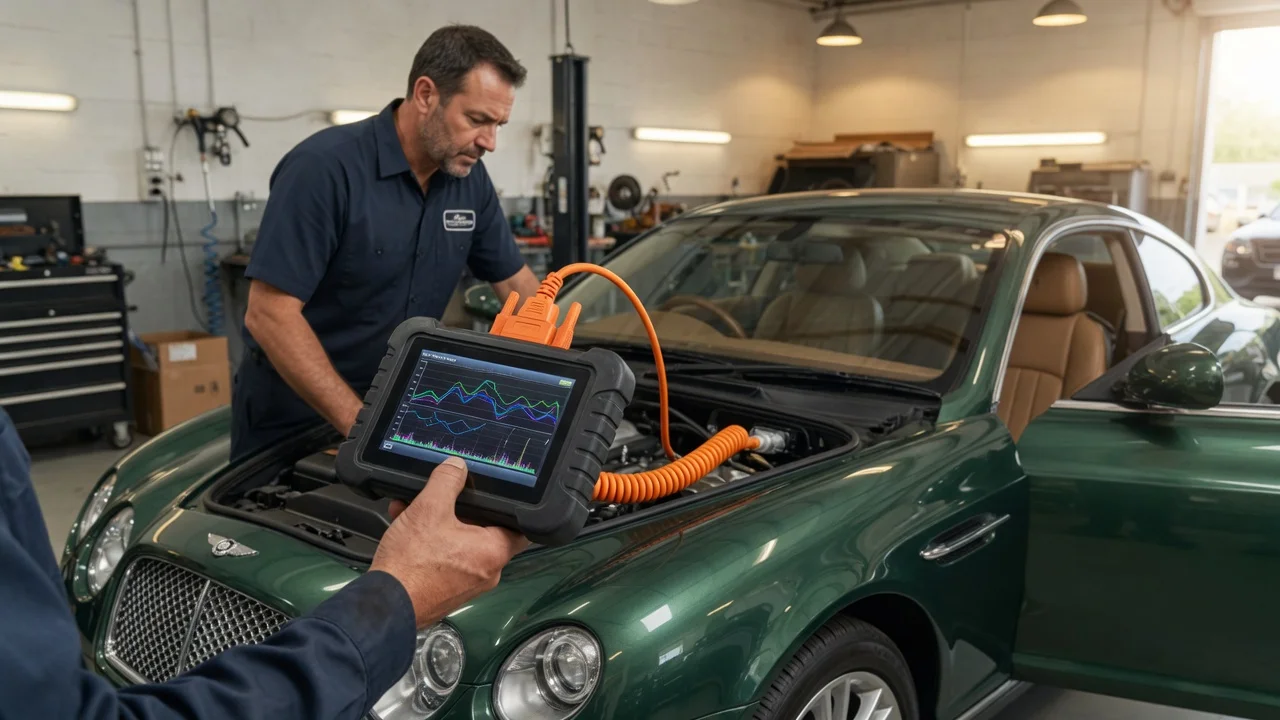
Code reader: reads and clears generic engine codes and basic live data; low cost, but limited for Jaguar systems. Handheld diagnostic tool: portable, self-contained, and often includes maker-specific menus; good for regular use without relying on a phone or laptop. Bluetooth or Wi-Fi adapter with an app: the adapter plugs into the port and a smartphone or tablet displays the data; app and license costs can affect the final value. PC or tablet-based dealer-level tool: the deepest coverage for many Jaguar modules, with more setup complexity and higher cost.
What changes the recommendation
For quick engine-code checks on a single vehicle, an inexpensive code reader may be enough. For an owner who wants to monitor multiple systems, reset maintenance reminders, perform service functions, or investigate warnings beyond the engine, a Jaguar-aware mid-range handheld or app-based tool is more practical.
The deciding factors are common across options: the number of supported modules, live data quality, bi-directional control where needed, update policy, and ease of use. Tools should be compared on the same model instead of assuming that broad advertising coverage means complete support for your specific Jaguar.
Flagged gaps
The supplied material does not include verified prices, model-by-model coverage tables, or completed transaction data. Do not treat advertised compatibility lists as proof of every supported function. If the purchase decision depends on a particular module, a filter, a reset procedure, or an update cost, the manufacturer’s current compatibility documentation for your exact market and model year should be checked before buying.