How to Choose EP 80W-90 Gear Oil: Specs, Compatibility and Buying Checks
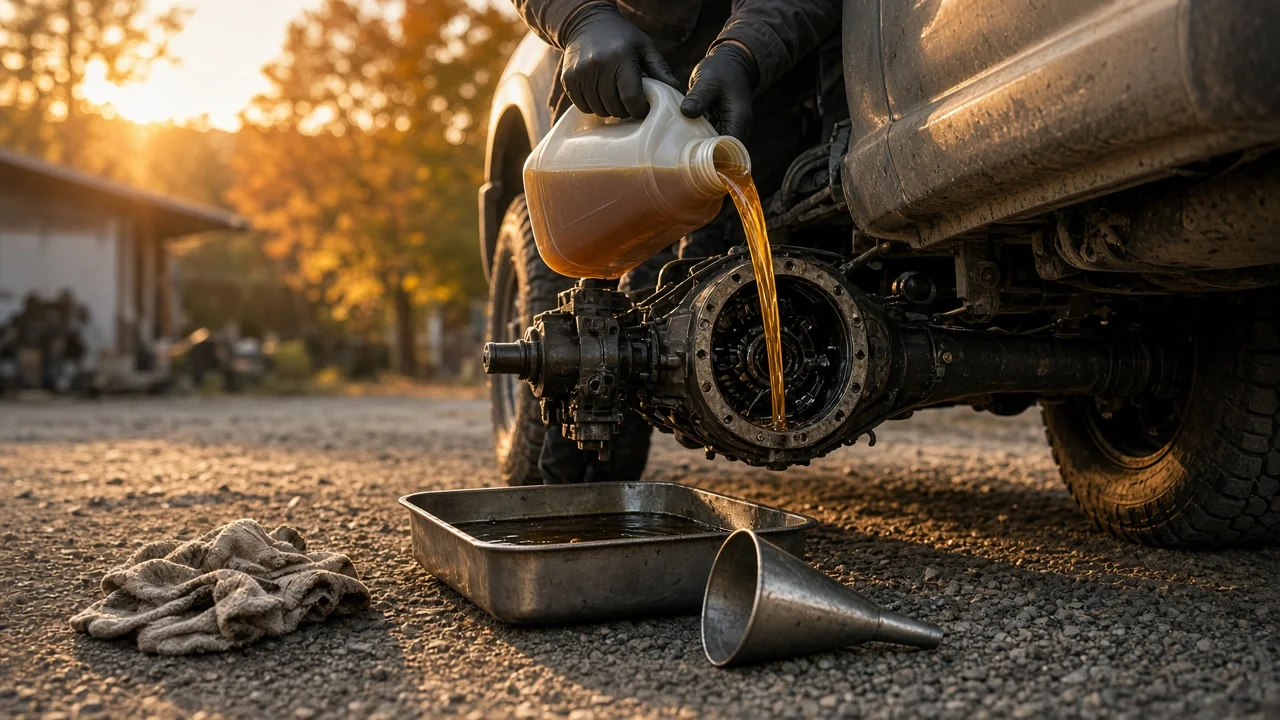
EP 80W-90 gear oil suits a gearbox, differential or transfer case only if the equipment maker calls for SAE 80W-90 viscosity and the oil carries the required API service category, usually GL-4 or GL-5. Viscosity alone is not enough. The performance category and any special requirements, such as limited-slip friction modifiers or compatibility with brass synchronizers, decide whether a given bottle is suitable. If your owner's manual or service information specifies a different viscosity, a synthetic-only fluid, or an automatic transmission fluid, EP 80W-90 is the wrong product.
What "EP 80W-90" actually means
The label combines two separate pieces of information. "EP" stands for extreme pressure, meaning the oil contains additives, typically sulfur and phosphorus compounds, that form a protective film on gear teeth under heavy sliding loads. Hypoid gears in rear axles are the classic example because their tooth design creates high sliding pressure that plain mineral oil cannot handle.
"80W-90" is the viscosity grade under the SAE gear oil classification. The "80W" part describes cold-temperature flow, and "90" describes thickness at operating temperature. Some products and listings write it as "80-90W" or "80/90"; these refer to the same multigrade. Gear oil viscosity numbers are on a different scale from engine oil numbers, so an 80W-90 gear oil is not comparable to an engine oil with similar-looking figures.
GL-4 or GL-5: the decision that matters most
The API service category tells you how much extreme pressure protection the oil provides and what kind of gear set it is designed for. Many 80W-90 oils are sold as GL-5, some as GL-4, and some claim both.
Category | Typical application | Key consideration; API GL-4 | Many manual transmissions and transaxles, some older or lightly loaded axles | Moderate EP additive level; often specified where synchronizers contain yellow metals such as brass or bronze; API GL-5 | Hypoid-gear differentials and axles in most cars, trucks and SUVs | Higher EP additive level; required for hypoid gears under heavy load; API MT-1 | Non-synchronized manual transmissions, mainly in heavy commercial trucks | Focused on thermal stability and seal compatibility; not a substitute for GL-5 in hypoid axles
Do not assume a higher number is always better. GL-5 oil in a gearbox designed for GL-4 can change synchronizer friction and, with some formulations, affect yellow-metal parts, which may show up as notchy or difficult shifting. Putting GL-4 oil in a differential that requires GL-5 may leave hypoid gears underprotected. Some products are formulated to meet both categories without the yellow-metal concern; if you need that, look for an explicit statement on the label rather than inferring it.
Equipment identification: confirm what you are filling
Gear oil requirements can differ between the front axle, rear axle, transfer case and transmission on the same vehicle, and between model years, trims and powertrains of the same nameplate. Before buying, identify the specific component.
Check the owner's manual or factory service information for the lubricant specification of each component, not just the vehicle overall. Look for an axle tag, stamped code or build-option label that identifies the axle or transmission type, since mid-year changes and optional axles are common. Note whether the vehicle has a limited-slip or locking differential, which may change the fluid requirement. For older vehicles, consider whether the original gearbox has been swapped or rebuilt, which can make the original specification inaccurate. For tractors, implements and other equipment, confirm whether the maker wants a dedicated gear oil or a universal tractor fluid, which is a different product category.
Limited-slip differentials and friction modifiers
Clutch-type limited-slip differentials often need a friction modifier so the clutches engage smoothly instead of chattering on tight turns. Some 80W-90 oils already include it and are marked as suitable for limited-slip use. Others require a separate additive. Check whether your differential needs the modifier, whether the oil already contains it, and whether the maker specifies a particular additive. Gear-type and some electronic locking differentials may not need any modifier, so adding it without reason is unnecessary.
Manufacturer approval and industry standards
Beyond the API category, some vehicle and axle makers publish their own approval numbers, and heavy-duty applications often reference standards such as SAE J2360. If your service information lists a specific manufacturer approval, buy an oil that states that approval on its label or technical data sheet. A product that claims it is suitable for or recommended for an application is making a weaker claim than one that lists a formal approval, which matters most during a warranty period.
80W-90 compared with common alternatives
Readers often see 80W-90 next to other grades on the shelf. The right choice depends on what the equipment maker specifies and, where a range is allowed, on climate and load.
Option | When it fits | Trade-off; Conventional 80W-90 | Older vehicles, equipment and axles that specify this grade; moderate climates | Usually lower cost; thicker in cold weather than many synthetic options; Synthetic 75W-90 | Many modern axles and transmissions; colder climates; where specified as a replacement | Better cold flow; often costs more; not automatically approved where 80W-90 is specified; 85W-140 | Heavy towing, hot climates or severe service where the maker allows it | Thicker at operating temperature; slower to flow when cold; may reduce efficiency; Automatic transmission fluid or dedicated manual transmission fluid | Gearboxes whose maker specifies these instead of gear oil | Not interchangeable with EP gear oil; using gear oil here can damage shifting components
If the service information lists 80W-90 as one option among several, a synthetic 75W-90 meeting the same category is a common upgrade for cold-weather starts and long service intervals. If the maker specifies only 80W-90 for a gearbox with brass synchronizers, sticking with the specified grade and category is the lower-risk choice.
Fill quantity and how much to buy
Fill quantity varies widely, from small transfer cases to large truck axles. Use the capacity listed in your service information rather than a general rule, and buy a little more than the listed figure to allow for spills and the oil that stays in the bottle. Many differentials and manual gearboxes are filled until the oil reaches the bottom edge of the fill hole, but some use a measured quantity, a dipstick or a separate check procedure. If you plan to service both axles, add the capacities together and check whether the front and rear require the same oil.
Level check and service interval
A level check is simple on most axles: with the vehicle level, remove the fill plug and confirm the oil reaches the specified point. Always loosen the fill plug before the drain plug, so you are not left with a drained component you cannot refill. When draining, look at the oil and the magnetic drain plug if fitted; a fine metallic paste is normal, but large chips, a milky appearance or a strong burnt smell suggest a problem worth investigating.
Service intervals depend on the vehicle and how it is used. Towing, off-road driving, water crossings, frequent short trips and commercial use are usually treated as severe service and call for shorter intervals. Follow the schedule in your owner's manual for your usage pattern, and change the oil promptly after submerging an axle, since water contamination degrades gear oil quickly.
Checks before you buy
The viscosity grade matches the specification for that exact component, model year and powertrain. The API category on the label, such as GL-4, GL-5 or both, matches what the maker requires. Limited-slip compatibility is stated if your differential needs it, or you have the correct additive. Any required manufacturer approval or industry standard is listed on the label or data sheet. The product is a gear oil and not a tractor hydraulic fluid, marine lower unit oil or transmission fluid with similar packaging. You are buying enough to cover the listed capacity of every component you plan to service. The container is sealed and undamaged, especially when buying from a marketplace seller. You have the tools to do the job: a fill pump or squeeze bottle, the correct plug socket, new crush washers or sealant if required, and a way to dispose of used oil properly.
Weighing cost against risk
When comparing listings, compare price per unit of volume rather than per bottle, because container sizes vary. Factor in any additive, sealant or gaskets the job requires, and the labor cost if a shop will do the work. Saving a small amount on a product with an uncertain category or approval is rarely worthwhile when the component it protects is expensive to repair. Where the specification is clear and several oils meet it, choose on availability, container size and whether you prefer conventional or synthetic within the allowed range.
Bottom line
Buy EP 80W-90 gear oil when the equipment maker specifies that grade, then narrow the choice by API category, limited-slip needs and any listed manufacturer approval. If the specification calls for GL-4 in a synchronized gearbox, avoid a GL-5-only oil unless it explicitly states yellow-metal compatibility. If the specification calls for a different viscosity or a transmission fluid, choose that instead. When the information for your exact vehicle is unclear, confirming the component identification first will prevent most wrong purchases.