How to Choose EP 150 Gear Oil
The short answer
EP 150 gear oil is an extreme-pressure gear oil with an ISO viscosity grade of 150. It is mainly an industrial lubricant for enclosed gear drives such as reducers and equipment gearboxes. Choose it when the manual for your gearbox calls for ISO VG 150 with EP additives, or names a standard that EP 150 products are made to meet. If your manual instead specifies an SAE grade such as 80W-90 or 85W-90 together with an API GL rating, follow that specification. A viscosity overlap between the two systems does not make the oils interchangeable.
What "EP 150" means
The number refers to the ISO viscosity grade (ISO VG). Viscosity is the oil's resistance to flow. An ISO VG 150 oil has a nominal kinematic viscosity of 150 centistokes at 40 °C, and the grade allows a range of plus or minus 10 percent, which is roughly 135 to 165 centistokes. Higher ISO numbers mean thicker oil at that reference temperature.
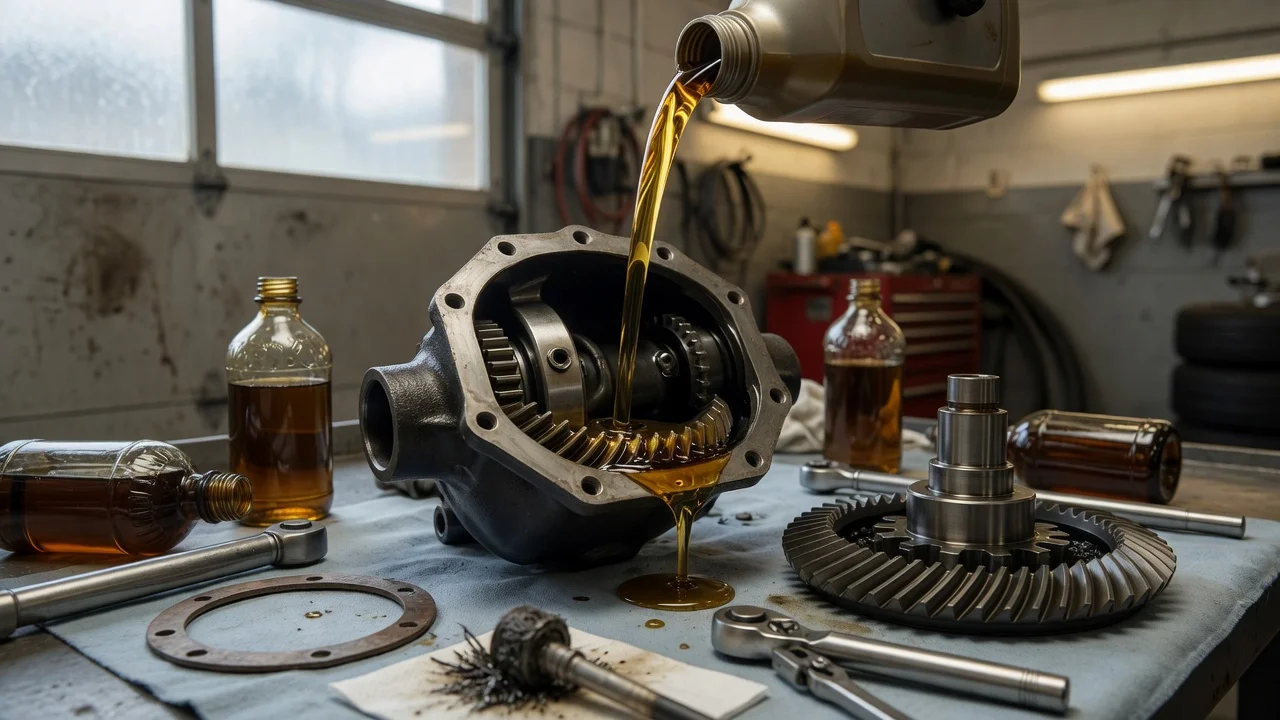
EP stands for extreme pressure. EP additives, commonly based on sulfur and phosphorus chemistry, react with gear surfaces under heavy load or shock to form a protective layer. That layer helps prevent scuffing and welding of gear teeth when the oil film alone is not enough. An oil sold as EP 150 therefore pairs a mid-range industrial viscosity with additives meant for loaded, steel-on-steel gearing.
Industrial EP gear oils are usually described by the standards they meet. Common references include DIN 51517 Part 3 (the CLP designation, so CLP 150 is a close label match), ISO 12925-1 categories such as CKC or CKD, and AGMA lubricant numbers, where an ISO VG 150 EP oil corresponds to AGMA 4EP. A product's datasheet should list which of these it actually meets.
Where it fits and where it may not
EP 150 is a common choice for enclosed industrial gear units, gearboxes on some agricultural, construction and processing equipment, and other drives whose manufacturer lists ISO VG 150 EP. It is generally not the default for passenger-car manual transmissions, transaxles or drive axles. Those components are normally specified with an SAE J306 viscosity grade and an API performance category such as GL-4 or GL-5, plus any vehicle-maker approval. The required grade and approval depend on the specific model year, market, trim and powertrain, so check the manual for your exact vehicle rather than a general chart.
Viscosity conversion charts place ISO VG 150 somewhere in the range of SAE 80W-90 to 85W-90, but charts disagree and the two systems measure different things. SAE gear grades also define low-temperature behaviour, and API categories involve performance tests that an industrial ISO-graded oil may not have been run against. Matching the thickness of the oil does not confirm a match in additive chemistry or tested performance.
Some EP chemistries can be harsh on yellow metals such as bronze and brass. This matters for components like brass synchronizer rings in some manual gearboxes and for bronze worm wheels. Worm gear drives often call for a different type of oil entirely, sometimes a compounded oil or a specific synthetic, and frequently at a different viscosity grade. Limited-slip differentials may also need friction modifiers that a general industrial EP oil does not contain. In any of these cases, use only an oil the manufacturer approves.
What to check before you buy
The equipment or vehicle manual: confirm it actually calls for ISO VG 150 with EP additives, or a named standard such as CLP 150, CKC/CKD 150 or AGMA 4EP. If it names a specific approval, the product must carry that approval. The correct grade for your conditions: some manuals list different grades for different ambient or operating temperatures. Don't move up or down a grade unless the manual allows it. The product datasheet: look for the standards met, viscosity at 40 °C and 100 °C, viscosity index, pour point and any load-carrying test results such as FZG load stage. Compare products only on values reported under the same test methods. Base oil type: mineral, PAO synthetic or PAG synthetic. Synthetics can offer better performance at temperature extremes, but PAG oils are generally not compatible with mineral or PAO oils, so a PAG product needs a full drain and flush when switching to or from it, and seal compatibility should be confirmed. Compatibility with what is already in the gearbox: if you're topping up rather than changing, use the same type and preferably the same product. Materials in the gearbox: if it contains bronze, brass or other yellow metals, confirm the oil is rated as safe for them. Cold-start conditions: if the gearbox starts in low temperatures, check the pour point and whether the manufacturer specifies a different grade for cold service. Quantity: confirm the fill capacity from the manual so you can choose a sensible container size, and plan for used-oil disposal.
Comparing cost
This guide does not quote prices, because none were assessed for it, and gear oil prices vary by market, seller, container size and date. To compare fairly, work out the price per litre, or per gallon, in the same currency and at the same point in time, and note whether shipping and tax are included. Treat advertised prices as asking prices, not what buyers have actually paid. For total ownership cost, add any labour, flushing oil if a change of oil type requires it, filters if the system has them, and disposal of the old oil. A synthetic oil often costs more up front. Only count on longer drain intervals as a saving if the equipment manufacturer permits them for that oil.
When to stop and confirm
Hold off on buying if the manual's specification is unclear, if it uses an SAE grade and API rating rather than an ISO grade, if the gearbox has worm gears, yellow-metal parts or a limited-slip differential, or if you can't identify which oil is currently in the unit. In those cases, confirm the requirement with the equipment or vehicle manufacturer, a dealer, or the oil supplier's technical documentation before you buy. Using the wrong gear oil can shorten component life, and fixing that usually costs far more than the oil.