Choose brake fluid for an Alfa Romeo Giulia
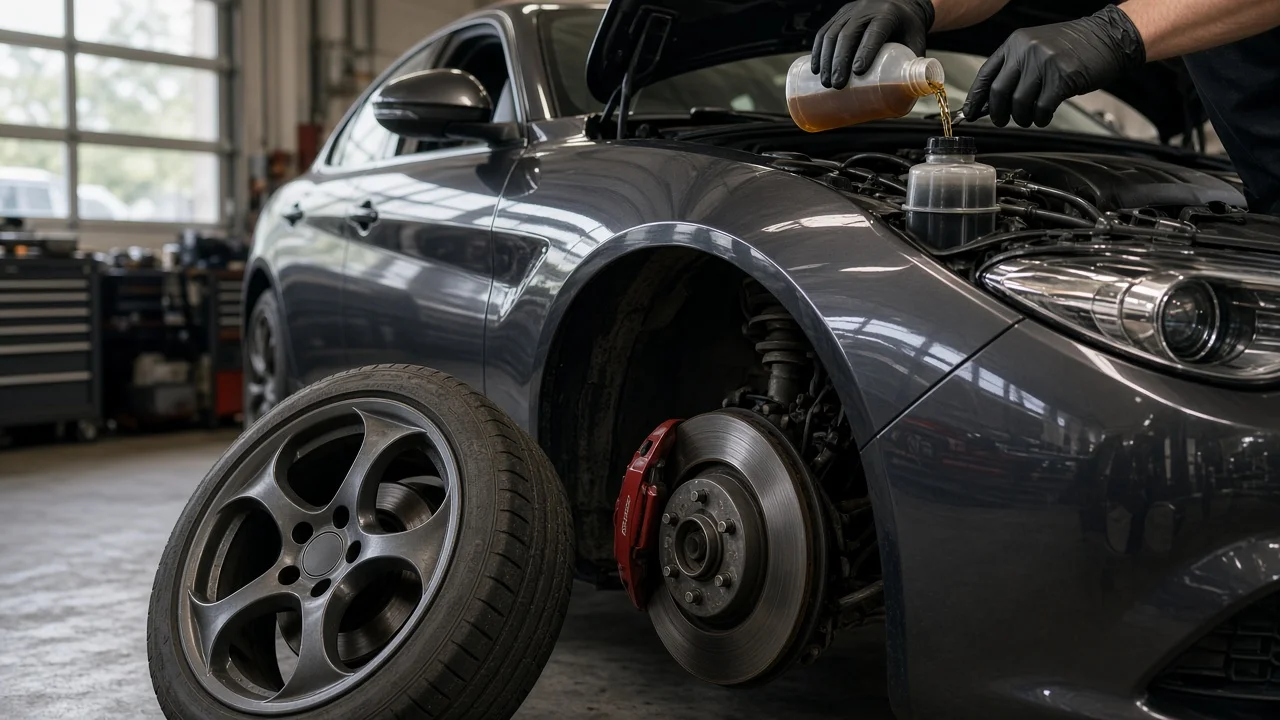
Choosing the correct brake fluid for an Alfa Romeo Giulia is more than matching a bottle to a reservoir. The fluid must work with the hydraulic system’s seals, calipers, ABS hardware, and heat range. Brake fluid transmits pedal pressure to the caliper pistons, which then squeeze the pads against the rotors. Moisture absorption, boiling point, and compatibility affect how that force feels and how consistently it survives hard stops. Because a Giulia can generate high brake temperatures during enthusiastic driving, selecting the wrong specification may erode pedal firmness long before the friction material or rotors reach their wear limits.
Essential answer
The Giulia’s brake hydraulic system is designed around a high-performance brake fluid that resists heat and moisture-related boiling. The owner’s manual remains the authoritative source for the exact DOT rating and any manufacturer-specific requirement, because Alfa Romeo and other brands can specify fluids beyond a generic DOT label. Brake fluid is hygroscopic, meaning it slowly absorbs water from the air. That moisture lowers the fluid’s boiling point and can lead to a soft pedal, longer stopping distances, or vapor bubbles under repeated braking. Selecting the approved specification preserves the hydraulic response the vehicle was engineered to deliver.
When evaluating brake fluid for a Giulia, the key distinction is between DOT 3, DOT 4, and higher-performance DOT 4 variants. DOT 4 generally has a higher dry and wet boiling point than DOT 3, making it better suited to spirited driving and repeated high-speed stops. However, a fluid with a higher boiling point does not automatically match every seal material or electronic stability control calibration. The correct choice is the fluid that meets the vehicle manufacturer’s specification, not simply the bottle with the largest DOT number. Aftermarket products should be checked for that stated fitment before the system is topped off or flushed.
Relevant alternatives
DOT 3 and DOT 4 fluids are common comparison points, but they are not interchangeable by convenience. DOT 3 may be acceptable in some older or lower-demand hydraulic systems, while DOT 4 is usually the safer baseline for a modern sports sedan with strong calipers and stability control. In a Giulia, repeated braking from highway speed or long descents can push fluid temperature upward. A fluid with a stronger wet boiling point retains a firmer pedal as moisture accumulates, which is a practical advantage when service intervals stretch between brake fluid changes.
High-performance or racing-oriented brake fluids can offer even more heat resistance, but they often require more frequent replacement because they may absorb moisture differently or provide less corrosion protection for daily street use. Silicone-based DOT 5 fluid is generally not appropriate for a system designed around glycol-based fluids and ABS hardware. The practical decision is a compatible glycol-based fluid meeting the manufacturer’s stated DOT and performance class. If the vehicle sees track use, a high-temperature DOT 4 option may be preferable, provided its chemistry and replacement schedule suit the Giulia’s braking system.