Choose brake fluid for an Alfa Romeo Giulia
The short answer
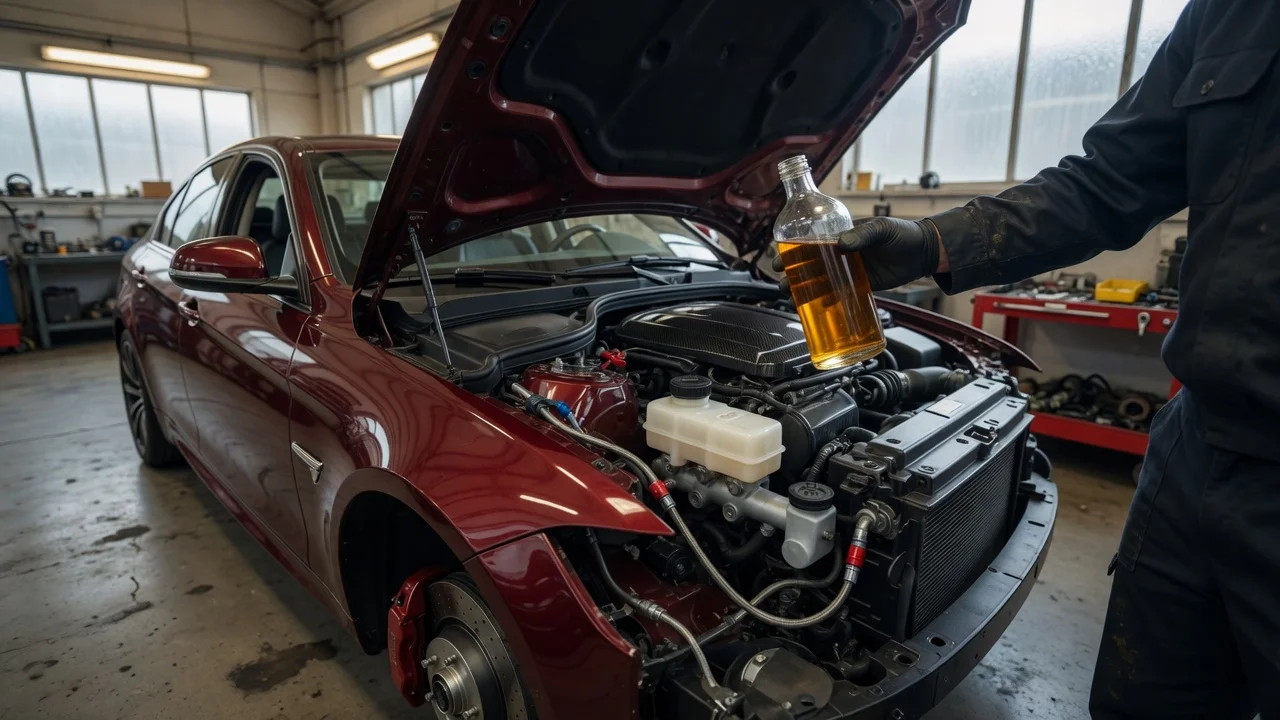
The current Alfa Romeo Giulia (the Type 952 sedan sold from 2016 onward) is generally documented as using a synthetic, glycol-based DOT 4 brake fluid. Owner's manuals for this generation commonly list the factory-fill product as Petronas Tutela TOP 4/S and describe it as meeting FMVSS 116 DOT 4, ISO 4925 and SAE J1704. If you do not buy that exact product, choose a fluid that states the same standards on the label, preferably one also rated ISO 4925 Class 6, a low-viscosity grade explained below.
Two qualifications matter. First, fluid recommendations can differ by model year, market and engine, and they may be revised over a model's life, so confirm the specification in the owner's manual or service information for your specific car. Second, this article covers the 952-generation Giulia; the older Giulia models of the 1960s and 1970s are entirely different vehicles with different brake hardware and are not covered here.
What the specification terms mean
DOT 4: a US federal standard (FMVSS 116) for glycol-ether brake fluid that sets minimum boiling points and other properties. The minimums are 230 °C dry (fresh fluid) and 155 °C wet (fluid that has absorbed a standardized amount of moisture). ISO 4925: the international brake fluid standard. Its Class 6 grade combines DOT 4-level boiling points with a lower maximum cold viscosity, set at 750 mm²/s at −40 °C, compared with 1,800 mm²/s for basic DOT 4. SAE J1704: an SAE specification for glycol-based brake fluid that broadly parallels the DOT categories. Dry versus wet boiling point: glycol fluids absorb water from the air over time, which lowers the boiling point. The wet figure indicates how the fluid performs after it has aged in service.
Low cold viscosity matters on modern cars because stability control and anti-lock systems move fluid rapidly through small valves and passages. The Giulia uses an integrated electronic brake system that combines brake actuation and stability control in one unit, so a fluid that flows well when cold is a sensible match. Whether Alfa Romeo strictly requires Class 6 for every market and year is not something this guide can confirm, which is another reason to check your manual.
Comparing the options
The table below compares the fluid types a Giulia owner is likely to encounter on shared criteria. Boiling point figures are the regulatory minimums for each category, not measured values for any particular brand. Individual products often exceed these minimums, but figures from different manufacturers are not always tested or reported the same way.
Fluid type | Minimum dry / wet boiling point | Cold viscosity | Suitability for the Giulia; Factory-specified DOT 4 (Tutela TOP 4/S or equivalent) | 230 °C / 155 °C | Low; marketed against ISO 4925 Class 6 | Default choice; matches documented specification; Other DOT 4 labelled ISO 4925 Class 6 | 230 °C / 155 °C | Low (750 mm²/s max at −40 °C) | Good alternative if labelled with the same standards; Basic DOT 4 without Class 6 rating | 230 °C / 155 °C | Higher (1,800 mm²/s max at −40 °C) | Compatible chemistry, but a weaker match for the electronic brake unit; confirm acceptability; DOT 5.1 (glycol) | 260 °C / 180 °C | Low | Chemically compatible with DOT 4; only use if your service information permits it; DOT 5 (silicone) | 260 °C / 180 °C | Different chemistry | Do not use; not compatible with glycol systems; DOT 3 | 205 °C / 140 °C | Varies | Below the DOT 4 specification; avoid
Which option fits your priorities
Everyday driving and warranty peace of mind: use the factory-specified fluid or a DOT 4 product that lists FMVSS 116 DOT 4, ISO 4925 Class 6 and SAE J1704. This keeps you aligned with the documented specification and simplifies dealer servicing. Cold climates: a Class 6 low-viscosity DOT 4 is the more relevant choice, since its cold-flow limit is considerably stricter than basic DOT 4. Occasional track days or heavy mountain use: a high-boiling-point DOT 4 or a DOT 5.1 glycol fluid can add a margin against brake fade caused by boiling fluid. Higher boiling points sometimes come with higher cold viscosity or shorter recommended change intervals, so read the product data sheet and check that the fluid suits an electronically controlled brake system. High-performance Quadrifoglio models: this guide cannot confirm whether the Quadrifoglio, including cars with carbon-ceramic brakes, carries a different fluid recommendation from other Giulia versions. Check the manual or ask an Alfa Romeo dealer before deviating from the listed specification.
Mixing, changing and bleeding
DOT 3, DOT 4 and DOT 5.1 are all glycol-based and can technically be mixed, but mixing generally lowers the system to the performance of the weakest fluid. A complete flush is the better practice when switching products. Silicone DOT 5 fluid must never be added to a Giulia's glycol system.
Because brake fluid absorbs moisture continuously, it needs periodic replacement regardless of mileage. Alfa Romeo service schedules commonly call for a change every two years, but intervals can vary by market and schedule revision, so confirm the figure for your car. Bleeding procedures for integrated electronic brake units can differ from conventional systems, and some steps may require a diagnostic tool. If you plan to do the work yourself, consult the official service procedure first. When in doubt, a workshop familiar with the Giulia is the safer route.
What to check before you buy
The brake fluid specification printed in your Giulia's owner's manual, or on or near the reservoir cap. That the bottle lists FMVSS 116 DOT 4 and, ideally, ISO 4925 Class 6 and SAE J1704. That the container is sealed and unopened, since opened fluid begins absorbing moisture. The replacement interval in your car's service schedule and whether the fluid is due for a change.