How to Reset the Check Engine Light on a Chevy Malibu
The check engine light on a Chevrolet Malibu can be reset in three ways. You can repair the fault and let the car clear the light on its own. You can clear the stored code with an OBD-II scan tool. On some model years you can disconnect the battery. Clearing the light does not repair anything, though. If the underlying fault is still there, the light will come back, and you will have erased information that would help diagnose it. The useful order is read the code, fix the cause, and then reset.
What the Check Engine Light Means
The check engine light is formally called the malfunction indicator lamp (MIL). It comes on when the engine control module stores a diagnostic trouble code (DTC) related to engine management or emissions. A DTC is a standardized code, such as P0420 or P0300, that points to a system or circuit. Every Malibu sold in the US since the nameplate returned in the late 1990s uses the OBD-II standard. That means the reading and clearing methods below apply across generations. The only differences are the trim details and where the diagnostic port sits under the dash. Some older GM vehicles label the lamp "Service Engine Soon" rather than showing an engine icon. It works the same way.
Do not confuse the check engine light with the oil-life or maintenance reminder. On many Malibus, the oil-life monitor is reset through the instrument cluster menu or a key-and-pedal sequence. That sequence has no effect on a stored engine trouble code.
Steady vs. Flashing: When Not to Reset
Steady light: a fault has been detected and stored. The car is usually safe to drive to a diagnosis, but have it checked soon. Flashing light: this usually indicates an active misfire severe enough to damage the catalytic converter. Reduce load and avoid hard acceleration. Have the car inspected before driving it further, and do not simply clear the code. Light with warning symptoms: if the light appears together with overheating, low oil pressure, a strong fuel smell, or a sudden loss of power, deal with that symptom first. Resetting the light is not the priority.
Method 1: Fix the Problem and Let the Light Clear Itself
After a repair, the engine computer keeps re-running its self-tests during normal driving. When the monitor that set the code passes on enough consecutive trips, the light turns off without any tool. For many faults this commonly happens after about three good drive cycles. A drive cycle is a sequence that includes a cold start, warm-up and a mix of driving conditions. The stored code may stay in history memory for some time afterward, but the lamp itself goes out. This is the most reliable method, because a light that stays off confirms the repair worked.
A loose or damaged fuel cap is a classic trigger for evaporative-emissions (EVAP) codes. If that turns out to be the cause, securing or replacing the cap and driving normally for several days often clears the light. EVAP monitors can take longer than other tests to complete, so the light may not go out immediately.
Method 2: Clear the Code With an OBD-II Scan Tool
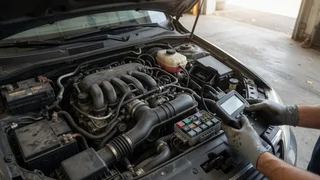
A scan tool is the cleanest way to reset the light on demand. Basic code readers, Bluetooth OBD-II adapters paired with a phone app, and professional scanners can all read and clear generic powertrain codes on a Malibu.
1) Park with the engine off and locate the 16-pin OBD-II port. On the Malibu it is under the dashboard on the driver's side, near the steering column. 2) Plug in the scan tool or adapter. 3) Turn the ignition to On (or press the start button without your foot on the brake), or start the engine if your tool's instructions call for it. 4) Read and record every stored and pending code, along with any freeze-frame data. Freeze-frame data is a snapshot of conditions at the moment the fault occurred. 5) Repair the cause the codes point to. 6) Use the tool's "Clear codes" or "Erase DTCs" function, then turn the ignition off. 7) Start the car and confirm that the light stays off. Then drive normally and watch whether it returns.
Many auto parts stores in the US will read codes at no charge. Store policies vary, and some locations will read codes but not clear them.
Method 3: Disconnecting the Battery
On many older vehicles, disconnecting the negative battery cable for a while erases stored codes and turns off the light. This is a blunt tool, and on newer Malibus it is less predictable. Some modules keep codes in non-volatile memory that survives a power loss. Removing power can also have side effects. It may clear the radio presets and the learned idle and fuel-trim values. On some model years it can affect power-window or start-stop calibration, and it may require relearn procedures. Models equipped with battery monitoring sensors may also need the new state recorded properly. If you use this method, disconnect the negative terminal first and reconnect it last. Expect the car to idle or shift a little differently until it relearns. A scan tool is generally the better choice.
Comparing the Reset Methods
Method | Tool needed | Confirms repair? | Main drawback; Repair and drive | None | Yes | Takes several drive cycles; Scan tool clear | Code reader or OBD-II adapter | Only after the light stays off | Resets readiness monitors; Battery disconnect | Basic hand tools | No | Inconsistent on newer models; erases learned settings
Readiness Monitors and Emissions Inspections
Any manual reset sets the car's readiness monitors back to "not ready." Readiness monitors are the internal self-tests for systems such as the catalytic converter, oxygen sensors and EVAP. In states with OBD-II-based emissions testing, a car with too many incomplete monitors can be rejected even if the light is off. Inspectors can also see that codes were recently cleared. After a reset, drive the car normally for several days, with a mix of city and highway driving, before the inspection. Many scan tools let you check readiness status yourself.
If the Light Comes Back
A returning light means the fault is still present or has recurred. Read the code again and compare it with the one you recorded earlier. Diagnose the system it points to rather than clearing it repeatedly. The same code number can have different common causes depending on the Malibu's generation and engine, so look up the code for your specific model year and powertrain. If the code involves misfires, fuel trim, or the transmission, or if you are unsure, a qualified technician with GM-capable diagnostic equipment can read manufacturer-specific data that generic readers may not show.
Bottom Line
To reset a Malibu's check engine light, read and record the code with an OBD-II tool, fix the cause, and then clear it with the tool or let it go out on its own over normal driving. Treat a battery disconnect as a last resort, not a fix. Never clear a flashing light without having the car diagnosed first.