How to Look Up Chevy Malibu Check Engine Codes
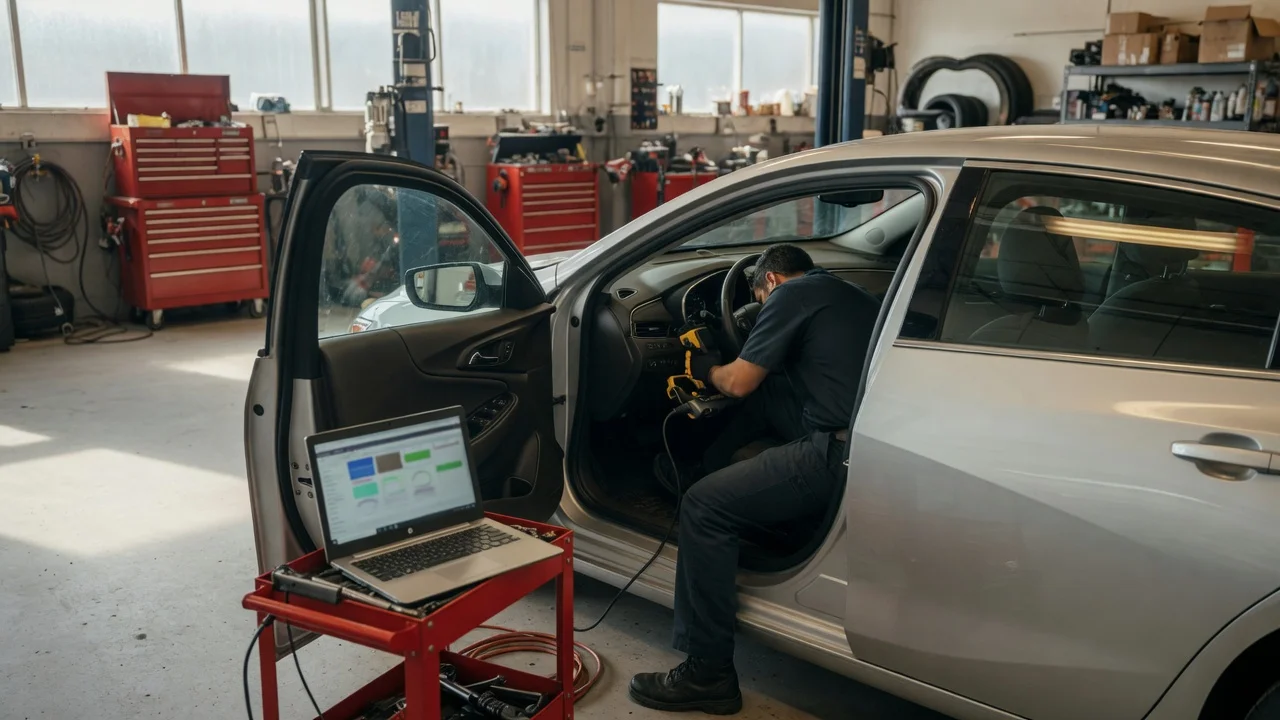
The short answer
To find out why the check engine light is on in a Chevrolet Malibu, connect an OBD-II scan tool to the car's diagnostic port and read the stored trouble codes. Every Malibu built since the nameplate returned for the 1997 model year uses the OBD-II system, which has been required on light-duty vehicles sold in the United States since the 1996 model year. Any OBD-II-compliant scanner can read the generic engine codes on these cars. Manufacturer-specific codes and deeper module data may require a scanner with GM coverage.
Reading a code tells you which system or sensor reported a fault. It does not by itself identify the failed part. The code is a starting point for diagnosis, not the final answer.
Scope: which Malibu models this applies to
This guide covers OBD-II-era Malibus, meaning the 1997 and later model years, across all engines and trims. Older Malibus from the original 1964 to 1983 run predate onboard diagnostic codes as described here, so the scanner method below does not apply to them. Code definitions and diagnostic steps for a specific fault can vary by generation and engine. For example, a four-cylinder, a V6 and a hybrid powertrain may report the same generic code for different underlying reasons. This article does not include generation-by-generation service data, so confirm repair procedures against service information for your exact model year and engine.
Ways to read the codes
Use your own OBD-II scanner: basic code readers plug into the port and display stored codes, and many can also clear them. Use a Bluetooth OBD-II adapter: a small dongle stays in the port and sends codes to a phone app. Feature coverage depends on the adapter and app. Ask an auto parts store: many retailers offer free code scans in the parking lot. Availability varies by store and location. Visit a repair shop or dealer: a professional scan tool can read manufacturer-specific codes, live sensor data and other control modules beyond the engine computer.
Step-by-step: reading a code yourself
1) Locate the diagnostic port, formally called the data link connector. It is a 16-pin, trapezoid-shaped socket. On most vehicles it sits under the dashboard on the driver's side, near the steering column. The exact position varies by Malibu generation, so check the owner's manual if you can't find it. 2) With the engine off, plug in the scanner. 3) Turn the ignition to the on position, or start the engine if the tool's instructions call for it. 4) Follow the scanner's prompts to read stored codes. If the tool offers them, note any pending codes and freeze frame data as well. 5) Write down every code exactly as shown before clearing anything.
How to read the code format
OBD-II trouble codes are five characters long, such as P0300. Each position carries meaning.
Position | Meaning | Examples; First character (letter) | System | P = powertrain (engine and transmission), B = body, C = chassis, U = network/communication; Second character (digit) | Code type | 0 = generic code defined by the industry standard; 1 = manufacturer-specific code; Third character | Subsystem | In powertrain codes, for example, 3 relates to ignition and misfire, and 4 to auxiliary emissions controls such as the catalytic converter and EVAP system; Last two characters | Specific fault | Identifies the particular circuit, sensor or condition
Generic codes beginning with P0 mean the same thing on a Malibu as on any other OBD-II vehicle. Codes beginning with P1 are defined by GM, so you need a GM-specific code reference or professional scan tool to interpret them reliably.
Examples of generic codes and their standard meanings
The codes below are standard generic definitions that apply to any OBD-II vehicle, including the Malibu. They are listed to show how codes read, not because they are documented as the most frequent Malibu faults. No Malibu-specific frequency data was available for this article.
P0300: random or multiple cylinder misfire detected. P0301 to P0306: misfire detected in a specific cylinder, where the last digit is the cylinder number. P0171: system too lean, bank 1, meaning the engine is detecting more air or less fuel than expected. P0420: catalyst system efficiency below threshold, bank 1. P0442: small leak detected in the evaporative emission (EVAP) system. P0455: large leak detected in the EVAP system. A loose or faulty fuel cap is one possible cause. P0128: coolant temperature below the thermostat regulating temperature.
What the light's behavior tells you
A steady check engine light indicates a fault that should be diagnosed soon but is not usually an emergency. A flashing light generally signals an active, severe misfire that can overheat and damage the catalytic converter. If the light flashes, reduce load and have the car checked promptly rather than continuing to drive normally. Warnings about oil pressure or overheating are separate and more urgent; follow the owner's manual guidance for those.
After you have the code
Research the code for your specific model year and engine, since likely causes differ between powertrains. Check simple items first where they are relevant, such as a fuel cap that isn't fully tightened for an EVAP code. Use freeze frame data, a snapshot of conditions when the fault was set, to see whether it happened cold, hot, idling or under load. Avoid replacing parts based on the code alone. A sensor code may point to wiring, a vacuum leak or another component rather than the sensor itself. Ask a dealer or check official recall lookup tools to see whether any open recalls, service campaigns or extended warranties cover the fault. This article does not list Malibu-specific bulletins.
A caution about clearing codes
Clearing codes turns off the light but does not fix the underlying problem. If the fault persists, the code will return. Clearing also resets the car's readiness monitors, the self-tests the computer runs on emissions systems. Until those monitors complete through normal driving, the car may not pass an OBD-based emissions inspection. Record the codes and freeze frame data before clearing, because that information is lost once the codes are erased.
Gaps in this guide
This guide explains how to retrieve and interpret check engine codes on OBD-II-era Malibus. It does not provide GM-specific code definitions, generation-specific port locations, known failure patterns for particular engines, or service bulletin details. For those, consult a GM service manual, a dealer, or a technician with access to factory service information.