How to Check Tire Tread Depth With a Penny
The Short Answer
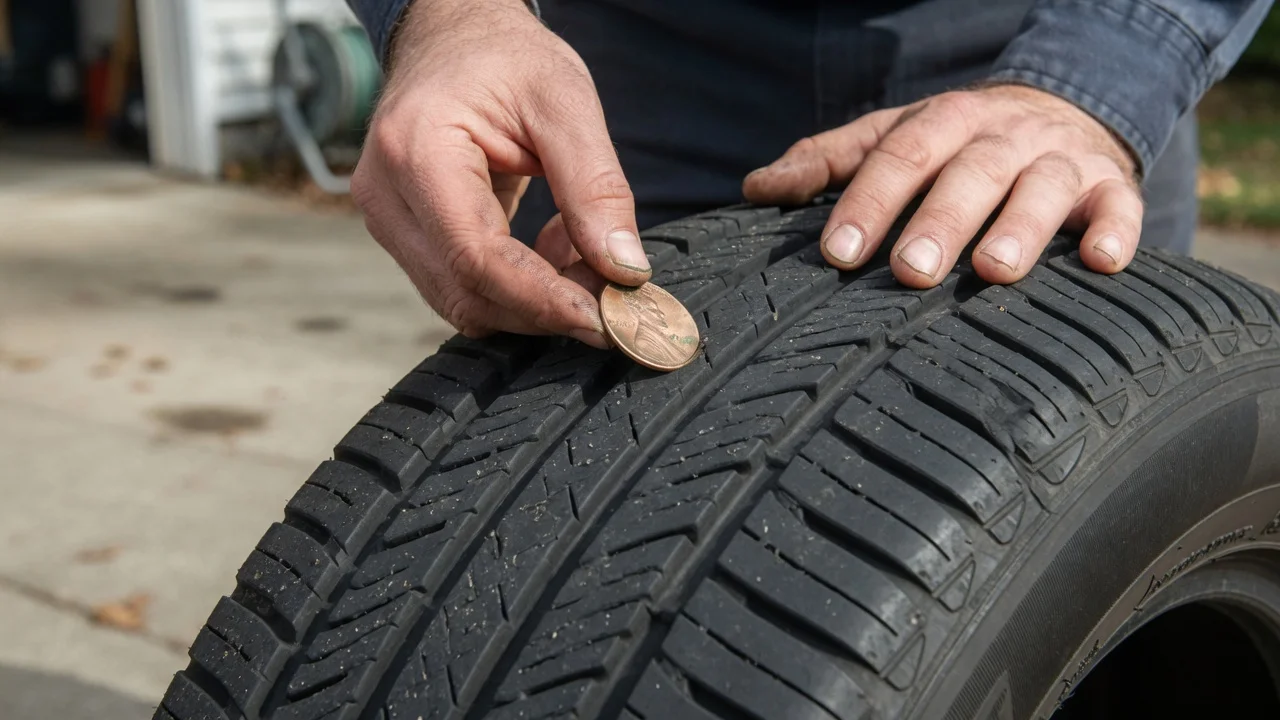
Place a U.S. penny into a tire groove with Abraham Lincoln's head pointing down into the tread. If you can see the top of Lincoln's head, the tread is worn to about 2/32 of an inch (roughly 1.6 mm) or less, and the tire should be replaced. If part of his head is hidden by the tread, the tire has more than 2/32 inch of depth at that spot.
Tread depth is the vertical distance from the top of the tread rubber to the bottom of its deepest grooves. Those grooves channel water, slush and snow away from the contact patch, so traction declines as they get shallower, especially on wet roads.
Two conditions change how you should read the result. First, the penny test is a pass-or-fail check at the 2/32-inch mark only. It does not tell you how much tread remains above that point. Second, 2/32 inch is the commonly cited minimum in most U.S. states, but legal limits vary by jurisdiction and vehicle type. The United Kingdom and many European countries, for example, use 1.6 mm across the central three-quarters of the tread. Check the rules that apply where you drive.
What You Need
A U.S. one-cent coin (penny); A level, safe place to park, away from traffic; Good lighting or a flashlight; Optional: a quarter for a rough check closer to 4/32 inch; Optional: a tread depth gauge for an actual measurement
Step-by-Step Penny Test
1) Park on level ground, shift into Park (or into gear for a manual), set the parking brake and turn off the engine. Do not perform the check on a road shoulder or anywhere you would be exposed to passing traffic. 2) If you can do so safely, turn the steering wheel fully to one side so the front tires' tread is easier to reach. 3) Look over the tire before inserting the coin. If you see exposed cords or steel belts, bulges, deep cuts or objects lodged in the tread, stop here. Do not drive on the tire. Have it inspected or replaced by a qualified tire technician. 4) Hold the penny with Lincoln's face toward you and his head pointing down. 5) Insert the penny into one of the main circumferential grooves, which are the long channels that run around the tire, rather than a small sipe or cross-groove. 6) Look at Lincoln's head. If the entire top of his head is visible, that spot is at or below 2/32 inch. If the tread covers part of his head, that spot is above 2/32 inch. 7) Repeat in the inner, center and outer grooves of the same tire. 8) Rotate the check around the tire. Move to several points around its circumference. Roll the vehicle forward slightly only if needed, then re-secure it before continuing. 9) Repeat the whole process on every tire, including a full-size spare if your vehicle has one.
How to Know You Are Done
The check is complete when you have tested multiple grooves at several points on each tire. Base your decision on the lowest reading, not the average. A tire that fails the penny test at any spot has worn to the replacement point there.
Most tires also have tread wear indicator bars. These are small raised rubber bridges at the bottom of the main grooves that sit at 2/32 inch. When the surrounding tread wears down flush with these bars, the tire has reached the same limit the penny test detects.
Reading Uneven Results
If readings differ noticeably across the tire or between tires, the wear pattern itself is a warning sign. Wear concentrated on the inner or outer edge, in the center only, or in a patchy pattern can point to incorrect inflation pressure, wheel misalignment, worn suspension parts or missed tire rotations. Diagnosing and correcting alignment and suspension problems is work for a qualified service shop. Replacing tires without fixing the cause can lead the new set to wear the same way.
Tread Depth Reference Points
Tread depth | What it generally means; About 10/32 to 11/32 in | Typical starting depth for many new passenger car tires; Deeper than 11/32 in | Common on some light truck, all-terrain and winter tires; 4/32 in (about 3.2 mm) | Wet-road traction is noticeably reduced; many tire organizations suggest planning for replacement; 2/32 in (about 1.6 mm) | Common legal minimum in most U.S. states; the penny test threshold
New tire tread depth depends on the tire's type, size and model. Look up the exact starting depth in the tire manufacturer's specifications if you want to judge how much of a tire's life has been used.
Limits of the Penny Test
The penny test only shows whether tread is above or below the minimum. A tire can pass and still have too little depth for confident braking on wet roads or for traction in snow.
For an earlier warning, some drivers use a quarter instead. With George Washington's head pointing down, the distance from the coin's edge to the top of his head is roughly 4/32 inch. If his whole head is visible, the tread is at or below that level.
For an actual number, use an inexpensive tread depth gauge, or ask a tire shop to measure during a rotation or service visit. A gauge is also the better tool for tracking wear over time, because coin tests are approximate and depend on how squarely the coin sits in the groove.
What to Do Next
If any tire fails the penny test, replace it before relying on it in wet or wintry conditions. Your vehicle's owner's manual or the tire manufacturer can tell you whether you need to replace tires in pairs or as a full set. This matters most on all-wheel-drive vehicles, where some manufacturers limit how much tread depth can differ between tires.
If your tires pass, repeat the check about once a month and before long trips. Keep tires inflated to the pressure listed on the placard in the driver's door jamb, and follow the rotation interval in your owner's manual.