Car Serial Number Lookup and VIN Decoding

The Short Answer: A Car's Serial Number Is Its VIN
When people ask for a car's serial number, they almost always mean the Vehicle Identification Number, or VIN. For cars and light trucks sold in the US from the 1981 model year onward, the VIN is a standardized 17-character code assigned by the manufacturer. No two vehicles produced within the standard's 30-year model-year cycle should share one. It identifies the maker, key vehicle attributes, the model year, the assembly plant and the individual vehicle's production sequence.
Two points can change the answer. First, "serial number" is sometimes used narrowly for the last six characters of the VIN, which make up the production sequence number rather than the full identifier. Second, components such as engines and transmissions can carry their own stamped serial or casting numbers that are separate from the VIN. Vehicles built before 1981 also used manufacturer-specific formats that were often shorter and do not follow the 17-character structure.
Where to Find the VIN
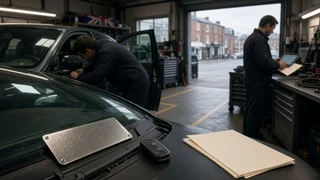
Dashboard, on the driver's side, visible through the base of the windshield; Driver's door jamb or door-edge label, often on the certification sticker; Vehicle title and registration documents; Insurance cards and policy paperwork; Service and repair records from dealers or shops
Exact label placement varies by manufacturer and model. Comparing the dashboard VIN, the door-jamb VIN and the VIN on the title is a basic check when buying a used vehicle, because a mismatch can point to a paperwork error, replaced panels or a more serious problem that warrants further investigation.
How the 17 Characters Are Organized
The VIN uses digits and capital letters, but never the letters I, O or Q, which are excluded to avoid confusion with 1 and 0. The code is divided into three main sections, with specific positions reserved for particular information.
Positions | Section | What it identifies; 1–3 | World Manufacturer Identifier (WMI) | Country or region of origin and the manufacturer; 4–8 | Vehicle Descriptor Section (VDS) | Manufacturer-defined attributes such as model line, body style, restraint system, engine type or series; 9 | Check digit | A calculated value used to detect transcription errors or invalid VINs (required for North American vehicles); 10 | Model year | A coded character for the model year, which may differ from the calendar year of manufacture; 11 | Plant code | The assembly plant, as defined by the manufacturer; 12–17 | Vehicle Identifier Section (VIS) sequence | The production sequence or serial number of the individual vehicle
Positions 4 through 8 and position 11 are defined by each manufacturer, so the same character can mean different things for different brands. Accurate decoding of those positions depends on the manufacturer's own coding for that model year. For manufacturers that build fewer than 1,000 vehicles a year, the third character is a 9 and positions 12 through 14 help identify the manufacturer, which shortens the production sequence portion.
The model-year character in position 10 follows a 30-year cycle that skips I, O, Q, U, Z and the digit 0. Because the cycle repeats, the same character can represent two model years 30 years apart, and other VIN details are used to tell them apart.
How a Car Serial Number Lookup Works
A VIN lookup generally does one of two things: it decodes the number into the vehicle's factory description, or it searches records tied to that number. These are different tasks, and it helps to know which one you need.
Decoding: The National Highway Traffic Safety Administration (NHTSA) offers a free decoder that translates a VIN into manufacturer-reported details such as make, model, model year, body class and engine information. Coverage of individual fields depends on what the manufacturer submitted. Safety recalls: NHTSA also provides a free VIN-based search for open safety recalls. Manufacturers and dealers can typically check recall status as well. Theft and total-loss records: The National Insurance Crime Bureau (NICB) offers a free VIN check for vehicles reported stolen and not recovered, or reported as salvage by participating insurers. Title history: The National Motor Vehicle Title Information System (NMVTIS) is a federal database of title, brand and salvage information. Reports are sold through approved third-party providers. Commercial history reports: Private services compile data such as reported accidents, ownership changes, odometer readings and service records. Their coverage depends on which sources report to them, so a clean report is not proof that nothing happened.
Prices, data coverage and report contents for paid services were not available in the evidence for this guide and vary by provider. Compare what each report actually includes before relying on it for a purchase decision.
Limits of VIN Decoding
A VIN describes the vehicle as built, not its current condition, aftermarket modifications or replaced parts. Trim, option packages and paint color are not always fully encoded. Manufacturer build records or window-sticker reproductions may be needed for those details. Free decoders may return incomplete fields for older, low-volume or imported vehicles. Pre-1981 vehicles need manufacturer- or era-specific references, because their serial numbers do not follow the modern standard. History reports reflect only incidents that were reported to their data sources.
Practical Next Steps
Start by reading the full 17-character VIN from the vehicle itself and confirming that it matches the title and registration. Run it through a free decoder to verify the make, model and model year. Check it for open recalls. For a used-vehicle purchase, add a theft and salvage check and a title-history report, then pair those results with an independent mechanical inspection, since no VIN-based record can confirm a vehicle's physical condition.