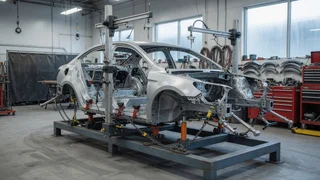
Car Body Repair Jig: What to Check Before You Buy

A car body repair jig holds a damaged vehicle's structure in a fixed, known position. It lets the technician measure the structure, pull it, and weld or bond it back to factory dimensions. Before buying one, check three things. First, the jig must cover the vehicles you actually repair. Second, you need reliable dimensional data for those vehicles. Third, it must suit the materials in modern structures, especially high-strength steel and aluminum. For most home DIYers, a full jig is hard to justify. Structural damage is usually better handled by a collision shop with suitable equipment. Simple measuring tools can cover basic checks at home.
What a Body Repair Jig Does
Collision damage can shift mounting points for the suspension, engine cradle, doors and outer panels. Sometimes the damage looks minor. A jig secures the vehicle at its structural anchoring points, usually the pinch welds along the rocker sills. It then gives a reference for checking control points against the manufacturer's dimensions. Control points are specific holes, bolts or flanges defined in the body dimension data.
Panel alignment is part of this work. Even door, hood and fender gaps can hide a structure that is out of specification underneath. Uneven gaps can also come from simple panel adjustment rather than structural damage. Measuring the structure is the only reliable way to tell these cases apart.
Main Types of Jig and Bench Systems
Type | How it works | Typical strengths | Typical limitations; Dedicated fixture (bracket) jig | Model-specific brackets bolt to the bench and locate exact structural points | Holds parts in position during welding and replacement; very direct confirmation of fit | Requires bracket sets per model; ongoing cost for new vehicles; Universal mechanical measuring jig | Adjustable pointers or gauges are set using published dimension data | Works across many vehicles without model-specific hardware | Slower setup; accuracy depends on careful technique; Bench with electronic measuring | Sensors, probes or targets compare measured points against a vehicle database | Fast measurement and documentation; useful for repair records | Software and data subscriptions; depends on database coverage; Frame rack or drive-on system with pulling towers | Vehicle is anchored on a platform and pulled with chains and towers | Strong pulling capability for heavy structural damage | Often needs a separate measuring system for verification
Many shops combine these. A rack or bench provides anchoring and pulling, and a measuring system or fixture set confirms the result. When comparing listings, check whether the measuring system is included or sold separately.
What to Check When Choosing a Jig
Vehicle coverage and dimensional data
A jig is only as useful as the data and fixtures behind it. Confirm that the system covers the makes, models and model years you expect to repair. Check coverage at the level of body style and platform, because one nameplate can have different structures across generations or markets. Ask how new models are added, how long that usually takes, and whether data updates or new bracket sets cost extra. For used equipment, find out whether the data is still supported and whether the license transfers to a new owner.
Substrate material and manufacturer repair requirements
Substrate material means the metal or composite the structure is made from. It affects which repair method is acceptable. Many current vehicles use advanced high-strength steels, aluminum or mixed materials. Some manufacturers limit sectioning, heating or straightening on certain parts, or require particular fixtures or anchoring methods. If you repair a brand with published repair procedures or a certification program, check its equipment requirements before buying. A general-purpose system may not satisfy them.
Aluminum repair usually calls for isolating tools and clamps from steel contamination. Steel particles on aluminum can promote galvanic corrosion. Check whether the jig offers suitable clamps or accessories if aluminum work is likely.
Anchoring and clamping
Look at how the clamps grip the vehicle and which pinch weld designs they fit. Some vehicles have unusual sill shapes, or manufacturer-specified anchoring points away from the pinch welds, and these may need adapters. Clamps that bite into the flange can damage factory coatings. Plan to restore that protection after the repair.
Pulling capacity and setup
If the system includes pulling towers, consider how many pulls can run at once and how freely the towers reposition around the vehicle. Also look at how the vehicle is loaded, whether by ramps, a lift or a tilt function. Manufacturers state rated capacities. Compare those figures against the vehicles you work on, not against a generic class of car.
Space, floor and utilities
Check the footprint, including the working space around the bench and towers. Confirm any floor anchoring requirements and whether the system needs compressed air or electrical supply. Some systems require anchors set into a concrete floor of a suitable condition. Verify this with the supplier before purchase rather than after delivery.
Measurement documentation
Insurers and customers increasingly expect pre-repair and post-repair measurement records. Electronic systems usually generate printouts or digital reports. Mechanical and fixture systems may need manual recording. If documentation matters for your work, find out what the system can produce.
Training, support and parts
Setup technique has a large effect on accuracy, especially with universal mechanical systems. Ask what training is included and how quickly technical support responds. Check whether replacement clamps, chains and fixtures are still available. With older or discontinued equipment, missing fixtures or unsupported software can make an otherwise solid bench far less useful.
Buying Used Equipment
Inspect the bench surface and rails for bending, cracks or weld repairs. Check that all clamps, adapters, chains and towers are present and work smoothly. Confirm which fixture or bracket sets are included and which vehicles they cover. For electronic systems, check software version, data subscription status and license transferability. Ask whether the system can be calibrated or verified, and who can do it. Factor in transport, installation and any floor work needed.
After the Structure Is Back in Specification
The jig's job ends once the structure measures correctly. The repair does not. Welding, straightening and clamping can remove factory coatings from inside sections and flanges. Corrosion protection has to be restored. This normally means proper surface preparation, weld-through or cavity protection products where the procedure calls for them, and seam sealers. Coating compatibility matters too. Primers, sealers and corrosion inhibitors should suit the substrate and the topcoat system that follows. The manufacturer's repair procedure and the coating supplier's guidance are the references to follow.
Is a Jig the Right Purchase for You?
A professional collision shop doing regular structural repairs should weigh the following. Choose a dedicated fixture system for frequent part replacement on a narrower range of vehicles. Choose a universal or electronic measuring system for broad coverage. Pair either one with a rack or bench that matches the pulling work involved. A restoration shop working on older body-on-frame or classic vehicles may find a universal mechanical system practical, provided dimension data exists for those vehicles.
For a home DIYer, a full jig is usually more equipment than one repair warrants. Sensible next steps are a tram gauge and published body dimensions for basic diagonal checks. If those checks show structural damage, take the vehicle to a shop that can measure and repair it to the manufacturer's procedure. Structural geometry affects how the vehicle handles and how it protects occupants in a later collision.