Can-Am Outlander 570 Coolant Type: What to Use and Why

The Can-Am Outlander 570 uses a liquid-cooled Rotax V-twin, so choosing the right coolant protects the engine against overheating, freezing and internal corrosion. The short answer: use an ethylene glycol-based coolant made for aluminum engines, mixed about 50/50 with distilled water. Can-Am's own XPS-branded extended-life premixed coolant is the simplest way to meet that requirement. Recommendations can change between model years, so the owner's manual for your machine overrides any general guidance, including this article's.
The Short Answer
For most Outlander 570 owners, these points cover the coolant specification:
Base: ethylene glycol antifreeze, not plain water. Compatibility: formulated for aluminum engines and radiators, with corrosion inhibitors suited to aluminum. Concentration: roughly half coolant and half distilled water, unless you buy a ready-to-use premix. Water: distilled or deionized only, because tap water leaves minerals and scale in the cooling circuit. Consistency: do not mix different coolant chemistries. If you switch types, drain and flush the system first.
Many riders choose BRP's premix because it removes the guesswork about chemistry and ratio. It is not the only option that can work, but anything else should match the requirements above and the guidance in your manual.
Why Coolant Choice Matters on This Engine
Coolant flows through the cooling circuit: the passages in the engine, the hoses, the radiator, and the thermostat that controls when coolant goes to the radiator. On top of setting the freezing and boiling points, the coolant carries additives that keep aluminum, seals and the water pump from corroding. A coolant with the wrong inhibitor package, or one that has broken down with age, lets corrosion and deposits build up inside the passages. Over time that reduces heat transfer and can block the radiator.
ATVs make this harder than a road car does. They often run slowly in heat with mud packed into the radiator fins, and they can sit unused for months in freezing weather. A correctly mixed, aluminum-compatible coolant protects the engine in both situations.
Comparing Your Options
Most buying decisions come down to a few choices. The table compares them by compatibility, convenience and risk. It does not cover price, which depends on the retailer and region.
Option | Strengths | Drawbacks | When it makes sense; BRP/Can-Am XPS extended-life premix | Matches the maker's recommendation; ready to pour; no ratio errors | Usually costs more per volume; mainly sold at dealers | Routine top-ups and full refills when you want a sure match; Aluminum-safe ethylene glycol premix (other brands) | Easy to find; ready to pour | You must confirm aluminum compatibility and avoid mixing it with a different chemistry | Full drain-and-refill when BRP coolant is unavailable; Aluminum-safe ethylene glycol concentrate | Flexible; cheaper per finished volume | Must be mixed accurately with distilled water | Owners who are comfortable measuring and mixing; Propylene glycol coolant | Less toxic to pets and wildlife | Different heat-transfer and freeze characteristics; not what the maker generally specifies | Only if your manual permits it; Plain water | Available anywhere | No freeze protection; poor corrosion protection; lower boiling point | Emergencies only, followed by a proper flush and refill
In practice, you can top up with BRP premix without worrying about compatibility. If you are already draining the system completely, a quality aluminum-safe ethylene glycol coolant at the right concentration is a reasonable alternative. What causes trouble is mixing chemistries that don't belong together, such as adding a generic universal coolant to a different factory fill. That can weaken the additives or cause sludge to form.
Getting the Coolant Concentration Right
A mix of about 50 percent glycol and 50 percent distilled water is the usual target. It gives a good balance of freeze protection, boil-over protection and heat transfer. More glycol is not automatically better. Above a certain point, extra glycol carries heat away less effectively and can even reduce freeze protection. If you mix concentrate yourself, measure it instead of estimating, and check the result with an antifreeze hydrometer or refractometer if you have one.
Checking and Topping Up
Check the level only when the engine is cold. The cooling system is under pressure when hot, and opening the pressure cap can spray scalding coolant. Use the coolant reservoir level marks for routine checks. Fill to the indicated range, not above it. If you often need to add coolant, look for leaks at hoses, clamps, the water pump area and the radiator. Also check whether the pressure cap is sealing properly. Keep radiator fins clear of mud and debris, since airflow matters as much as coolant quality.
Refilling and Removing Air Pockets
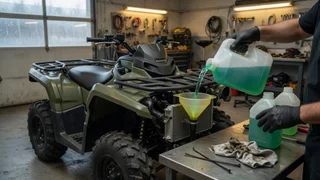
After a drain and refill, air can get trapped in the engine and radiator. Air pockets stop coolant from reaching hot spots and can cause local overheating or erratic temperature readings, even when the reservoir looks full. Fill slowly, use any bleed points described in your manual, and run the engine with the cap handled as the manual instructs. Let the thermostat open so coolant circulates and pushes out trapped air. Recheck and top up once the engine has fully cooled, and check again after the next ride.
When to Replace the Coolant
Coolant wears out even if the level never drops, because its additives get used up. Follow the replacement interval in the maintenance schedule for your model year. Replace it sooner if the coolant looks discolored, rusty, oily or cloudy, or if the machine has overheated. Dispose of old coolant through a local recycling or hazardous-waste collection point. It is toxic and tastes sweet to animals.
Bottom Line
For the Can-Am Outlander 570, use an aluminum-compatible ethylene glycol coolant at about a 50/50 mix with distilled water. BRP's XPS premix is the easiest choice for top-ups and refills. If you use another brand, do so at a full drain-and-refill, check that it suits aluminum, and avoid mixing chemistries. The owner's manual for your specific model year has the final say on specification, capacity and service intervals.