Choose Can-Am Outlander 570 coolant
The short answer
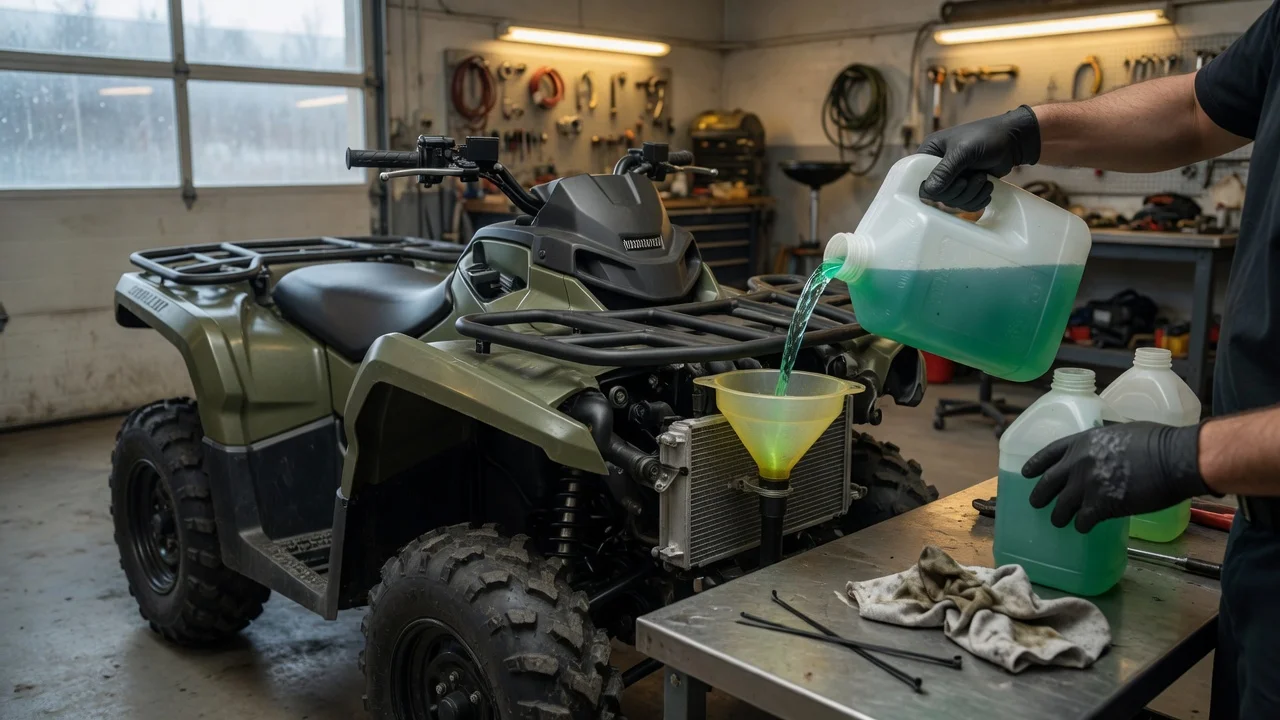
The Can-Am Outlander 570 uses a liquid-cooled Rotax engine with aluminum parts. It needs an ethylene glycol coolant made for aluminum engines. BRP owner's documentation generally names two acceptable choices. The first is BRP's own premixed coolant. The second is a 50/50 blend of silicate-free ethylene glycol antifreeze and distilled or demineralized water. Silicate-free means the antifreeze is made without silicate corrosion inhibitors.
This article draws on no supplied documents for any specific model year. It does not list part numbers, capacities or service intervals, because those can differ by model year, trim and market. Check them in the owner's manual or with a BRP dealer before you buy.
What to confirm for your machine
Model year and market: confirm the coolant BRP specifies for your exact Outlander 570. Recommendations and part numbers can change over production years. Coolant chemistry: the coolant should be ethylene glycol based, made for aluminum engines and silicate-free. Avoid products that do not state they are suitable for aluminum. Mix ratio: if the coolant is not premixed, the usual target is 50 percent antifreeze and 50 percent distilled or demineralized water. Check your manual for any colder-climate guidance. Water quality: use distilled or demineralized water. Minerals in tap water can leave deposits in the cooling system. Capacity and bleeding: get the system capacity and the air-bleeding procedure from your service documentation. Trapped air can cause overheating even when the coolant is correct.
BRP premix or a generic 50/50 mix?
Most owners choose between BRP's ready-to-use coolant and a compatible antifreeze they mix with water themselves. The comparison below covers the practical trade-offs. It uses no measured performance data or prices, because none were supplied.
Criterion | BRP premixed coolant | Silicate-free ethylene glycol, mixed 50/50; Fit with manufacturer guidance | Named directly by BRP, so there is no guesswork | Allowed when it meets the stated chemistry; Mixing | None, ready to pour | You mix it with distilled or demineralized water; Risk of error | Low | Higher if you pick the wrong chemistry or ratio; Availability | Mainly through BRP dealers and parts suppliers | Usually easier to find at general auto parts retailers; Best suited to | Warranty-conscious owners and anyone who wants the simplest route | Owners who are comfortable checking labels and mixing accurately
Editorial judgment: choose BRP's premix if the machine is under warranty or you want to avoid compatibility questions. A correctly specified and correctly mixed generic coolant is a reasonable alternative, as long as it meets the documented requirements.
Mixing coolant types
Coolants use different inhibitor packages, which are the additives that protect the system against corrosion. Mixing dissimilar products can make that protection less predictable. If you are unsure what is already in the system, drain and refill it rather than topping up with something else. Follow the drain, refill and bleeding steps in the service documentation for your model year.
Gaps in this guide
This guide does not cover exact BRP part numbers, coolant capacity, replacement intervals, temperature protection ratings or differences between Outlander 570 model years. Get those details from the owner's manual, the service manual or a BRP dealer for your specific vehicle.