Buy and replace brake pads and rotors as a set
The short answer
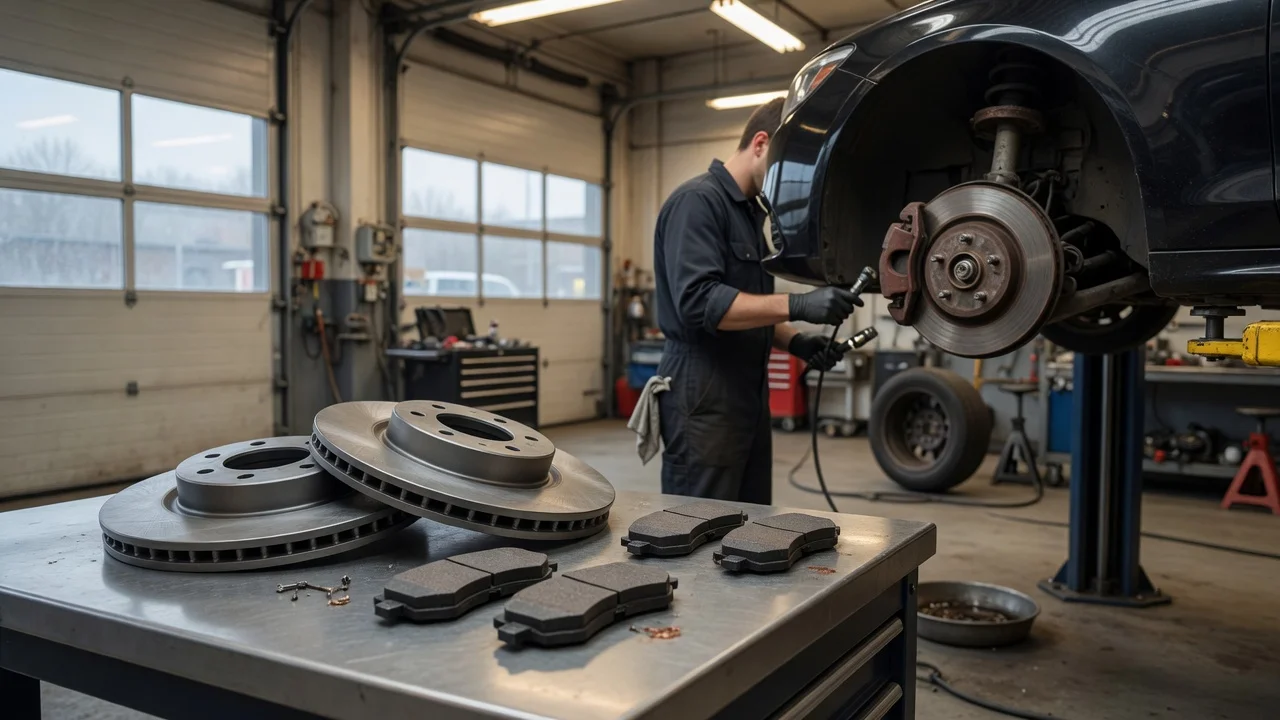
Replacing brake pads and rotors together is usually the simplest and most predictable choice, especially if the rotors are worn, grooved, cracked, discolored from heat, or causing a vibration in the brake pedal or steering wheel. New pads bed in best against a fresh, flat rotor surface, and a matched kit removes most of the guesswork about fitment.
There is one condition that changes this answer. If the rotors are still above the minimum thickness specified for your vehicle and their surfaces are smooth and true, replacing the pads alone can be acceptable. Some rotors can also be resurfaced (machined flat on a brake lathe) instead of replaced, but only if enough material remains after machining to stay above that minimum. Whether that applies depends on your specific rotors and the measurement, not on a general rule.
How to tell whether your rotors need replacing
The rotor is the metal disc the pads clamp against to slow the wheel. It wears down gradually with every stop. Most rotors have a minimum thickness value cast or stamped on them, often marked as a discard or minimum thickness figure, and the same specification appears in the vehicle's service information. A shop or a careful home mechanic measures the rotor with a micrometer and compares the reading to that value.
Thickness at or below the stated minimum, or close enough that machining would take it below; Deep grooves or scoring, often caused by pads worn down to their metal backing; Cracks, particularly around the edges or cooling vanes; Pulsation or shudder under braking, which often points to uneven rotor thickness; Blue or dark heat spots, or a raised lip at the outer edge of the friction surface
If any of these are present, buying the pads and rotors as a set is the sensible route. If none are present and the rotors measure within specification, pads alone may be enough.
Replace by axle, not by wheel
Brakes should be serviced in axle pairs: both front wheels together, or both rear wheels together. Replacing parts on only one side can cause uneven braking and pulling. Front and rear brakes typically use different pads and rotors, and many kits are sold for a single axle, so a front pad and rotor kit will not cover the rear and vice versa. Front brakes generally do more of the stopping work and often wear sooner, but check the condition of each axle rather than assuming.
Choosing a brake pad and rotor kit that fits
A pad and rotor kit pairs pads and rotors intended for the same vehicle and axle, which reduces the chance of buying mismatched parts. Fitment, however, can vary within a single model. The same model in the same year may use different rotor diameters or caliper designs depending on trim, engine, drivetrain, towing or performance packages, and market. Before buying from any retailer, online or in person, confirm the following.
Model year, make and model; Trim level and engine or powertrain; Drivetrain, such as front-wheel drive, rear-wheel drive or all-wheel drive; Any brake, performance, heavy-duty or towing package; Which axle you are replacing: front or rear; The vehicle identification number (VIN), if the seller offers a VIN-based fitment check
If the listing shows more than one possible part for your vehicle, compare the old rotor's diameter or the part number on your existing components before ordering. When fitment is still unclear, a dealer parts counter can look up the original part for your VIN.
What "best" means for pads and rotors
There is no single best brake pad and rotor combination for every vehicle. The right choice depends on how the vehicle is used. No test results or product rankings were supplied for this article, so the comparison below describes common trade-offs between pad types rather than specific brands.
Pad type | Typical strengths | Typical trade-offs; Ceramic | Quiet operation, low visible dust, smooth feel for daily driving | Often costs more; may be less suited to sustained heavy loads on some vehicles; Semi-metallic | Strong heat tolerance, suited to towing, heavy vehicles or spirited driving | Can be noisier, produce more dust and wear rotors faster; Organic (non-asbestos organic) | Soft, quiet, gentle on rotors | Tends to wear faster and fade sooner under heat
For rotors, the main choice is usually between plain-faced rotors and drilled or slotted designs. Plain rotors match the original design on most everyday vehicles. Drilled or slotted rotors are marketed for heat and gas management, but they are not automatically an upgrade for ordinary driving. Many rotors also come with a protective coating that limits rust on non-contact surfaces. A practical starting point is to match or exceed the original equipment type for your vehicle and choose the pad compound that fits your driving: commuting, towing, mountainous roads or performance use.
What affects brake pad and rotor replacement cost
No pricing data was supplied, so this article does not quote figures. Prices vary by vehicle, region, retailer and part quality, and should be checked directly with sellers or shops. The main factors are:
Vehicle type: larger, heavier or performance-oriented vehicles often use larger and more expensive components; Part grade: economy, original-equipment-equivalent and premium parts differ in price; Pad compound and rotor design, such as coated, drilled or slotted rotors; Number of axles serviced; Labor rates if a shop does the work; Additional parts found during inspection, such as calipers, slide pins, hardware or brake fluid; Whether the rotors can be resurfaced rather than replaced, where that option is offered
When comparing quotes, ask whether the price covers one axle or both, whether new hardware is included, and whether the rotors are being replaced or resurfaced.
What else to check during the job
Replacing pads and rotors is a good moment to inspect the rest of the system. Caliper slide pins should move freely and be lubricated with a brake-specific grease. Abutment clips and anti-rattle hardware are often included in kits and are worth replacing. Inspect brake hoses for cracks or swelling, and check the brake fluid condition against the service interval in your owner's manual. After installation, new pads and rotors usually need a bedding-in procedure, a series of controlled stops that transfers an even layer of pad material onto the rotor. Follow the pad manufacturer's instructions for this step.
Brakes are safety-critical. If you are not confident measuring rotors, torquing wheel and caliper fasteners to specification, or bleeding the system, have the work done or checked by a qualified technician.
Next step
Have the rotors measured and inspected, or check them yourself against the minimum thickness value for your vehicle. If they are worn, damaged or causing vibration, buy a matched pad and rotor kit for the correct axle after confirming fitment by year, trim, powertrain and brake package. If they are within specification and in good condition, new pads alone may be a reasonable, lower-cost option.