Brake Pad, Rotor and Caliper Replacement Cost: Understanding a Full Quote
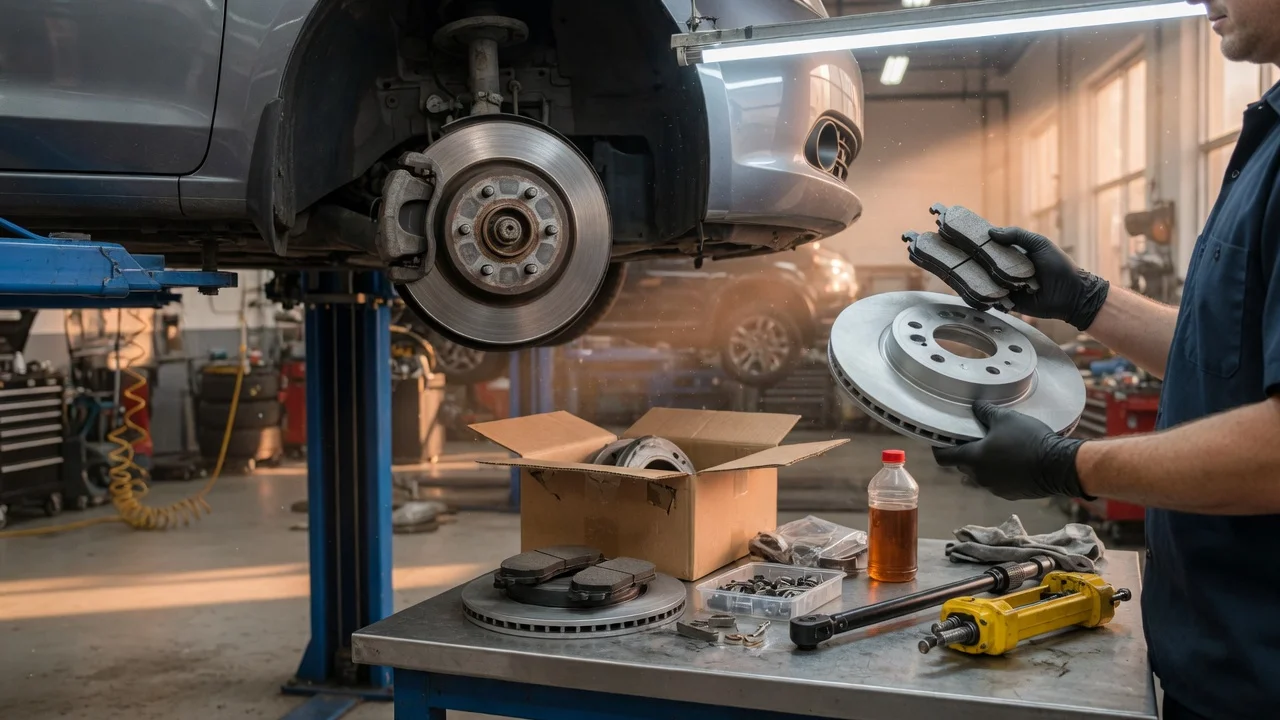
What a full brake job quote actually answers
A full quote for brake pads, rotors, and calipers is a combined parts-and-labor price for restoring one or more corners of the braking system, not a single nationwide number. The amount you pay depends on which axle is being serviced, how many calipers are replaced, the vehicle’s make, model year, trim, and powertrain, the grade of parts, and whether related hardware, fluid, or seized fasteners are included. Without those details, any figure is only a starting range, not a bid you can rely on.
Ask for a written estimate that names the axle (front, rear, or both), lists pads, rotors, and each caliper as separate lines, and states whether the price is for one side or the pair. Calipers are often quoted per side; pads and rotors are usually quoted per axle. If the shop cannot yet confirm whether a caliper is seized, leaking, or simply due for refresh, the quote should say so and separate the confirmed work from optional or inspection-dependent items.
What belongs on a complete quote
A useful quote itemizes more than three part names. Pads create friction against the rotor. The rotor is the metal disc the pad clamps. The caliper is the hydraulic clamp that squeezes the pads. Replacing all three on an axle is a common “full brake job,” but shops still bill the pieces separately because each part has its own part number, warranty, and labor time.
Parts: friction pads (often an axle set), rotors (usually two per axle), and each caliper (left and right priced independently, new or remanufactured). Hardware and consumables: abutment clips, slide-pin boots, shims, anti-rattle springs, caliper slide grease, and new crush washers or banjo-bolt seals if a hydraulic line is opened. Brake fluid: bleed volume for that axle or a full-system flush if fluid is old, contaminated, or mixed. Labor: pad and rotor R&R, caliper R&R, hydraulic bleed, parking-brake adjustment on some rear designs, and electronic parking-brake (EPB) retract or recalibration when the vehicle requires a scan tool. Taxes, shop supplies, environmental fees, and alignment or road-test time if those are charged separately.
If a line is missing, treat the total as incomplete. A “pads and rotors” price that later adds two calipers, fluid, and EPB labor is a different job. A “caliper” price that omits the matching pad set and a resurface-or-replace decision on the rotor is also incomplete, because a new or reman caliper still needs a true, clean friction surface and fresh pads to seal and wear evenly.
Conditions that change the price
Vehicle specification is the first material condition. Front and rear brakes often use different pad compounds, rotor diameters, and caliper designs. Performance, towing, hybrid, and heavy-duty packages can use larger rotors, multi-piston calipers, or unique pad shapes that do not interchange with the base trim. Model year changes, facelifts, and market-specific brakes (for example different rotor hats or parking-brake types) can split a “same model” search into incompatible parts. If the year, market, trim, and powertrain are not confirmed, compatibility and price both remain unresolved.
Scope is the second condition. Replacing pads and rotors on one axle is a different job from replacing both calipers on that axle, and both of those differ from a four-wheel job. Technicians often recommend replacing calipers in pairs on the same axle so clamping force stays even. A single leaking or seized caliper can still be replaced alone, but the quote should explain the trade-off: lower parts cost now versus a second visit if the opposite side fails soon after.
Part grade is the third condition. Economy, OEM-equivalent, and performance pads differ in dust, noise, and fade resistance. Rotors may be blank, coated, drilled, or slotted. Calipers may be new or remanufactured, loaded (pads already installed) or unloaded. Loaded calipers can look cheaper until you notice that rotors, fluid, and labor are still extra. Coatings, hardware kits, and lifetime-pad promotions change the parts subtotal without changing the labor book time.
Labor variables are the fourth condition. Rusted fasteners, seized slide pins, broken bleeder screws, collapsed hoses, and stuck parking-brake mechanisms add time that a clean book estimate does not include. Vehicles with electronic parking brakes need a scan-tool procedure to retract the pistons; skipping that step risks damage and is not interchangeable with a simple C-clamp retract. Some rear disc designs use an integrated drum-in-hat parking brake that needs adjustment after the rotor comes off. Hybrid and some electronic-stability systems may require a specific bleed sequence. Those extras belong on the quote as either included operations or “if found” allowances.
How to read parts versus labor
Parts are the physical components and kits. Labor is the time to remove wheels, compress or electronically retract pistons, swap pads and rotors, unbolt and replace calipers, open the hydraulic system, bleed air, torque fasteners to spec, and verify pedal feel. A low parts total with high labor can still be a fair quote on a rust-belt vehicle or a tight engine-bay layout. A high parts total with modest labor can be fair when you choose coated rotors, premium pads, or new (not reman) calipers.
Quote line | What to confirm | Why it matters; Pads | Axle, compound, whether a hardware kit is included | Wrong-axle pads will not fit; cheap pads can noise or fade; missing clips cause rattle or uneven wear; Rotors | Replace versus machine, coated or plain, one axle or both | Machining is only viable if thickness and runout remain in spec; mismatched rotors affect pedal feel; Calipers | New or reman, loaded or unloaded, left and/or right, bracket included | Brackets, slides, and pistons fail differently; a loaded unit may duplicate the pad charge; Fluid and bleed | Axle bleed versus system flush, fluid spec | Opened hydraulics must be bled; the wrong spec can damage seals or ABS units; EPB / scan tool | Retract, relearn, or none | Required on many late-model rear brakes; omitting it understates labor; Taxes and fees | Shop supplies, environmental, disposal | These can move a “parts and labor” number after you approve the job
Questions that turn a range into a decision
Before you approve work, match the quote to the inspection. Ask which symptoms or measurements justified each caliper: a seized piston, a leaking boot, a frozen slide, a collapsed hose, or uneven pad wear. Pads and rotors are often planned maintenance once friction material or rotor thickness is at or below spec. Calipers are condition-based. Paying for all three on both axles is appropriate when inspection supports it; it is optional when only one axle is worn and the opposite calipers still slide and seal.
Which axle, and is the price for one side or the pair? Are both calipers required, or is one confirmed failed and the other a recommendation? Are rotors being replaced or machined, and do they still meet minimum thickness? Is brake fluid a top-off, an axle bleed, or a full flush, and which specification is used? Does the vehicle need an electronic parking-brake retract or a scan-tool calibration, and is that labor in the total? What is warrantied: pads only, rotors, calipers, or the assembly as a system, and is it parts, labor, or both?
Compare quotes only after those answers match. A cheaper ticket that omits calipers, fluid, hardware, and EPB labor is not the same job as a higher ticket that includes them. A mobile or parts-store install price may exclude rusted hardware, seized bleeders, and diagnostic time that a full-service shop builds in. Independent shops, dealers, and specialists can all be valid choices; the comparable document is the line-item scope, not the headline total.
What this article cannot pin down
No specific dollar amounts, shop rates, or part-catalog prices are included here because those figures vary by region, vehicle, part brand, and current parts availability, and they were not supplied as verified data. Minimum rotor thickness, pad wear limits, fluid specifications, and torque values are also vehicle-specific and belong on the service information for that VIN, not in a generic cost guide. If your estimate lacks the axle, the caliper count, the rotor decision, and the fluid/EPB lines, ask the shop to complete those items before you treat the total as a full replacement cost.
A practical next step
Use the written quote as a checklist: confirmed diagnosis, named axle, pads, rotors, each caliper, hardware, fluid, labor operations, and any scan-tool work. Approve the job when those lines match the inspection and your budget for that axle. If a caliper is only recommended “while we are in there,” you can stage the work—pads and rotors now, calipers later—provided the current calipers still move freely, do not leak, and leave even pad wear. If a piston is seized or a seal is leaking, replacing that caliper with the friction parts on the same visit is the safer sequence, because a sticking clamp will destroy new pads and rotors quickly.