BMW M3 Models by Year: A Generation-by-Generation Guide
The short answer
The BMW M3 has been built across six main generations, each identified by an internal chassis code: E30, E36, E46, the E90/E92/E93 family, F80, and G80 (with the related G81 Touring). Knowing the chassis code is the most reliable way to separate one M3 from another, because body styles, engine layouts and market availability changed with each generation.
One qualification matters for US readers. A generation's production span is not the same as the model years sold in the United States. Some generations reached the US later than other markets, some US cars used different engines from European versions, and a car built late in a calendar year is often registered as the following model year. The dates below describe broad generation eras and should be treated as a starting point, not a substitute for checking the individual vehicle.
A note on the dates in this guide
The research supplied for this article did not include confirmed dates, specifications or prices. The generation sequence, chassis codes and approximate eras below reflect widely documented public information. Power figures, exact US model-year boundaries, special editions and pricing are left out because they were not verified for this guide. Confirm those details with a VIN decoder, the vehicle's documentation or a BMW dealer before buying.
BMW M3 generations at a glance
Generation (chassis code) | Approximate production era | Body styles | Engine layout; First (E30) | Mid-1980s to early 1990s | Coupe; convertible in some markets | Naturally aspirated four-cylinder; Second (E36) | Early to late 1990s | Coupe, sedan, convertible | Naturally aspirated inline-six; Third (E46) | 2000 to 2006 | Coupe, convertible | Naturally aspirated inline-six; Fourth (E90 sedan, E92 coupe, E93 convertible) | 2007 to 2013 | Sedan, coupe, convertible | Naturally aspirated V8; Fifth (F80) | 2014 to 2018 | Sedan only | Twin-turbocharged inline-six; Sixth (G80 sedan, G81 Touring) | 2020 onward | Sedan; Touring wagon in some markets | Twin-turbocharged inline-six
How each generation differs
E30: the original
The first M3 was based on the E30 3 Series and developed with motorsport homologation in mind. Homologation means building a minimum number of road cars so a model qualifies for a racing series. It used a four-cylinder engine rather than a six, which sets it apart from every generation that followed until turbocharging arrived.
E36: broader range, market differences
The E36 expanded the M3 beyond a coupe to include sedan and convertible versions and moved to an inline-six engine. This generation is where US and European specifications diverged noticeably: US-market cars used a different version of the six-cylinder engine than European cars. Buyers comparing E36 listings should confirm which market a car was built for.
E46: inline-six refined
The E46 kept a naturally aspirated inline-six and was offered as a coupe and convertible, without a sedan. It also offered an automated manual gearbox option alongside the conventional manual in many markets.
E90, E92 and E93: the V8 era
This is the only M3 generation with a V8 engine. It was sold in three body styles, each with its own chassis code: E90 for the sedan, E92 for the coupe and E93 for the convertible. A dual-clutch transmission became available alongside the manual.
F80: sedan only, turbocharged
With the F80, BMW moved the two-door models to a separate M4 nameplate, leaving the M3 as a four-door sedan. The engine returned to an inline-six, now twin-turbocharged. If you are searching for a coupe or convertible from this period, look under M4 rather than M3.
G80 and G81: current generation
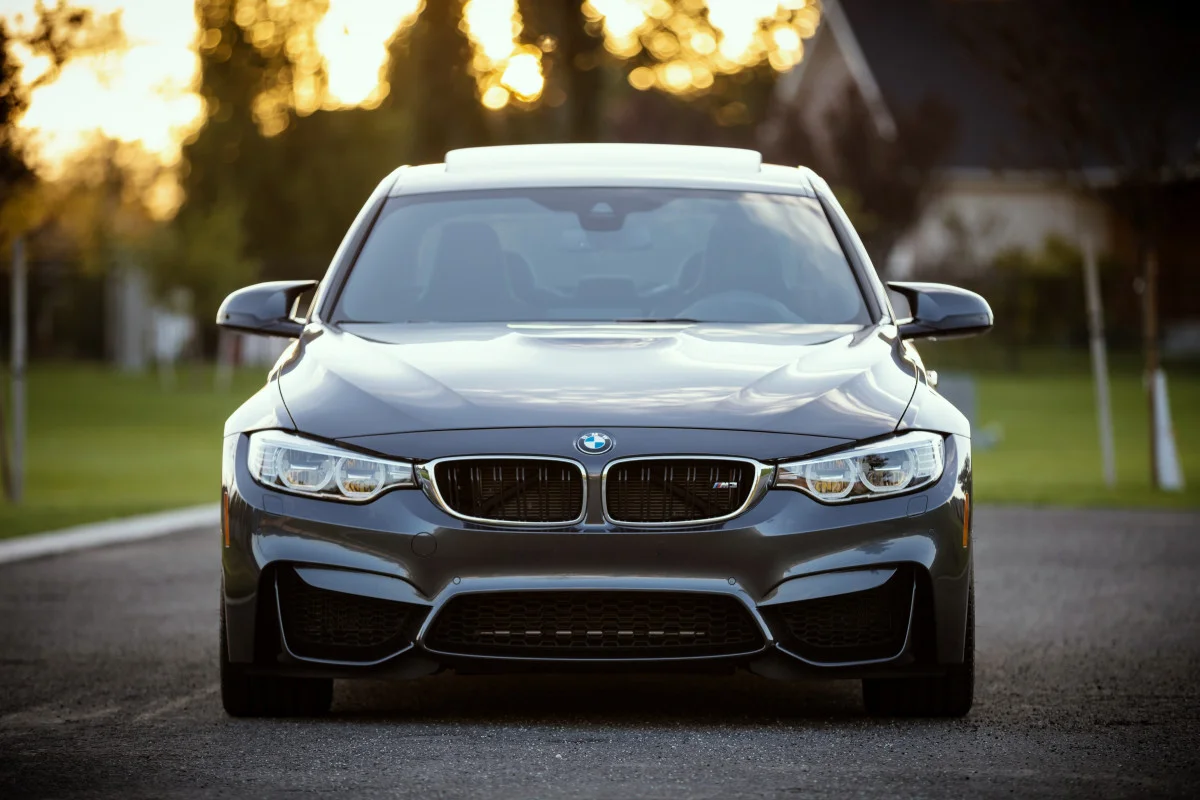
The current M3 continues with a twin-turbocharged inline-six and is visually distinguished by its large vertical front grille. All-wheel drive became available on the M3 for the first time in this generation. A Touring wagon version, coded G81, was added, but it has not been part of the US lineup, so US shoppers will generally encounter only the G80 sedan.
How to confirm a specific M3's model year
Generation eras overlap with model-year changes, so the individual car is the final authority. These checks apply to US-market vehicles:
VIN, 10th character: on vehicles sold in the US, the 10th character of the 17-character Vehicle Identification Number encodes the model year. Build date label: the certification label, usually on the driver's door jamb, shows the month and year of manufacture. This can differ from the model year. VIN decoding: a full decode identifies the model, body style and market, which helps separate US-specification cars from imports. Service and ownership records: these can confirm whether a car has original equipment for its stated year and market.
What this guide does not cover
Exact US model-year start and end points for each generation, mid-cycle updates, limited editions, Competition packages, engine outputs, performance figures and market values were not part of the verified research for this article. Each of these varies by year, market and trim, so check them against model-specific documentation before using them to compare or price a car.