Chassis Codes: How to Identify a Vehicle Platform
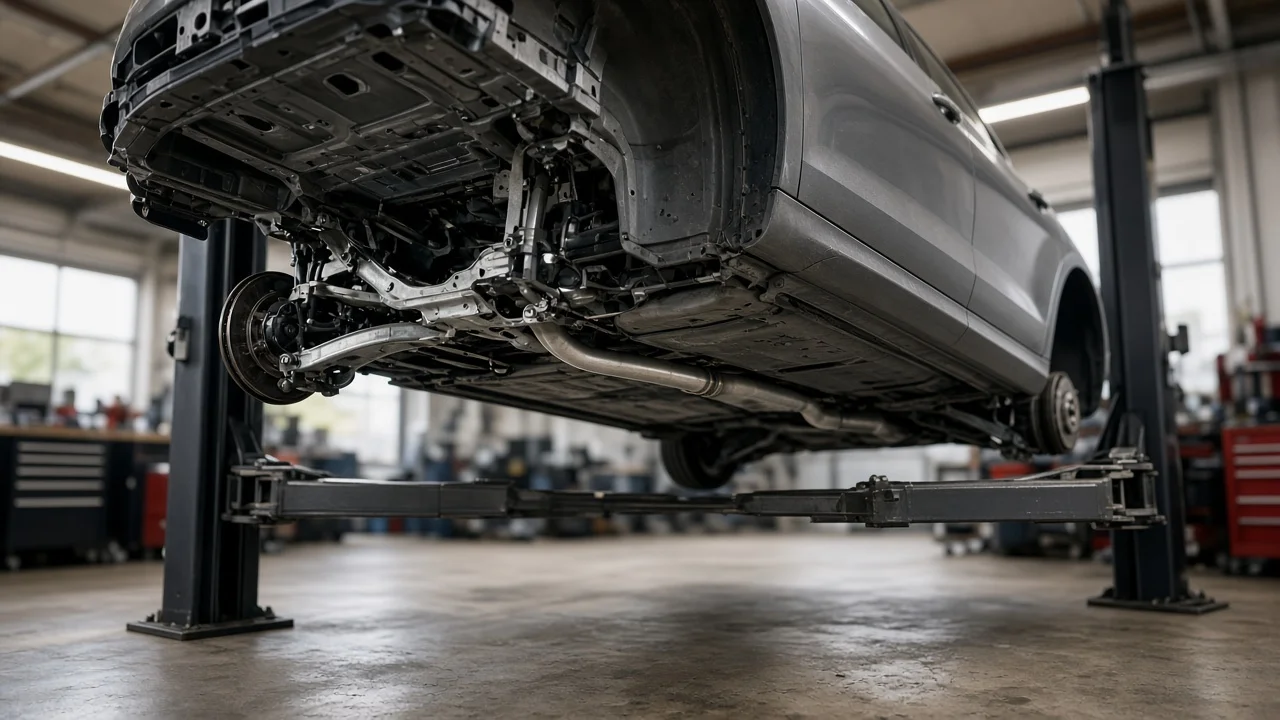
A chassis code is a short internal designation a manufacturer assigns to a specific vehicle design, usually one generation of one model in one body style. Enthusiasts, parts suppliers and service technicians use these codes because they are more precise than a model name. "BMW 3 Series" covers decades of very different cars. "G20" points to one generation of the 3 Series sedan. The qualification that matters most is that chassis codes follow no universal standard. Each manufacturer has its own scheme. Some codes describe a body style, some describe a whole generation, and some overlap with what other brands call a platform.
What a chassis code identifies
In most schemes, a chassis code narrows a vehicle down to a model generation and often a body style. One code typically spans several model years and many trim levels and powertrain variants. A mid-cycle facelift usually keeps the same code. BMW calls its facelift a Life Cycle Impulse (LCI), and an updated car is commonly described as, for example, a "G20 LCI" rather than given a new code.
A chassis code usually does not tell you the exact engine, transmission, drivetrain, trim level or market specification. To pin down those details you need the full VIN, the build data or the option codes.
Chassis code vs. related terms
Term | What it describes | Typical scope; Chassis code | Manufacturer's internal designation for a model design | One generation, often one body style; Platform | Shared engineering architecture (structure, suspension layout, electrical systems) | Can underpin many models, sometimes across brands; Model generation | A full redesign cycle of a nameplate | Several model years, possibly several chassis codes for different bodies; Model year | The year designation used for sale and registration | One year; may not match production date; Body style | Sedan, wagon, coupe, convertible, SUV and so on | May carry its own chassis code depending on the brand; Trim level / powertrain variant | Equipment package or engine and drivetrain combination | Many trims and powertrains share one chassis code; VIN | 17-character unique identifier for one specific vehicle (US and most markets) | A single vehicle
Readers most often confuse chassis codes with platforms. Volkswagen's MQB is a platform, a modular architecture shared by many different models. Each model built on it still has its own model or generation designation. A platform tells you what engineering a car shares with others. A chassis code tells you which specific car design you are looking at.
How different manufacturers structure their codes
Code formats vary widely. The examples below show common patterns. They are not complete catalogs, so treat any single code as something to confirm for your exact vehicle.
BMW: a letter for the code series plus a number. Older cars use E codes (for example E46, E90), later cars use F codes (F30), then G codes, and newer models have begun moving to U codes (for example U11 for an X1 generation). Each body style generally gets its own number. Mercedes-Benz: a letter commonly indicates body type, for example W for sedan, S for estate, C for coupe, A for cabriolet and X for many SUVs, followed by a number shared across that model family's bodies (W205 sedan, S205 estate and C205 coupe for one C-Class generation). The G-Class is known by its W463 designation. Japanese manufacturers: alphanumeric codes that often encode engine family and model, such as AE86 for a Toyota Corolla generation, JZA80 for a Toyota Supra generation, S13 and S14 for Nissan Silvia/240SX generations, R32 through R34 for Nissan Skyline generations, and EG or EK for Honda Civic generations. Codes can differ by body style and market. Mazda MX-5 Miata: generations are widely referred to as NA, NB, NC and ND. Porsche 911: generations are known by type numbers such as 996, 997, 991 and 992. American nameplates: Ford Mustang generations are commonly identified as S197, S550 and S650, and Chevrolet Corvette generations as C5 through C8. These act more like generation codes than body-specific chassis codes. Volkswagen: enthusiasts often use "Mk" generation numbers (Golf Mk7, Mk8). Internal type codes and platform names such as MQB sit alongside them.
What "chassis code G" usually means
A search for a G chassis code almost always concerns BMW's G-series. BMW used this generation of codes for models that succeeded the F-series cars. Each number identifies a model and body style, so a sedan and a wagon of the same 3 Series generation have different codes. Commonly cited examples include the following.
Code | Model and body style; G20 | 3 Series sedan; G21 | 3 Series Touring (wagon); G22 | 4 Series coupe; G23 | 4 Series convertible; G26 | 4 Series Gran Coupe; G80 | M3; G82 | M4 coupe; G42 | 2 Series coupe; G87 | M2; G29 | Z4 roadster; G30 / G31 | 5 Series sedan / Touring (the generation before G60); G60 | 5 Series sedan (later generation); G11 / G12 | 7 Series standard / long wheelbase; G70 | 7 Series (later generation); G01 / G02 | X3 / X4; G05 / G06 / G07 | X5 / X6 / X7
Not every recent BMW is a G-code car. Some models moved to U codes, and older generations of the same nameplates use F or E codes. The G-series also has nothing to do with the Mercedes-Benz G-Class, whose internal designation follows Mercedes' own W-numbering. If a listing or parts catalog mentions a "G" code, check which brand and nameplate it refers to before you assume compatibility.
Why the chassis code matters
Parts compatibility: suspension, body panels, lighting and many interior parts are cataloged by chassis code. A part for a G20 sedan may not fit a G21 wagon, even though both are 3 Series cars of the same generation. Service and repair information: procedures, torque specifications and wiring diagrams are often organized by chassis code, then refined by engine and production date. Buying research: the code helps you compare generations, read owner discussions about known issues, and avoid mixing up information from different designs that share a name. Modification and aftermarket support: aftermarket products are typically marketed by chassis code, sometimes split further by pre- and post-facelift production. Import and registration: in the Japanese domestic market, vehicles carry a frame number that begins with the model designation instead of a 17-character VIN. The chassis code is therefore central to identifying imported Japanese cars.
How to find a vehicle's chassis code
Decode the VIN: on US-market vehicles, characters 4 through 8 (the vehicle descriptor section) encode attributes such as model, body and engine. These characters rarely spell out the chassis code. A brand-specific VIN decoder or dealer lookup translates them. Check the vehicle labels: some manufacturers print a model or type code on the door-jamb certification label, a build plate or an under-hood sticker. Review documents: window stickers, build sheets, service records and dealer invoices sometimes list the model code. Ask a dealer parts department: with the VIN, they can confirm the exact designation along with production date and option codes. For Japanese-market imports: the frame number on the vehicle and its export or registration papers normally begins with the chassis code.
Common pitfalls
Model year is not production date: a vehicle sold as one model year may have been built in the previous calendar year. Running changes and facelifts follow production dates, so parts catalogs often ask for the build month. Generational overlap: when a new generation launches, the outgoing and incoming chassis codes can be sold side by side for a period, sometimes for different body styles of the same nameplate. Market specification differences: the same chassis code can come with different engines, emissions equipment, lighting or safety hardware depending on the market. US-spec and European-spec cars sharing a code are not always parts-identical. Informal naming: enthusiast shorthand such as "Mk7" or "NA" is widely understood, but it may not match the manufacturer's internal type code. Parts catalogs may use the official designation instead.
Practical takeaway
Use the chassis code to identify which design you are dealing with, meaning the generation and usually the body style. Then use the VIN, production date and market specification to narrow down the exact car. For parts and service decisions, confirm all of these. Matching the code alone does not guarantee that two vehicles are identical.