Black and Decker Car Battery Charger Alternator Check: What It Tells You and When to Use a Dedicated Tester
The short answer
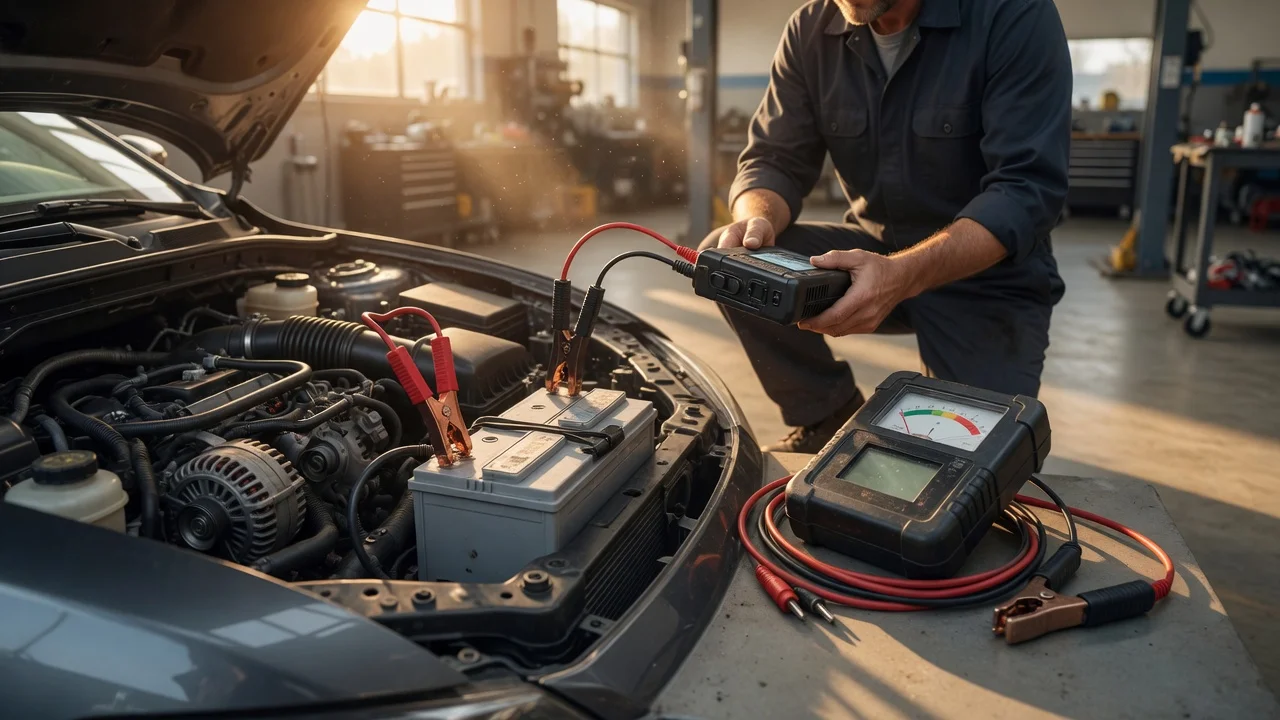
Some Black and Decker battery chargers include an alternator check function. If yours does, it can give a quick indication of whether the charging system is putting out voltage while the engine runs. This only applies if your model has the feature. Black and Decker sells many chargers, maintainers and jump starters, and not all of them include it. Check the control panel and the owner's manual for a mode labelled alternator check or similar. If you can't find one, your unit can charge or maintain the battery but can't test the alternator, and you'll need a dedicated car battery and alternator tester or a multimeter.
This article doesn't cover a specific charger model, so the exact button sequence, display messages and pass/fail thresholds for your unit aren't confirmed here. Use your manual as the authority for those details.
What an alternator check actually measures
The alternator charges the battery and powers the electrical system once the engine is running. A charger-based alternator check reads the voltage at the battery terminals with the engine running and compares it with a reference range. If the voltage stays near resting battery level, the alternator may not be charging. If it is well above the expected range, the voltage regulator may be overcharging the battery.
A voltage reading is only a screening check. It doesn't measure how much current the alternator can deliver under load, and it can't separate an alternator fault from a wiring, belt or connection problem. A battery that is failing internally can also distort the result.
General procedure
The steps below are the usual pattern for charger-based alternator checks. Your model's sequence may differ, so follow the manual where they conflict.
1) Park on level ground with the parking brake set and the transmission in Park or neutral. 2) Connect the positive (red) clamp to the battery's positive terminal and the negative (black) clamp to the negative terminal or the grounding point the manual specifies. 3) Route the cables well away from belts, pulleys, the cooling fan and hot exhaust parts. 4) Start the engine and let it settle at idle. 5) Select the alternator check mode on the charger. 6) Read the result on the display or indicator lights. 7) If the manual says so, repeat the check with headlights, blower fan or other loads switched on to see whether voltage holds up. 8) Switch off the engine before disconnecting the clamps, removing the negative clamp first.
Reading the result
Many charging systems are commonly described as running roughly 13.5 to 14.5 volts at the battery with the engine on, compared with about 12.6 volts for a fully charged battery at rest. Treat these as general reference points, not specifications for your vehicle. Many newer vehicles use smart or variable charging that lets voltage drop deliberately at times, and vehicles with start-stop systems or AGM batteries may also behave differently. Hybrids and electric vehicles usually charge the 12-volt battery through a DC-DC converter rather than a belt-driven alternator, so a conventional alternator check may not apply. For your model year, trim and powertrain, the service information is the reliable source for normal charging voltage.
Result pattern | What it may suggest | Sensible next step; Voltage within the charger's normal range | Charging system is likely producing output | Test or charge the battery if starting problems continue; Voltage close to resting battery level | Alternator may not be charging, or there is a belt, fuse or wiring issue | Inspect the belt and connections, then get a load test; Voltage well above the normal range | Possible voltage regulator fault | Have the charging system checked soon; Reading drops sharply when loads are switched on | Output may be weak under demand | Get a load test from a shop or dedicated tester
When a dedicated battery and alternator tester is the better choice
A charger's alternator check is convenient if you already own the charger, but it is a basic test. A dedicated battery and alternator tester is more useful if you want to assess battery health, such as cranking ability or state of health, alongside charging voltage, or if you need to diagnose a recurring no-start. A basic digital multimeter can also read charging voltage, but it won't load-test the battery. If your results are borderline or conflicting, many parts stores and repair shops can load-test the battery and charging system, which is more conclusive than a voltage reading alone.
What still needs confirming
Before relying on the result, confirm three things: whether your Black and Decker model has an alternator check mode, what readings or indicators that model treats as a pass or fail, and what charging voltage your vehicle's manufacturer specifies. These details vary by product and vehicle, and none of them could be confirmed here.