Auxiliary Battery Replacement: What to Check Before You Buy

The short answer
In most cases, replacing an auxiliary battery means matching the original battery's chemistry, physical size, terminal layout and capacity, then installing it so the vehicle's charging system recognizes it. The right replacement depends on what the auxiliary battery actually does in your vehicle. A small factory backup battery in a modern car has different requirements than a deep-cycle house battery in a camper or an add-on second battery for a winch or fridge. Two conditions change the job the most. Some vehicles must have a new battery registered or coded to the car's computer. A switch to a different chemistry, such as lithium, may also require a different charger, isolator or DC-DC charger.
Identify which kind of auxiliary battery you have
The term "auxiliary battery" covers several different setups. Before you shop, figure out which one applies to your vehicle, because each has different replacement priorities.
Factory backup or support battery: a small secondary 12-volt battery that some newer vehicles use to keep electronics, start-stop systems or shift-by-wire functions powered while the engine restarts or the main battery is under load. These are often tucked under the dash, under a seat, near the main battery or in the cargo area. Hybrid or EV 12-volt battery: in many electrified vehicles, the conventional-looking 12-volt battery runs the computers and accessories, while the high-voltage pack drives the vehicle. Owners sometimes call this the auxiliary battery. It is separate from the high-voltage battery and is usually replaced as a standard maintenance item. Dual-battery or house battery setup: an aftermarket or factory second battery in a truck, overland build, RV or van that powers accessories such as fridges, lights or inverters without draining the starting battery. Commercial or emergency vehicle auxiliary battery: a second battery that supports equipment loads such as radios, lighting or lift gates.
Your owner's manual, the label on the existing battery and the battery's mounting location are the quickest ways to tell which type you have. If the vehicle shows a dash message about the auxiliary battery, that message usually refers to the factory support battery and not the main starting battery.
Signs it is time to replace it
Auxiliary batteries often fail quietly because they rarely handle the engine-starting load that would reveal a weak main battery. Common signals include:
A dashboard warning that names the auxiliary or backup battery. Start-stop that stops working or becomes inconsistent. Electronics that reset, flicker or display errors during restarts. Accessories on a house battery that shut off much sooner than they used to. A battery that will not hold a charge after a full recharge, or that shows swelling, leaks or corroded terminals.
A warning light alone does not prove the battery is bad. A failing charging circuit, a loose connection, a blown fuse or a faulty isolator or relay can produce similar symptoms. A load test or a battery analyzer check, plus a look at the charging circuit, helps you avoid replacing a good battery.
What to check when choosing a replacement
Specification | Why it matters | Where to find it; Chemistry (flooded, EFB, AGM, gel, lithium) | The vehicle's charging strategy is tuned for a particular chemistry. A mismatch can lead to undercharging, overcharging or a shortened life. | Label on the old battery, owner's manual; Group or case size | The battery must fit the tray and hold-down. Factory support batteries are often small, uncommon sizes. | Old battery label, fitment guide by year, make, model and trim; Terminal type and orientation | Reversed or different terminals may not reach the cables or may contact metal parts. | Visual check of the old battery; Capacity (amp-hours) and reserve capacity | These ratings show how long the battery can supply power. They matter most for house and accessory batteries. | Old battery label, original equipment specification; Cold cranking amps (CCA) | This rating matters if the auxiliary battery can assist with starting. It is less important for pure accessory duty. | Old battery label; Venting | A battery mounted inside the cabin or cargo area may need a sealed design or a vent tube connection. | Original battery design, mounting location; Warranty and date code | A fresh battery and clear warranty terms protect you if the unit fails early. | Retailer and battery label
Confirm fitment using your vehicle's exact model year, trim and powertrain. The same model can use different auxiliary batteries depending on whether it has start-stop, a mild-hybrid system, a particular engine or a regional equipment package. If a parts lookup shows more than one option for your vehicle, compare the label on your existing battery before you buy.
Choosing a battery chemistry
For a factory support battery, the safest choice is usually the same chemistry the vehicle came with. Many modern support batteries are AGM (absorbent glass mat), a sealed design that tolerates frequent cycling and can be mounted in enclosed spaces. Replacing an AGM battery with a conventional flooded battery is generally not recommended, because the vehicle may charge it incorrectly and a flooded battery can vent gas indoors.
For a house or accessory battery, you have more flexibility, and the trade-offs are more significant:
Flooded deep-cycle: the lowest upfront cost and widely available, but it needs ventilation, is sensitive to mounting angle and may need periodic maintenance. AGM deep-cycle: sealed and vibration-resistant, with no maintenance required. It is a common upgrade for vehicle-mounted accessory systems. Lithium iron phosphate (LiFePO4): lighter and able to use more of its rated capacity, with long cycle life. It costs more upfront. It usually needs a charging source designed for lithium, often a DC-DC charger, and some units have limits on charging in freezing temperatures. Check the manufacturer's charging requirements before choosing one.
Check the charging side, not just the battery
An auxiliary battery depends on how it gets recharged. Factory systems use the vehicle's own charging controls. Aftermarket dual-battery setups typically use one of the following:
A voltage-sensitive relay or battery isolator, which connects the batteries when the alternator is charging and separates them when it is not. A DC-DC charger, which regulates charging to suit the auxiliary battery's chemistry. It is often preferred in vehicles with smart alternators that vary their output and for lithium batteries. A solar controller or shore-power charger in campers and RVs.
If you change chemistry or capacity significantly, confirm that the isolator, DC-DC charger or solar controller supports the new battery or can be set to a matching profile. A good battery paired with the wrong charging profile can fail early.
Battery registration and coding
Some vehicles track battery age and condition and adjust charging accordingly. On these vehicles, the car's computer may need to be told that a new battery was installed, and sometimes what type and capacity it is. If you skip this step, the system may keep charging the new battery as if it were an old one. This can shorten battery life or leave warnings active. Whether your vehicle requires it varies by make, model year and equipment. A dealer, a shop with the right scan tool, or a capable consumer scan tool can perform registration where needed.
DIY or professional installation?
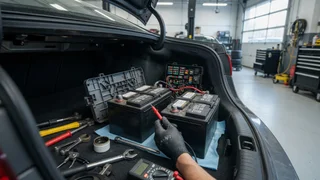
Replacing a house battery in an accessible tray is often a straightforward DIY job. Factory support batteries can be more involved. They may sit behind trim panels, under seats or deep in the dash, and the vehicle may need coding afterward. A professional install is worth considering in these situations:
The battery is hard to reach or requires removing interior panels or components. Your vehicle requires battery registration and you do not have a compatible tool. You are changing chemistry and need the charging hardware reconfigured. Warning lights persist after the swap, which suggests a wiring or charging fault.
General installation practices
Exact steps differ by vehicle, so follow the procedure for your model where one exists. These general practices apply to most 12-volt battery swaps:
Turn off the ignition and all accessories. Note any radio codes or settings that may reset. If your vehicle's procedure allows it, consider a memory saver to preserve settings. Disconnect the negative terminal first and reconnect it last to reduce the risk of a short. Clean the cable ends and the tray. Check for corrosion or damaged cables. Secure the new battery with the original hold-down so it cannot shift. Reconnect any vent tube on batteries mounted inside the cabin or cargo area. Carry out battery registration if your vehicle requires it. Then confirm that warnings have cleared and that start-stop or accessories work normally.
Core charges and disposal
Lead-acid batteries are widely recycled in the US. Many retailers add a refundable core charge that you get back when you return the old battery. Return it to the seller or a recycling point instead of discarding it. Lithium batteries follow separate recycling rules, so ask the seller or a local recycler how to handle them.
Quick buying checklist
Confirm which auxiliary system your vehicle uses and why the battery is being replaced. Rule out charging, fuse or wiring faults if the symptoms are unclear. Match chemistry, case size, terminal layout and capacity to the original, or to your planned upgrade. Verify fitment by exact model year, trim and powertrain. Make sure the charging hardware supports the battery you choose. Find out whether your vehicle needs battery registration. Check the date code, warranty terms and core return policy before buying.