Airbag Effectiveness, Advantages and Limitations
The Short Answer
Airbags are effective at reducing serious injury in many crashes, but only as part of a system. They are designed to work alongside seat belts, not replace them, which is why they are formally called a supplemental restraint system (SRS). Their main advantage is cushioning the head and chest so occupants don't strike hard interior surfaces. Their main limitations are that they protect best only in the crash types and seating positions they were designed for, they deploy with considerable force, and they can injure people who are unbelted, sitting too close, or too small for the seat they occupy.
This guide does not cite specific effectiveness percentages or injury statistics, because no verified figures were supplied for it. For quantified estimates, consult crash-safety data published by US safety authorities and independent crash-testing organizations.
How Airbags Work
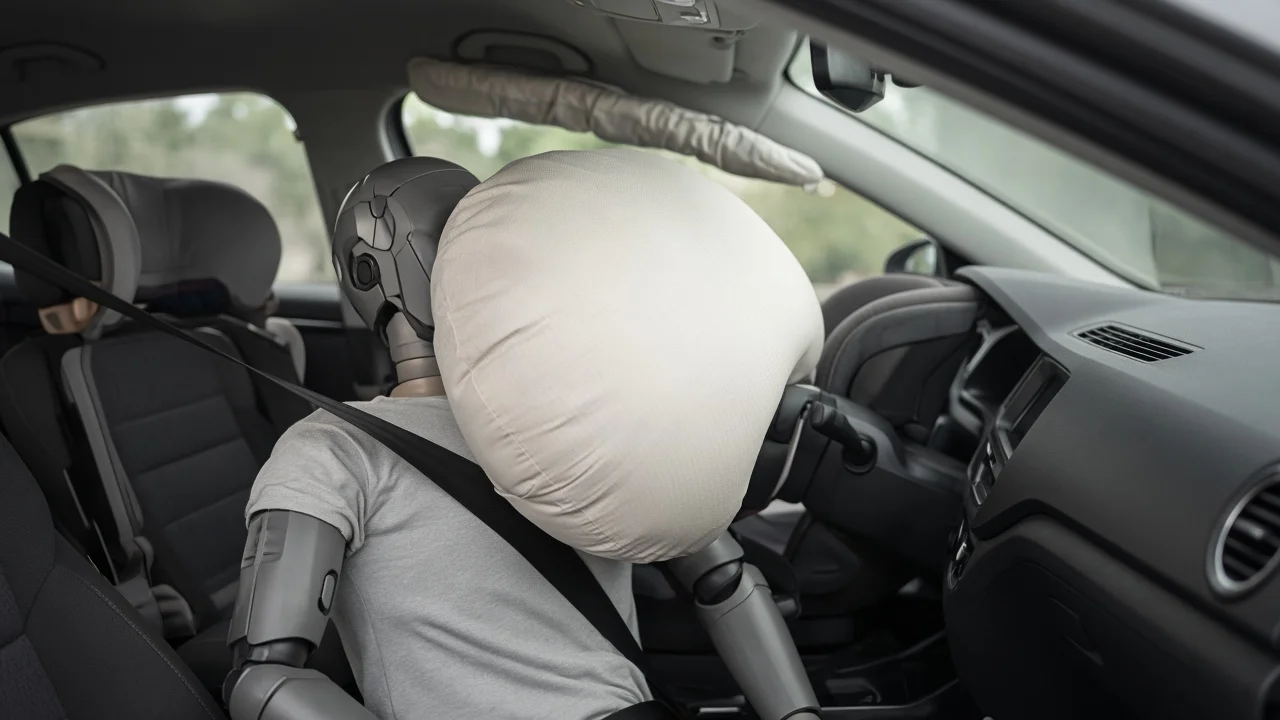
Crash sensors detect a sudden deceleration or impact and signal a control module. If the event meets the deployment criteria, an inflator rapidly fills a fabric cushion with gas. The cushion inflates within a fraction of a second, absorbs some of the occupant's forward or sideways motion, then deflates through vents so it doesn't trap or rebound the occupant. Airbags are single-use. Once deployed, they and related components must be replaced.
Deployment Zones and What Each Protects
Modern vehicles may have several airbags, each covering a different zone. The exact layout varies by model year, trim and market, so check the owner's manual or the SRS markings on the trim panels to confirm what a specific vehicle has.
Frontal airbags: in the steering wheel and the passenger-side dashboard; they protect the head and chest in frontal crashes. Side torso airbags: usually in the seat or door; they protect the chest and pelvis in side impacts. Curtain airbags: deploy down from the roof rail along the side windows; they protect the head in side impacts and, in some designs, help keep occupants inside during a rollover. Knee airbags: below the dashboard; they help control lower-body movement in frontal crashes. Other types: some vehicles add center airbags between front occupants, seat-cushion airbags or rear-seat airbags. Availability is model-specific.
Advantages of SRS Airbags
They reduce head and chest injury by spreading crash forces over a larger area than a steering wheel, dashboard or door panel would. They work automatically, with no action required from occupants. They complement seat belts: belts hold the body in position, and airbags cushion what the belt can't fully restrain, especially the head. Side and curtain airbags add protection in side impacts, where there is little crush space between the occupant and the striking vehicle or object. In the US, newer frontal systems are generally designed to adjust deployment based on factors such as crash severity, seat belt use and occupant detection, which reduces risk to smaller occupants. Capabilities vary by vehicle.
Limitations and Disadvantages
They are not a substitute for seat belts. An unbelted occupant can move toward the airbag during pre-crash braking and be struck by it as it inflates, which raises injury risk. Deployment force can cause injuries, including abrasions, bruising, minor burns and temporary hearing effects. These are usually far less severe than the injuries the airbag helps prevent, but they are real. Sitting too close to the steering wheel or dashboard increases the risk of injury from the deploying airbag. They are dangerous for young children in the front seat. A rear-facing child seat must never be placed in front of an active frontal airbag, and children are generally safest in the back seat. Each airbag covers only certain crash types. Frontal airbags, for example, may not deploy in many side, rear or rollover crashes, and low-severity impacts may not trigger any deployment. They are single-use. After deployment, the airbags, and often sensors or other components, must be replaced, which adds to repair cost and can affect whether a vehicle is economical to repair. Defective inflators have been the subject of large US recalls. A faulty inflator can turn an airbag into a hazard, so open recalls should be checked and repaired promptly.
How to Get the Most Protection
Wear a properly adjusted seat belt on every trip, in every seat. Sit upright, with a reasonable distance between your chest and the steering wheel, and avoid leaning on doors where side airbags deploy. Put children in the back seat in an appropriate child restraint, and never place a rear-facing seat in front of an active frontal airbag. Don't place objects, mounts or feet on or near airbag covers on the dashboard, steering wheel, seats or pillars. If the SRS or airbag warning light stays on, have the system inspected, because it may not deploy as intended. Check your vehicle identification number for open airbag recalls, especially when buying a used vehicle.
Bottom Line
Airbags are a well-established safety technology that meaningfully reduce injury risk, but their benefit depends on correct use: a fastened seat belt, a proper seating position, children seated appropriately, and a system free of faults and open recalls. When comparing vehicles, look at which airbag zones are fitted and how the vehicle performs in independent crash testing, rather than at the airbag count alone.