To Be Safe From Airbag-Related Injuries: How to Sit, Steer and Secure Passengers
The Short Answer
Airbags reduce the risk of serious injury in a crash, but they inflate with great force. Most airbag-related injuries happen to people who are too close to the airbag, out of position, unbelted, or are children seated in front of an active airbag. To stay safe, always wear a seat belt, sit back from the steering wheel or dashboard, keep your body and objects out of the airbag's path, and seat children in the back seat in a restraint suited to their size.
A deployment zone is the space an airbag fills as it inflates. Frontal airbags deploy from the steering wheel hub and the dashboard. Side airbags usually deploy from the seatback or door. Curtain airbags drop down from the roof rail above the side windows. Knee airbags, where fitted, deploy from the lower dashboard. The exact locations depend on the make, model and model year, so check your owner's manual and the airbag labels on the sun visors, pillars or seats.
Conditions That Change the Answer
Children: US federal safety guidance recommends that children aged 12 and under ride in the back seat. A rear-facing child seat must never be placed in front of an active frontal airbag, because the deploying airbag strikes the back of the seat close to the child's head. Shorter drivers: people who cannot reach the pedals while sitting well back from the wheel are at higher risk. Adjustable pedals or pedal extenders can help; a qualified mobility or vehicle specialist can advise. Pregnancy: wear the lap belt low across the hips and below the belly, with the shoulder belt across the chest and to the side of the belly. Keep as much distance from the steering wheel as safe control allows. Older vehicles and recalls: some airbag inflators have been recalled for defects that can cause injury on deployment. An open recall changes your risk regardless of how well you sit.
Step-by-Step: Setting Up a Safe Seating Position
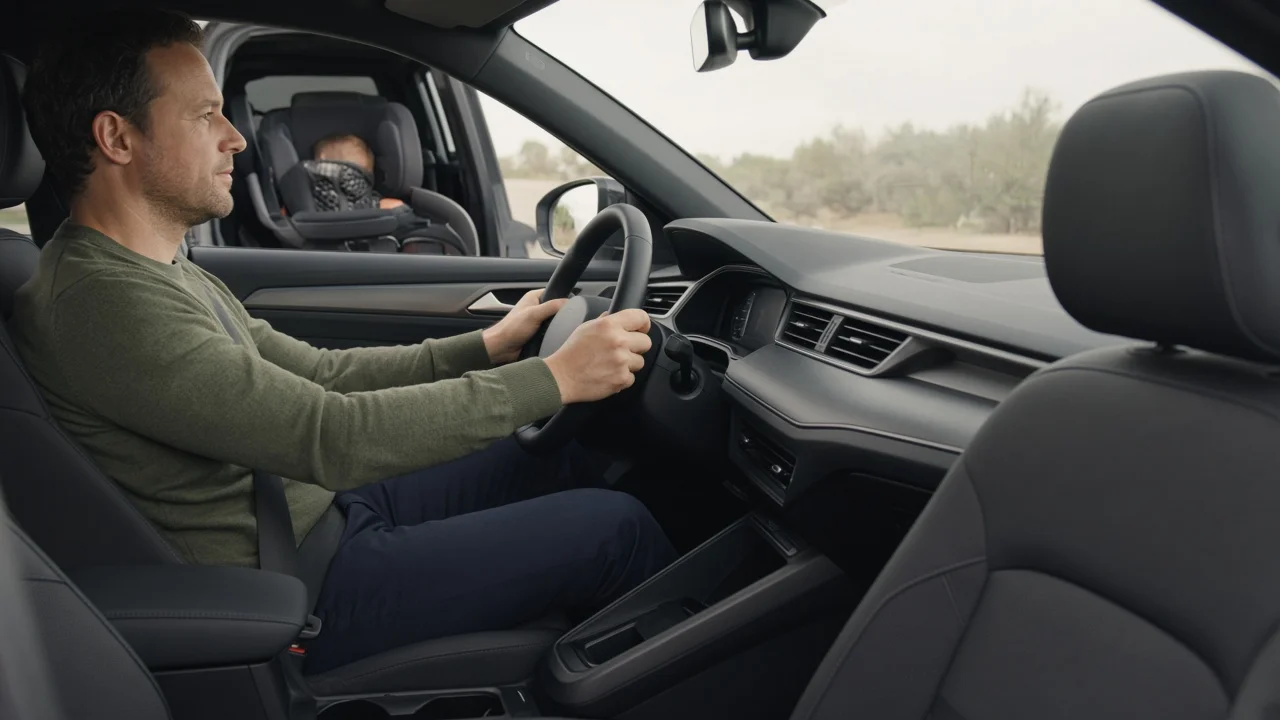
1) Fasten the seat belt every trip, with the lap portion low across the hips and the shoulder portion across the middle of the chest and collarbone, not under the arm or behind the back. Airbags are designed to work together with belts, not replace them. 2) Move the driver's seat back as far as you can while still reaching the pedals comfortably. US federal safety guidance recommends keeping at least 10 inches between the center of the steering wheel and your breastbone. 3) Recline the seatback slightly if needed to gain distance, but avoid a deep recline, which lets the body slide under the lap belt. 4) Tilt an adjustable steering wheel so the airbag points toward your chest rather than your head and neck. 5) Hold the wheel at roughly the 9 and 3 o'clock positions, or slightly lower. Avoid placing hands or arms across the center of the wheel, where the airbag cover opens. 6) Front passengers should sit upright with the seat moved back, feet on the floor, and never rest feet or legs on the dashboard.
Keeping Deployment Zones Clear
Keep phones, mounts, ornaments and other objects off the airbag covers on the steering wheel and dashboard; they can become projectiles. Do not lean your head against the door or window, where side and curtain airbags deploy. Do not fit aftermarket seat covers on seats with side airbags unless they are approved for that vehicle, since they can block deployment. Avoid hanging heavy items from grab handles or near the headliner where curtain airbags emerge. Do not hold children or pets on your lap in any seat.
Front-Seat Passenger Airbag Systems
Many newer vehicles use an occupant classification system that senses who is in the front passenger seat and can switch the passenger frontal airbag off, often shown by a "passenger airbag off" indicator. These systems are not a substitute for seating children in the back. If the indicator does not match the occupant, for example it shows off for an adult or on for a small child, have the system checked. In the US, a manual airbag on/off switch may be installed only in limited cases approved by federal regulators, such as certain medical conditions or when a child must ride in front.
How to Verify Your Setup
Measure or estimate the gap between your breastbone and the steering wheel center while seated in your normal driving position. Confirm the SRS (supplemental restraint system) or airbag warning light comes on briefly when the vehicle starts and then goes out. If it stays lit, flashes, or never appears, have the system inspected. Check for open airbag recalls using your vehicle identification number (VIN) through the manufacturer or the federal vehicle safety recall lookup, and have any recall repair completed. Read the airbag section of your owner's manual to confirm where each airbag is located and any model-specific seating or child-seat warnings. Check that the passenger airbag status indicator, if fitted, matches who is sitting there.
Limits of This Guidance
No specific crash-test data, airbag specifications or model-by-model deployment details were available for this guide. Airbag types, locations and passenger-detection features differ between vehicles and model years, so your owner's manual and the manufacturer remain the authoritative sources for your vehicle. If you have a medical condition, a disability, or a physical size that prevents a safe seating distance, consult your physician and a qualified vehicle modification specialist before considering changes to the airbag system.