4L60E Shift Solenoid Diagram and Location
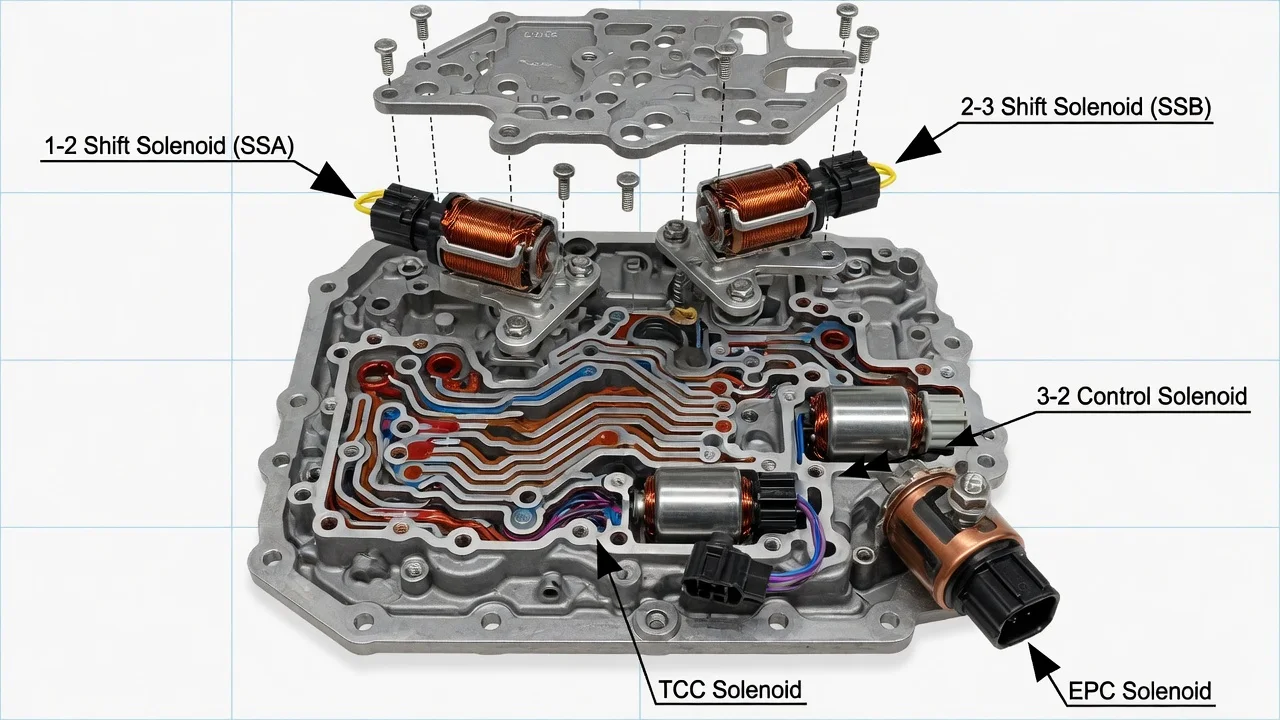
On the GM 4L60E four-speed automatic, the two shift solenoids cannot be seen from outside the transmission. They sit on the valve body inside the case, behind the transmission oil pan. This guide explains where to find them and how to read a typical solenoid diagram. It also covers how the solenoids produce each gear and what an owner can reasonably check before choosing a repair. A symptom alone does not prove that a solenoid has failed.
Where the 4L60E shift solenoids are located
The 1-2 shift solenoid, often labeled shift solenoid A, and the 2-3 shift solenoid, labeled shift solenoid B, mount directly to the valve body. The valve body is bolted to the underside of the transmission case. To reach the solenoids, drain the transmission and remove the oil pan and filter. With the pan off, you will see the valve body, the internal wiring harness and the solenoids. The solenoids are held in place by retaining clips rather than bolts, and each one has an O-ring seal where it enters its bore in the valve body.
The shift solenoids share the valve body with other electrical parts. These include the pressure control solenoid, the 3-2 downshift control solenoid, and one or more torque converter clutch solenoids, depending on model year. All of them connect through the internal harness to a single pass-through connector on the outside of the case. That connector is the only part of the solenoid circuit you can reach without lowering the pan, which is why many diagnostic checks start there.
Reading a shift solenoid diagram
A typical 4L60E diagram shows the valve body from below. Each solenoid is labeled by function, and the diagram shows how the internal harness runs to the case connector. A wiring diagram adds the connector pin assignments and circuit colors. Pin numbering and harness layouts changed over the production run, so use a diagram that matches your exact vehicle and model year rather than a generic image. Parts that look the same are not proof that they fit your transmission.
Most diagrams also include a solenoid application chart. On the 4L60E, the standard pattern in Drive is: • First gear: A on, B on. • Second gear: A off, B on. • Third gear: A off, B off. • Fourth gear: A on, B off. This chart is the key to interpreting shift behavior. For example, if the transmission loses power to both solenoids, it follows the both-off pattern for third gear. The vehicle then usually pulls away sluggishly in that higher gear.
How the shift solenoids control gear changes
The shift solenoids do not move gears themselves. The powertrain control module decides when to shift, using inputs such as vehicle speed, throttle position and engine load. Some vehicles use a separate transmission control module for this job. The module switches each solenoid on or off, and the solenoids open or block small fluid passages. That change in hydraulic signal moves the shift valves in the valve body. The shift valves then send line pressure to the clutches and bands that produce each gear.
The system is hydraulic as well as electrical. A solenoid can test fine electrically and still cause a problem if its seal leaks, its passage is blocked by debris, or the valve it signals is sticking. That makes fluid condition and the correct fluid specification important. The 4L60E uses a Dexron-type automatic transmission fluid. The correct current product for your vehicle is listed in the owner's manual or service information.
What changes the answer for your vehicle
First, confirm the transmission type. GM used the 4L60E for many years in trucks, SUVs, vans and rear-wheel-drive cars. It is closely related to the later 4L65E and 4L70E. These units share the same general layout, but connectors, solenoid part numbers and torque converter clutch control differ between versions and years. The transmission identification tag or the build information for the vehicle is a better guide than the vehicle model alone.
How the transmission is installed affects access. In most trucks and SUVs, you can reach the pan from underneath with the transmission in place. Some cars, such as Corvette models with a rear-mounted transmission, are packaged differently and follow their own procedures. Four-wheel-drive versions add a transfer case behind the transmission, but this usually does not change pan access. Check the service procedure for your specific vehicle before starting work.
What the owner can do
Start by reading the diagnostic codes with an OBD-II scanner. On GM vehicles, codes such as P0751 and P0753 relate to shift solenoid A, and P0756 and P0758 relate to shift solenoid B. An electrical circuit code means the module detected a fault somewhere in the circuit. The cause could be the solenoid, the internal harness, the case connector, the external wiring or the module. A performance code means an expected shift did not happen, which can also come from hydraulic or mechanical causes.
Next, check the basics: • Fluid level and condition, including burnt smell or heavy debris. • The case connector, for corrosion, bent pins, or fluid seeping in from a leaking seal. Note the shift behavior precisely: which gear the vehicle starts in, which shift is missing or harsh, and whether the problem appears hot or cold. Service history also helps, since a recent fluid service, earlier valve body work or wiring repairs can narrow the possibilities.
If you are comfortable working under the vehicle, you can measure solenoid resistance at the case connector, or directly at the solenoid with the pan removed. Compare the reading with the specification in the service information for your year. To replace a solenoid, remove the retaining clip and pull out the old unit. Lubricate the new O-ring with transmission fluid, seat the solenoid fully, and refit the clip. Use a new pan gasket, refill with the specified fluid, and check the level using the manufacturer's procedure.
Limitations and next steps
Codes and resistance tests narrow down the fault, but they do not always confirm it. A solenoid can pass a resistance test and still stick intermittently. Replacing a solenoid will not fix worn clutches, a damaged valve body or a wiring fault elsewhere in the circuit. Have a transmission shop do pressure testing and a fuller diagnosis if codes return after replacement, if the transmission slips or flares between gears, or if the fluid contains significant metal or friction material. A technician with a capable scan tool can switch each solenoid on and off and watch the response. That is a more direct test than resistance alone.