4-stroke scooter engine oil
The short answer
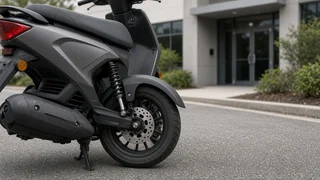
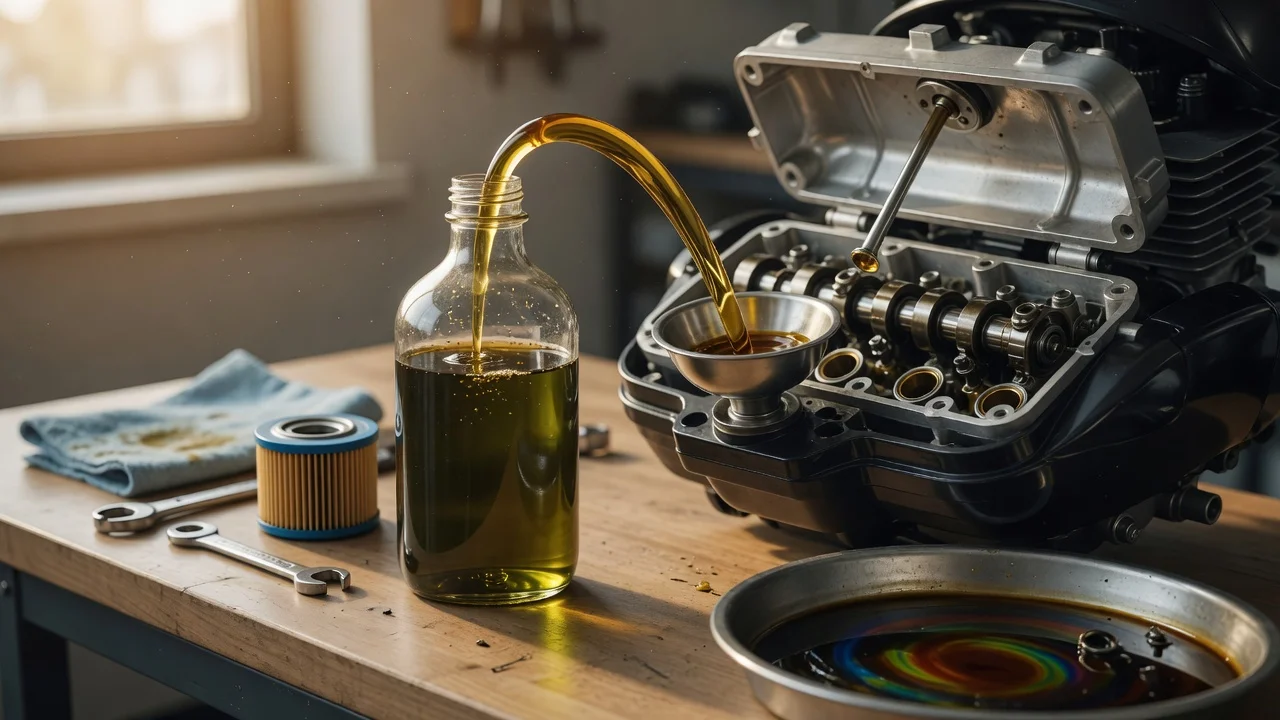
Four-stroke scooter engine oil is crankcase lubricant formulated for a four-stroke scooter engine: it stays in the sump, is circulated by a pump, and is not mixed into the fuel. The correct product is the viscosity grade and performance specification printed in the owner’s manual for that model, market and year—typically a motorcycle or scooter oil meeting JASO T 903 (MA, MA2 or MB) plus an API service category, not an unmarked “universal” bottle. Using the wrong friction class or viscosity can raise wear, harm fuel use, or, on machines with a wet clutch, cause clutch slip. Two-stroke premix or injector oil is a different product and does not substitute.
What four-stroke scooter oil has to do
In a four-stroke engine the same oil film protects the crankshaft bearings, piston and cylinder, camshaft or rockers, and valve train. On many automatic scooters it does not lubricate the final-drive gears; those often have a separate gearbox or reduction-case oil. On some designs a wet multi-plate clutch shares the engine oil, which is why clutch-friction ratings exist. Heat, stop-start traffic, high engine speed for a given road speed, and a small sump make scooter duty harsher than a typical car engine of similar displacement, so scooter-specific or motorcycle-rated oils are written around that duty.
JASO classes: MA, MA2 and MB
JASO T 903 is the Japanese Automotive Standards Organization motorcycle-oil classification most scooter makers cite. It grades oils by how much friction they allow at a clutch-type test surface. JASO MA and the tighter MA2 grade are higher-friction oils intended where a wet clutch shares the engine oil and must not slip. JASO MB is a lower-friction grade intended for many belt-CVT scooters that do not use a wet multi-plate clutch in the engine oil. The manual—not the bottle marketing—decides which class applies. Filling a wet-clutch engine with MB (or with many “energy conserving” car oils that behave like MB) can cause clutch slip. Filling an MB-specified CVT scooter with MA or MA2 is often tolerated by the clutch because there is no wet clutch in that oil, but it can raise internal friction versus the specified MB oil; follow the maker’s class when it is stated.
Viscosity grade
The SAE grade (for example 10W-40 or 5W-40) describes cold-start flow (the “W” number) and hot operating thickness (the second number). Common temperate-climate scooter fills are 10W-40; some manuals allow 5W-40, 10W-30, 15W-40 or a single-grade oil depending on ambient temperature and market. A grade that is too thick when cold delays lubrication at start-up; a grade that is too thin when hot can thin the film on bearings and the cam. If the manual lists a temperature chart, pick the grade that matches the climate you actually ride in. Do not assume a car 5W-30 “fuel economy” oil is equivalent even if the numbers look similar.
API and other performance marks
API petrol (gasoline) categories such as SJ, SL, SM, SN or SP describe detergent, wear and oxidation performance in four-stroke spark-ignition engines. Makers usually require a minimum API letter and a JASO class together. Later API letters generally supersede earlier ones for petrol engines, but “Resource Conserving” or similar friction-modified car oils can conflict with JASO MA/MA2 wet-clutch needs. If the scooter specifies JASO MA or MA2, choose an oil that states that JASO class on the label rather than inferring it from API alone. Documented factory specifications always outrank a generic API claim.
Engine oil is not always gearbox oil
Many twist-and-go scooters keep engine oil in the crankcase and a separate gear oil in the final-drive or reduction case behind the rear wheel. Capacities, change intervals and grades for those two fluids are independent. Gear oil is often a hypoid or GL-rated gear lubricant at a different viscosity (commonly an SAE 80W-90 class product where specified). Putting engine oil in the reduction case, or gear oil in the engine, is a specification error. Check the manual for two fill points, two drain points and two quantities before you service the machine.
Mineral, semi-synthetic and fully synthetic
Base-stock type is secondary to meeting the stated SAE grade and JASO/API spec. Mineral oils can be correct where the manual allows them and the drain interval is short. Semi-synthetic and fully synthetic oils are often chosen for higher temperature stability and longer advertised drain intervals, but an extended interval is valid only if the vehicle maker (or a documented severe-service schedule) allows it. High-revving, air-cooled or heavily loaded scooters are commonly filled with a synthetic 4T oil that still carries the required JASO class. There is no universal rule that “synthetic is always required”; the specification on the filler cap or in the book is the requirement.
How to choose a bottle
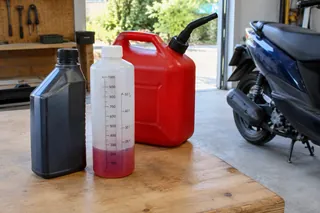
Read the owner’s manual (or the under-seat / filler-cap label) for SAE grade, JASO MA/MA2/MB, and minimum API category for your model year and market. Confirm whether the engine uses a wet clutch in the same oil; if it does, do not use JASO MB or friction-modified car oil. If the scooter is a belt CVT with a specified MB oil, prefer a labelled JASO MB 4T scooter oil in the listed viscosity. Match climate: use the manual’s temperature-versus-grade table when one is printed. Buy four-stroke (4T) oil only. Two-stroke (2T) oil is for fuel mixture or injection systems and will not protect a four-stroke sump. Treat gearbox or final-drive oil as a second, separate purchase when the design has a reduction case.
Capacity, colour and change practice
Fill volume varies with displacement, dry versus oil-filter change, and whether the scooter is on the centre stand. Typical small scooters use on the order of a litre in the engine, but that figure is not a specification; the manual’s cubic-centimetre or litre quantity is. Change the oil at the interval the maker gives for your riding (often shorter for dusty roads, short trips or high load), and sooner if the oil is milky, fuel-smelling or heavily blackened with metal. Check level on the dipstick or sight glass with the scooter upright as the book describes—tilting a kickstand machine will fake a low or high reading. Replace the crush washer on the drain bolt when the manual calls for it, and refill slowly, because overfilling can wet a clutch, raise crankcase pressure or smoke from the breather.
What this guide does not fix
No single viscosity or JASO class is correct for every four-stroke scooter. Claims about a given brand’s wear numbers, a specific drain kilometre figure, or oil capacity for an unnamed 50 cc, 125 cc or 300 cc model are not stated here because they depend on the vehicle’s published specification. If the manual is missing, identify the exact model code and year and obtain that document before guessing from a similar displacement. Mixing leftover two-stroke oil, diesel engine oil, or unlabelled top-up bottles is outside the supported choice.