2-Stroke Engine Oil and Fuel Mix Ratios Explained for Bikes and Scooters
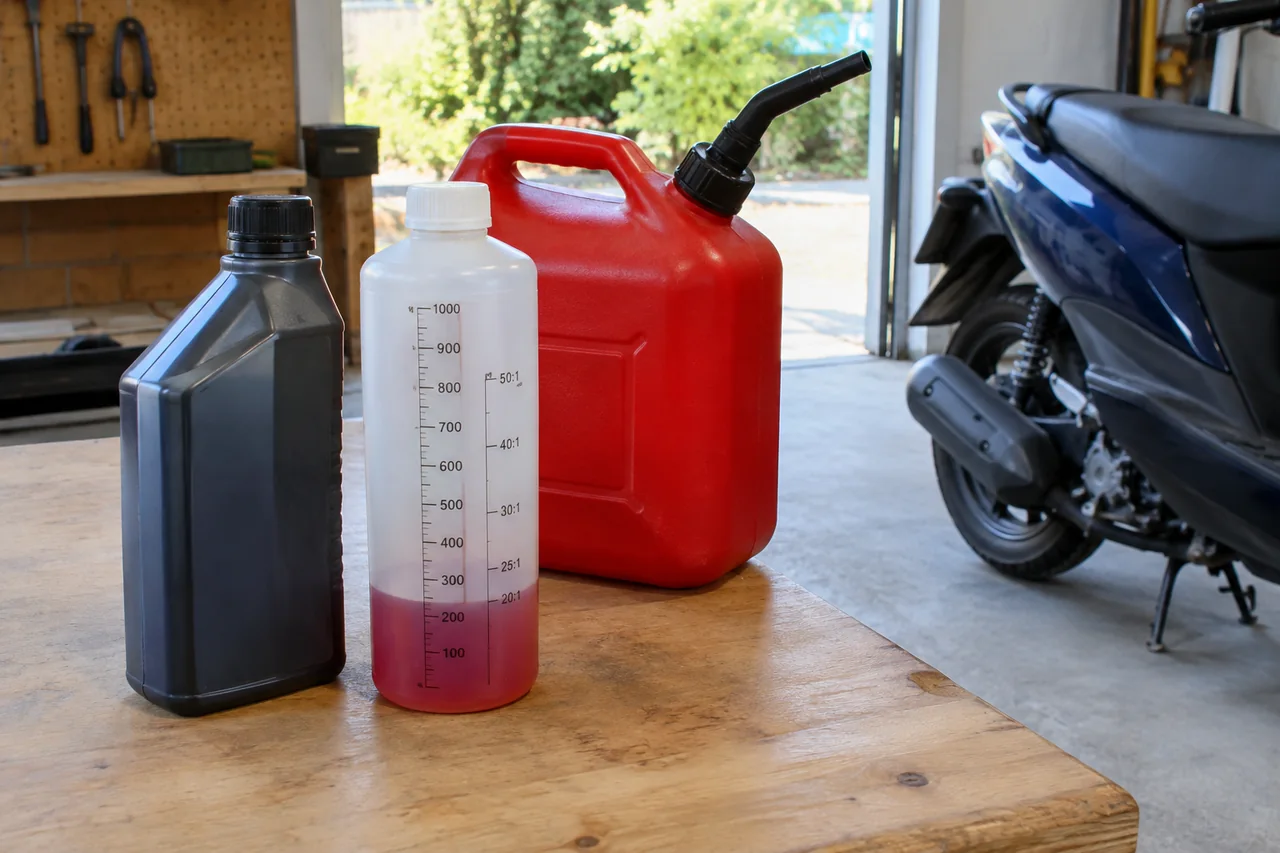
A two-stroke engine asks more of its oil than almost any other motor on the road. The oil makes one pass through the engine and then burns. Its quality, and how much of it the engine gets, decide whether the engine runs clean or seizes. This guide covers how that lubrication works, what the labels mean, how to mix accurately and which symptoms need a technician.
Why a two-stroke engine burns its oil instead of storing it in a sump
In a four-stroke engine, oil sits in a sump and gets pumped around again and again. A two-stroke uses its crankcase as part of the intake path. The fuel and air charge passes through the crankcase before it travels up the transfer ports into the cylinder. That design leaves no room for a pool of oil. Instead, the oil rides along with the incoming mixture, coats the moving parts it passes, and then burns and leaves with the exhaust.
That passing mist of oil is the only protection for the crankshaft main bearings, the connecting rod's big-end and small-end bearings, the piston skirt and rings, and the cylinder wall. Because the engine uses up oil all the time, the rider has to keep supplying it, either mixed into the fuel or held in an injection tank. Two-stroke oil also carries additives that limit carbon on the piston crown, ring lands, exhaust port and spark plug. Ordinary four-stroke motor oil isn't made to burn cleanly, so never use it as a substitute. The owner's manual says what the engine needs.
Two-cycle, two-stroke and 2T oil: different names for the same product
Two-cycle, two-stroke, 2-cycle and 2T all name the same type of oil. The different names come from regional habit and industry convention. American lawn and garden retailers tend to say two-cycle, while motorcycle and scooter markets in Europe and Asia often print 2T. The name on a bottle says nothing about the oil's quality, so choosing by the word on the front label doesn't work.
What matters is the intended use and the performance standard. Oil sold for chainsaws, string trimmers, outboard motors and motorcycles can share the two-cycle name while meeting very different specifications. Turn the bottle over and look for certification marks, the recommended range of mixing ratios, and whether the oil is meant for premix, oil injection or both. A scooter with an injection pump needs an oil that the label approves for that system. A generic blend made for handheld garden tools isn't enough.
Types of 2T oil and what the JASO and TC-W3 standards tell you
2T oils use one of three base oils: mineral, semi-synthetic or full synthetic. Mineral oils are the cheapest, but they tend to smoke more and leave more deposits. Semi-synthetic blends burn cleaner and hold up better under heat at a moderate price, which makes them a common scooter 2T oil. Full synthetic two-stroke oil generally burns cleanest, keeps its protective film best at high temperatures and costs the most. It suits engines that are worked hard.
Base oil is only part of the picture. JASO is the Japanese standard for motorcycle and scooter two-stroke oils, and its grades run from FB through FC to FD. Each higher grade sets tighter limits on smoke and exhaust blockage and requires better cleaning ability. The manual names the minimum grade the engine needs. TC-W3 is a standard for water-cooled outboard boat engines with different priorities, so don't use it unless the manual allows it. Oils for injection systems must also flow reliably through a metering pump in cold weather. Check the standard printed on the bottle, not the color, smell or brand reputation.
How oil gets into the engine: premix versus oil injection on bikes and scooters
Premix is the simplest method. You measure oil straight into the fuel, either in a fuel can or in the tank, so every fill-up has the correct proportion. Oil injection, often called autolube, uses a separate oil tank and a pump driven by the engine. The pump meters oil into the intake or crankcase based on throttle position and engine speed. The rider never has to mix fuel, but the oil tank still needs regular checks.
To tell which system a machine uses, look for a separate oil filler cap, a low-oil warning light on the dashboard, or a statement in the manual that the fuel must be premixed. The two systems fail in different ways. An injection oil tank must never run empty, and putting plain gasoline into a premix machine can leave the engine without lubrication within minutes. Some owners convert injection systems to premix. That changes how the engine is lubricated, so talk it over with a qualified technician first.
Reading and mixing fuel ratios such as 50:1, 40:1 and 32:1 correctly
A ratio such as 50:1 means fifty parts fuel to one part oil by volume. A smaller first number means more oil, so 32:1 has more oil than 40:1, which has more than 50:1. One US gallon holds 128 fluid ounces, so it needs about 2.6 ounces of oil at 50:1, 3.2 ounces at 40:1 and 4 ounces at 32:1. In metric, each liter needs 20 milliliters, 25 milliliters and about 31 milliliters for those same ratios.
The correct ratio comes from the manufacturer's manual for your engine. The ratio on the oil bottle is only a general recommendation and may differ. A measuring bottle with volume markings removes the guesswork. Start with fresh fuel and pour part of it into an approved fuel container. Add the measured oil, top up with the rest of the fuel, then close the container and shake it gently. Label the can with the ratio and the date. Mix outdoors or somewhere well ventilated, away from flames and sparks. Don't store premixed fuel for long, because the blend breaks down over time.
Choosing the right oil for your specific bike or scooter
No single oil is best for every two-stroke. Start with the standard the manual requires. Then consider whether the machine uses premix or injection, whether it is air-cooled or liquid-cooled, and how hard it is worked. A commuter scooter cruising at steady city speeds puts modest, predictable demands on its oil. A competition motocross bike held at high revs for long stretches needs an oil that keeps protecting under intense heat.
The exhaust matters too. Some oils leave more residue, which can build up carbon in an expansion chamber and may harm the catalytic converters on newer scooters. On those machines, a cleaner-burning oil often makes sense. Once an oil has worked well, stick with it. On an older engine, check the manual or ask a dealer before switching between mineral and synthetic oil. Advice from dealers and manufacturers should count for more than general internet opinion, especially on whether an oil suits a particular model.
Symptoms of wrong oil or ratio and when to get professional help
Too little oil usually makes itself known through harsh mechanical noise, a loss of power, or an engine that tightens up or seizes once it gets hot. A technician who later takes the cylinder off may find scoring on the piston. Too much oil, or poor-quality oil, looks different: heavy blue smoke, fouled spark plugs, oily drips from the exhaust, a slow response to the throttle and carbon building up at the exhaust port.
These symptoms are clues, not proof. Smoke and fouled plugs can also come from carburetor settings, a failing crankshaft seal, a worn piston or a faulty injection pump. A symptom alone doesn't confirm that the oil or the ratio was wrong. If the engine tightens up, knocks or suddenly loses power, stop riding. Have a qualified technician run compression and leak-down tests. On machines with oil injection, the technician should also check the pump's adjustment and cable settings if the engine seems to be getting too little or too much oil.