Choosing a 4-Seater Off-Road Buggy: What to Check Before You Buy
The short answer
A four-seat off-road buggy suits you if you regularly ride with three passengers and your trails, storage and transport can handle a longer, heavier machine than a two-seater. For most US buyers, that means a four-seat side-by-side, also called a UTV or SxS, rather than a traditional dune buggy or sand rail. The answer changes if you mainly ride narrow, width-restricted trails, plan to drive on public roads, or will carry young children. Each of those conditions can rule out a model or require extra equipment and paperwork.
No verified model-specific data such as prices, dimensions, power figures or availability was available for this guide. The checks below are general principles. Confirm every specification against the manufacturer's documentation for the exact model year, trim and powertrain you are considering.
What "four-seat buggy" usually means
The term covers several different kinds of vehicles, and their intended uses differ. Identify which type a listing describes before you compare anything else.
Type | What it is | Typical fit; Four-seat side-by-side (UTV/SxS) | Factory-built machine with two rows of seats, a roll cage and seatbelts | Trail riding, family recreation, ranch or property use, depending on the model's sport or utility focus; Sand rail or dune buggy | Tube-frame vehicle, often custom or small-shop built | Dunes and open terrain; build quality and parts support vary widely by builder; Recreational go-kart-style buggy | Smaller, lower-powered machine, often imported | Light use on private land; check dealer support and parts availability carefully
Match the vehicle to where you will ride
Riding location matters more than any spec-sheet number. A four-seater has a longer wheelbase, the distance between front and rear axles. That generally improves stability over bumps but makes tight switchbacks and narrow trees harder to clear.
Trail width limits: some public trail systems restrict vehicle width. Check the rules for the areas you ride, and compare them with the vehicle's published width for that trim. Terrain: dunes, rocks, mud and forest trails reward different suspension, tire and drivetrain setups. Transport: confirm that your trailer or truck bed, and your tow vehicle's rated capacity, can handle the vehicle's length and weight. Storage: measure your garage or shed against the vehicle's length, width and height, including any roof or accessories you plan to add.
Seating, passengers and safety
Rear seats vary in legroom, seat style and how easily passengers can get in and out. If the rear passengers will be adults, confirm they fit comfortably with helmets on before you buy.
Occupant protection: look for a roll-over protective structure (ROPS), a cage designed to protect occupants in a rollover, plus seatbelts at every seat, and doors or side nets. Passenger age and size: manufacturers set minimum age and size requirements for passengers, and some states add their own rules. Read the owner's manual and check local law if children will ride. Grab handles and footrests: every passenger should be able to brace themselves with feet flat on the floor and hands on a handle. Helmets and eye protection: plan to budget for gear for all four occupants.
Powertrain and drivetrain
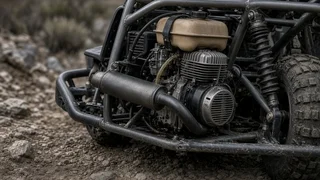
Extra seats mean extra weight, so engine output matters more on a four-seater. Compare power and torque within the same model year and trim, because figures can change between years and between versions that share a name.
Fuel type: gasoline is most common. Diesel and electric versions exist in some lineups and differ in range, refueling or recharging, noise and maintenance. Transmission: many side-by-sides use a CVT, a belt-driven automatic transmission. The drive belt is a wear item, so ask about its condition and replacement history. Drivetrain: check whether the vehicle offers selectable two-wheel and four-wheel drive and a locking front differential, which helps traction on rough or slippery ground. Suspension and clearance: compare suspension travel and ground clearance for your terrain, using figures for the exact trim, since these often differ across a lineup.
Street legality and registration
Most four-seat off-road buggies are sold for off-highway use only. Whether one can be registered for road use, and what equipment that requires, depends on your state, and sometimes on county or city rules. Off-highway vehicle registration or permits may also be needed to ride on public land. Check with your state's motor vehicle agency or off-highway vehicle program before you buy if road or public-land use matters to you.
Buying new versus used
A new vehicle from a dealer typically comes with a manufacturer's statement of origin and a warranty. A used one can cost less but needs closer inspection. Off-road machines are often worked hard, and visible cosmetic wear does not always reflect mechanical condition.
Paperwork: match the VIN on the frame to the title or other ownership documents. Title requirements for off-road vehicles vary by state. Usage: ask for the engine hour reading and maintenance records. Frame and cage: look for bends, cracks, welds or fresh paint that could hide crash damage. Wear items: inspect the CVT belt, wheel bearings, ball joints, tie rods, CV boots, brakes and tires. Recalls: check whether any open recalls apply to the specific VIN. Modifications: aftermarket lift kits, tires or engine tuning can affect warranty coverage, handling and reliability.
Ownership costs to plan for
Beyond the purchase price, plan for insurance, registration or permits, a trailer if you do not already have one, safety gear for four riders, and routine maintenance on the manufacturer's schedule. For lesser-known brands, confirm that a nearby dealer or shop can service the vehicle and that common parts are readily available before you commit.
Next step
Write down where you will ride, who will ride with you and how you will transport the vehicle. Then shortlist four-seat models whose published width, weight, seating and drivetrain fit those needs, and verify each figure for the specific model year and trim. Test-sit the rear seats with your actual passengers if you can, and have any used machine inspected before you pay.