Why Does Engine Oil Viscosity Change With Temperature?
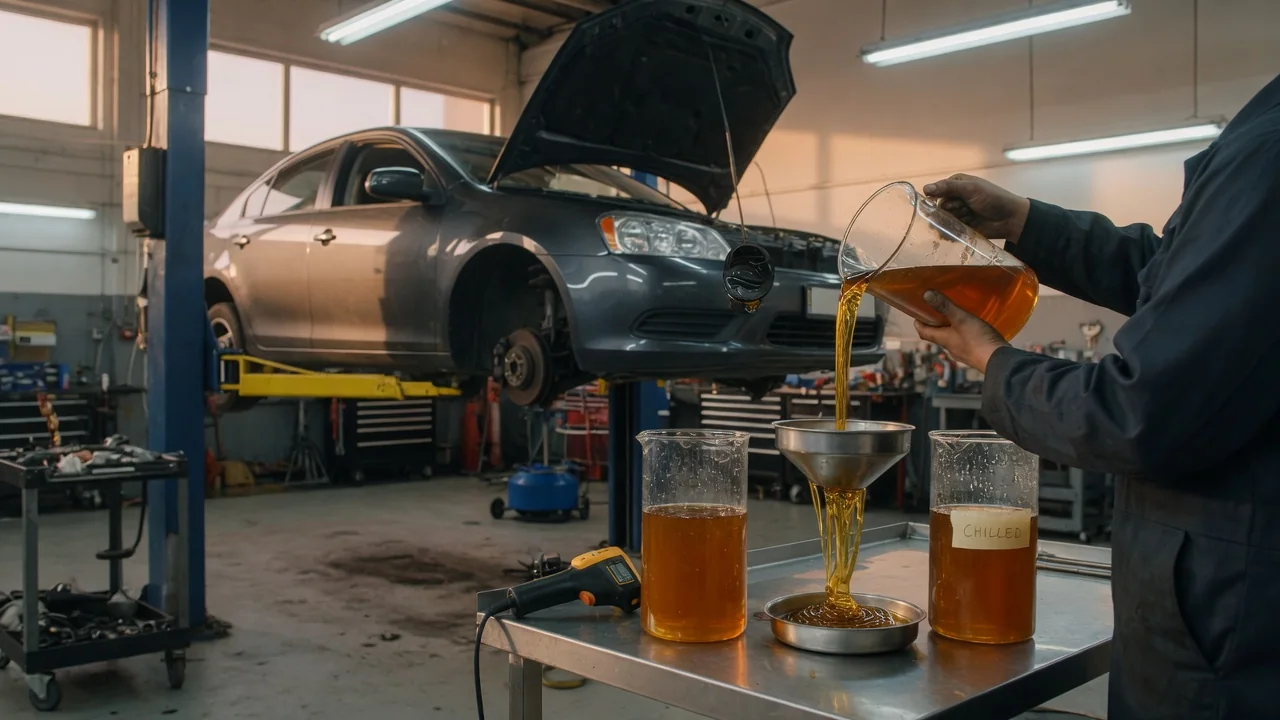
Engine oil does not have one fixed thickness. On a winter morning the same oil pours slowly from the bottle, and once the engine reaches operating temperature it flows far more freely. Knowing why engine oil viscosity changes with temperature explains how multigrade oils are designed, what the numbers on the label mean, and why the grade your engine maker recommends matters. This guide covers the causes of the oil viscosity temperature effect, cold flow, film thickness when hot, and how specifications describe both.
Cold flow: why oil thickens as it cools
Viscosity is a fluid's resistance to flow. In oil it comes from how the molecules interact as they slide past one another. Lubricating oil is made of fairly long hydrocarbon molecules that attract each other weakly and can tangle together. In cold oil those molecules move slowly and have little energy to overcome the forces holding them close, so the layers of oil resist sliding and the fluid feels thick. As temperature rises, the molecules gain kinetic energy, move slightly apart, and slip past each other more easily. The relationship is not linear. Viscosity usually rises steeply as oil cools, so the difference between a cold morning and a mild afternoon can be large even though the oil itself has not changed.
Cold flow matters most in the first moments after the engine starts. The oil pump has to draw oil through the pickup and push it through the filter and passages before it reaches the bearings, cam surfaces, and other moving parts. Very thick oil slows that trip and adds drag that the starter has to overcome while cranking. Some mineral base oils also contain wax-like components that can start to form crystals at low temperatures, which restricts flow further. Formulators add pour point depressants to interfere with that crystal growth. Synthetic base stocks are generally more uniform at the molecular level and tend to flow better in the cold. Actual performance still depends on the complete formulation, not on the base oil label alone.
Hot thickness: holding a protective film when warm
The opposite problem appears once the engine is fully warm. Many engine components, especially crankshaft and connecting rod bearings, rely on hydrodynamic lubrication. Motion drags oil into a narrowing gap, which builds pressure that keeps the metal surfaces separated by a thin film. How thick that film is depends heavily on viscosity. If the oil gets too thin at operating temperature, the film shrinks and the surface high points start carrying more of the load. Lubrication then shifts toward mixed or boundary conditions, where wear protection depends more on additive chemistry than on the fluid itself. Hot thickness means having enough viscosity left when the oil is at its thinnest to keep that separating film intact under load.
Multigrade oils narrow the gap between cold and hot behavior mainly through viscosity index improvers. These are long polymer molecules that stay fairly compact in cool oil, where they add little thickness, and expand as temperature rises, partly offsetting the natural thinning of the base oil. The approach has limits. Under high shear, such as in tight bearing clearances, the polymer chains can line up with the flow and temporarily lose some of their thickening effect. Over time, mechanical stress can also break some chains apart, which causes permanent viscosity loss. Formulators balance polymer type and base oil quality to keep this shear loss within acceptable bounds for the oil's grade.
Specification: how viscosity grades describe both extremes
In the United States, engine oil viscosity grades follow the SAE J300 standard. A multigrade label such as 5W-30 describes the two temperature extremes separately. The number before the W, which stands for winter, reflects cold performance. It is measured by tests that simulate cranking resistance and how well the oil can be pumped when cold. A lower W number means the oil stays more fluid at lower temperatures. The number after the dash reflects hot behavior. It is based on kinematic viscosity at 100 degrees Celsius and a minimum high-temperature, high-shear viscosity measured at 150 degrees Celsius. A higher second number means the oil stays thicker at operating temperature.
Another measure, the viscosity index, summarizes how much an oil's viscosity changes between two reference temperatures. A higher index means a flatter curve and less change. It appears on some technical data sheets but is not part of the grade printed on the bottle. Viscosity should also be kept separate from overall quality. The grade only describes thickness under defined conditions. Detergency, wear protection, deposit control, and compatibility with emissions hardware are covered by separate performance standards and manufacturer approvals, which appear elsewhere on the container and in the owner's manual.
Practical implications and limits
Because cold flow and hot film strength pull in opposite directions, the right grade is a compromise chosen for a particular engine design. Bearing clearances, oil pump capacity, and hydraulically operated parts such as lifters, chain tensioners, and variable valve timing systems are all developed around an expected viscosity range. That is why the owner's manual is the authoritative source. Some manuals list a single grade, while others show acceptable grades for different outdoor temperature ranges. Choosing a thicker oil because it seems more protective can slow cold-start flow and may interfere with systems calibrated for a specific viscosity. Going thinner than specified can reduce the hot film margin the engine was designed around.
The grade on the label also describes fresh oil under laboratory conditions, not oil that has been in service for months. In use, fuel dilution can thin oil, oxidation and soot can thicken it, and shear can gradually reduce what the viscosity improvers contribute. Oil temperature also differs from outdoor temperature and depends on how the car is driven. Frequent short trips may keep the oil from fully warming up, which lets moisture and fuel build up. Symptoms such as a low oil pressure warning or unusual noise at startup call for diagnosis rather than a switch to another grade. General viscosity principles explain why oil behaves as it does, but they cannot predict the exact requirements of any individual engine.