Why Does Cold Air Reduce Tire Pressure? The Physics and What to Do
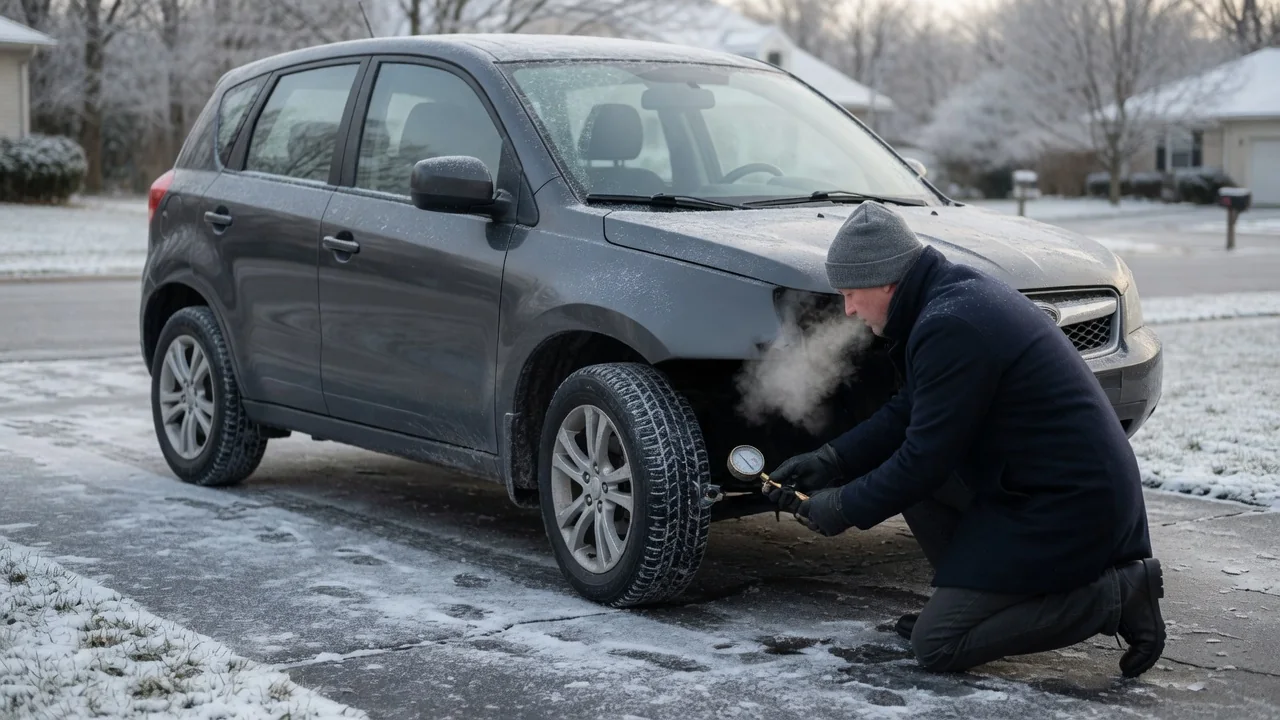
Tire pressure drops in cold weather because the air inside the tire is a gas, and gases exert less pressure as they cool. Nothing has to leak for the gauge reading to fall. The same amount of air simply pushes less on the tire's inner walls. This article explains the cold weather tire pressure physics, how to check pressure correctly when temperatures fall, why the tire pressure monitoring system often reacts on chilly mornings, and where the general rules stop applying.
Temperature and gas: the physics behind the drop
Air is made of molecules that move constantly and collide with everything around them, including the inner liner of a tire. Pressure is the combined force of those collisions spread over the surface. When air cools, the molecules move more slowly and hit the walls less often and with less force, so the pressure falls. A tire is a nearly fixed container, so the volume of air cannot shrink much to compensate. Most of the temperature change therefore shows up directly as a change in pressure. The ideal gas law describes this relationship between pressure, volume, temperature and the amount of gas.
One detail explains why the effect is so noticeable. The gas law works with absolute pressure and absolute temperature, while a tire gauge shows gauge pressure, the pressure above the surrounding atmosphere. Absolute pressure is the gauge reading plus roughly 14.7 psi of atmospheric pressure at sea level. Absolute temperature is measured from absolute zero, so an ordinary drop of a few dozen degrees is only a small percentage change. That small percentage applies to the whole absolute pressure, but the entire loss comes out of the portion the gauge displays. A modest temperature change therefore produces a visible drop on the gauge.
Applying those relationships to a tire in the common passenger-car pressure range gives the widely cited rule of thumb of about 1 psi of change for every 10 degrees Fahrenheit. It is an approximation, not a fixed constant, but it matches everyday experience well. A tire set correctly on a mild afternoon can read several psi low after a sharp overnight cold snap without losing any air. Filling with nitrogen does not change this behavior in any meaningful way, because nitrogen follows the same gas law.
Cold checks: measuring pressure the right way
The pressure shown on the vehicle placard, usually located on the driver's door jamb and repeated in the owner's manual, is a cold inflation pressure. It assumes the tire is at ambient temperature rather than warmed by driving. Driving flexes the tire and heats the air inside, which raises the reading. A measurement taken after a long drive will look higher than the true cold value, and letting air out to match the placard at that moment leaves the tire underinflated once it cools down.
The most reliable routine is to check pressure before driving, after the vehicle has been parked for several hours, such as first thing in the morning. If air has to be added at a station some distance away, the tires will already have warmed on the way there. Noting the cold reading at home first shows how much air each tire actually needs, so the warm reading at the pump can be adjusted accordingly. Check all four tires with a dependable gauge and refit the valve caps afterward to keep dirt and moisture out of the valves.
Where the car is parked also matters. A vehicle kept in a heated garage can read correctly indoors and then lose pressure once it sits outside in freezing air. If the car spends most of its winter hours outdoors, setting pressure at outdoor temperature gives a more realistic result. During seasonal transitions, checking more often makes sense, because one large temperature swing can move pressure further than weeks of normal slow air loss. The maximum pressure molded into the sidewall is a structural limit, not an inflation target.
TPMS: why the warning light appears on cold mornings
A tire pressure monitoring system alerts the driver to underinflation with a dashboard warning. Direct systems use sensors, usually mounted inside each wheel at the valve, that measure pressure and transmit it to the vehicle. Indirect systems have no pressure sensors. They use wheel speed data from the antilock braking system and infer low pressure from changes in how fast a tire rotates, since an underinflated tire has a slightly smaller rolling diameter. Which type a vehicle uses, and what information it displays, depends on the manufacturer and model.
Cold mornings are a classic trigger for the warning. If a tire was already slightly below the recommended level, an overnight temperature drop can push it past the system's threshold. After some driving the air warms, pressure rises, and the light may go out on its own. That does not mean the problem has resolved itself. The tire is still low whenever it is cold, and the warning will likely return on the next chilly morning. The correct response is to check every tire with a gauge and inflate to the placard pressure.
TPMS is a safety net, not a substitute for regular checks. Systems are generally designed to warn only when pressure falls well below the recommended value, so a tire can be low enough to affect handling and wear before any alert appears. On many vehicles, a light that flashes at startup and then stays on points to a system fault rather than low pressure. Some vehicles also need a reset or relearn procedure after inflation, tire rotation or sensor replacement, and the owner's manual describes the correct steps.
Practical implications and limits
Underinflation caused by cold has the same consequences as underinflation from any other cause. A soft tire flexes more, which builds heat and increases rolling resistance, and that can raise fuel consumption. It also tends to wear the outer edges of the tread faster and can make steering feel less precise. In winter, when grip is already limited, keeping the tire's contact patch shaped as intended is especially worthwhile.
The 1 psi per 10 degrees figure has limits. The actual change depends on starting pressure, tire size and how the tire structure itself responds to temperature. Sunlight on one side of the car, recent driving or a spot near a heated building can make individual tires read differently at the same moment. Tires run at higher pressures, common on trucks and some SUVs, tend to change by more psi for the same temperature swing because their starting absolute pressure is higher. Treat the rule as an estimate and the gauge reading as the measurement that counts.
Cold also cannot explain every pressure loss. If one tire repeatedly drops faster than the others, or pressure keeps falling while temperatures stay steady, a leak from a puncture, a damaged valve, corrosion at the wheel bead or a faulty sensor seal is more likely. Those cases call for inspection rather than routine topping up. The reverse also holds: pressure set in winter will rise when warm weather returns, so checking against the placard through every season keeps the tires where the vehicle manufacturer intends.