Why Does a Car Shudder During Very Tight Turns?
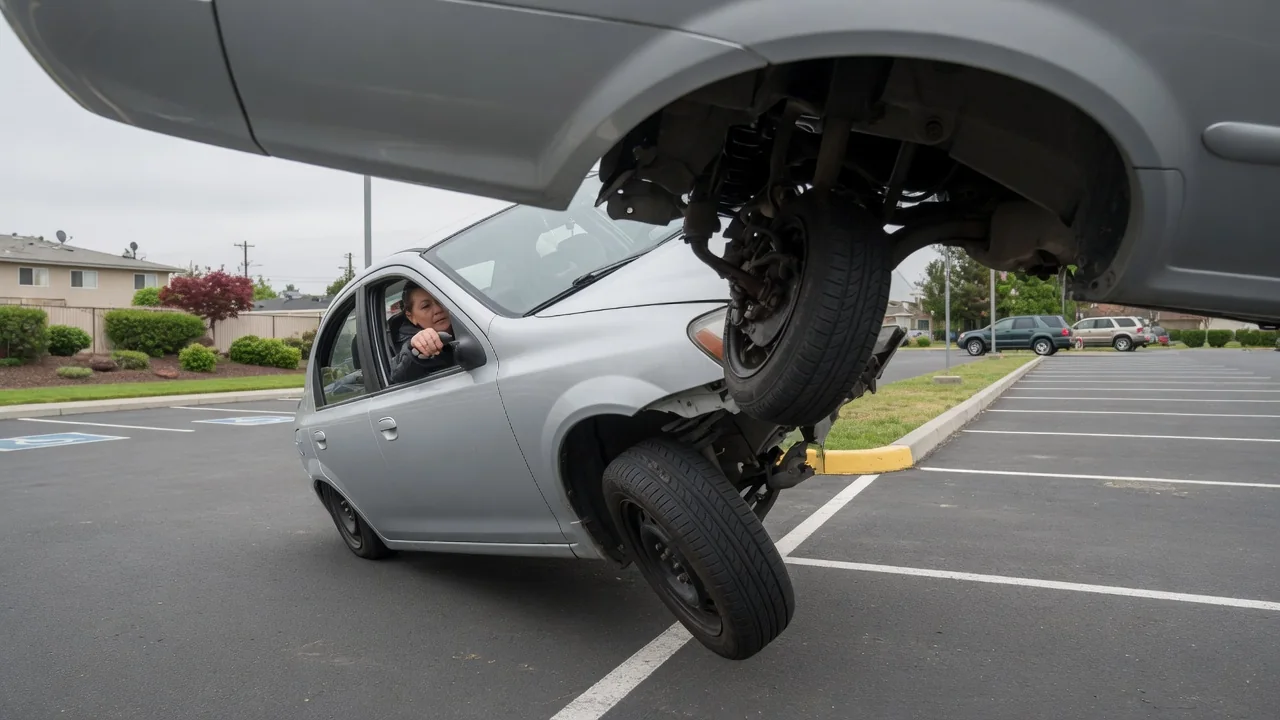
A shake or hop felt through the steering wheel while creeping into a parking space can be unsettling, and it leads many owners to ask why a car shudders during very tight turns. The answer usually falls into two broad families: tires scrubbing across the pavement, or drivetrain parts binding as the wheels travel different distances. Sorting between them starts with careful observation.
Surface and steering lock
At full steering lock, the two front wheels follow arcs of different radius, and steering geometry cannot keep both tires perfectly aligned with their paths at every angle. One tire ends up dragged slightly sideways, a behavior commonly called tire scrub. On grippy surfaces such as sealed concrete, painted garage floors, or dry asphalt, the tread grips, flexes, and then releases in quick succession, which the driver feels as a low-speed shudder or hop rather than a smooth roll.
Surface and temperature change the sensation noticeably. The same maneuver on gravel, wet pavement, or loose dirt often feels smooth because the tread can slip without storing and releasing energy. Cold weather tends to make it more pronounced, since stiffer rubber compounds resist flexing, and wide, low-profile, or performance-oriented tires usually scrub more than narrow all-season ones. Some vehicles are known for this trait by design, so a mild skip at full lock on a cold morning is not automatically evidence of a fault.
Drivetrain layout
How power reaches the wheels shapes what a tight turn demands. In any corner the outside wheels travel farther than the inside ones, and the front axle travels farther than the rear. Differentials exist to allow those speed differences. A part-time four-wheel-drive system that locks the front and rear axles together has no such allowance between them, so on dry pavement the driveline winds up and releases through the tires, producing a pronounced binding, hopping sensation that disappears once two-wheel drive is selected.
All-wheel-drive vehicles use a center coupling, clutch pack, or viscous unit to manage that difference, and when the unit engages more firmly than intended, or its fluid has degraded, a similar bind can appear in tight parking maneuvers. Limited-slip differentials can chatter when their clutches grab instead of slipping smoothly. On front-wheel-drive cars, worn outer constant-velocity joints more often click or pop at full lock, though a rough joint can also contribute vibration under power. Exact designs differ widely, so the vehicle's own documentation matters.
Inspection
A sensible inspection begins with the tires, because they are easy to check and frequently involved. Mismatched brands, uneven tread depth between axles, or incorrect pressures change rolling circumference, and on all-wheel-drive vehicles that mismatch can force the center coupling to work constantly. Feathered or cupped tread edges hint at alignment or suspension wear. A look at the rubber boots covering the axle joints is also worthwhile, since a torn boot that has flung grease suggests a joint running without proper lubrication.
Beyond what an owner can see, a technician can raise the vehicle to check for play in tie rod ends, ball joints, strut mounts, and wheel bearings, any of which can let a wheel shift under the loads of full lock. Power steering condition deserves attention too, because a pump or electric assist struggling at the steering stops can send a groan or shake through the wheel. Differential and transfer case fluid condition is assessed against the manufacturer's specification, since the correct fluid type varies by vehicle.
Everyday Use and Observations
Day-to-day patterns are valuable clues. Note whether the shudder appears only when the tires are cold and fades after a few miles, which leans toward tire scrub, or whether it persists or worsens once everything is warm, which leans toward a driveline coupling or differential. Notice whether it occurs in both directions or just one, in forward and reverse, and whether it changes when the car coasts through the turn compared with when throttle is applied.
Where the sensation arrives also helps. Vibration through the steering wheel points toward the front tires, steering, or front axle joints, while a shudder felt through the seat or floor suggests the rear axle or center of the vehicle. Accompanying sounds matter: rhythmic clicking, a low groan, or a moaning chatter each suggest different sources. If the vehicle has selectable drive modes, comparing behavior between them, on a suitable surface and as the owner's manual permits, can separate a driveline cause from a tire one.
Limits and Next Steps
Observation has limits. Several causes feel nearly identical from the driver's seat, and a warning light or stored fault code related to the all-wheel-drive system is a lead to interpret rather than proof that a specific component has failed. Many such codes are manufacturer dependent, so their meaning needs to be confirmed for the exact vehicle. Replacing parts on a hunch, or changing fluid with a product that does not match the specified type, can add expense without resolving the shudder.
A mild, cold-weather skip that never changes may simply be a characteristic worth mentioning at the next service visit. A shudder that is new, growing stronger, tied to one direction, or joined by clicking, grinding, a burning smell, or warning lights deserves prompt professional evaluation, because continued binding puts stress on tires, joints, and couplings. Describing the conditions clearly, including surface, temperature, speed, steering angle, and drive mode, gives a technician the best chance of reproducing the problem and confirming the cause before any repair is recommended.