Why Car Water Pumps Fail
A car water pump fails when its bearing, seal, impeller, housing, or drive mechanism degrades enough to stop moving coolant reliably. The result can be a slow leak, noise, overheating, or sudden loss of the drive belt. This guide explains the failure modes and the practical signs that help a driver respond before engine damage occurs.
Essential answer
A water pump usually breaks through gradual mechanical wear rather than one abrupt event. The impeller bearing develops play, the shaft seal begins to weep, or the impeller corrodes and loses its ability to pressurize the cooling circuit. In some engines, oil or a failing belt tensioner accelerates that wear and changes how the pump fails.
Once the pump cannot maintain flow, heat concentrates around the cylinder head and radiator inlet. If the leak is external, coolant may drip near the drive belt area. If the weep passage is clogged, coolant can instead push past the seal into the bearing, causing rapid failure. Treating any loss of flow as a possible pump fault helps prevent a warped head or failed head gasket.
How it works
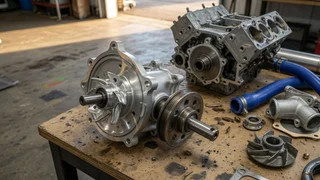
The pump is a compact centrifugal unit driven by the timing belt, accessory belt, or chain. The engine spins an impeller inside a housing, flinging coolant outward to create pressure difference between the radiator side and the engine block. The thermostat controls whether that moving coolant continues through the radiator or recirculates through the engine during warm-up.
A bearing supports the shaft while a mechanical seal keeps coolant away from it. Small amounts of pressure from the pressure cap and thermal expansion give the seal a difficult job, especially when air pockets or incorrect coolant concentration raise local temperatures. If the seal allows coolant to reach the bearing, the grease washes out and the pump starts to howl or wobble.
Strengths, limitations and suitability
A well-matched pump is reliable when the cooling system stays clean, the belt tension is correct, and the coolant specification suits the engine materials. Its main strength is simplicity: a properly lubricated bearing and intact seal can last through many years of normal driving without separate adjustment. The pump also works well across stop-and-go and highway conditions because its output rises with engine speed.
The limitation is that it depends on the rest of the cooling circuit. Debris from a degrading hose, an over-concentrated coolant mixture, or a radiator blockage can increase pump workload and erode the impeller. A failed pressure cap that does not hold system pressure may allow localized boiling and air pockets, which reduces pump efficiency even if the pump itself is still rotating.
Procedure
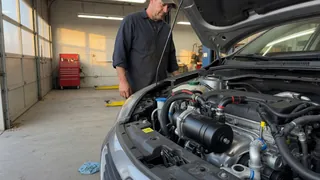
Begin by checking the coolant level and inspecting the pump area with the engine cool. Look for a stain running down from the weep hole, a loose bearing with visible wobble at the pulley, or coolant spray on nearby belts and hoses. Do not open a hot pressure cap; system pressure can cause serious burns.
When replacing a pump, follow the manufacturer procedure for draining, belt removal, gasket cleaning, and refilling. Use the specified coolant concentration and bleed air pockets from the cooling circuit before extended driving. After the repair, run the engine to operating temperature and watch the pump area and temperature gauge while the thermostat opens.
Diagnosing a problem
A pump-related symptom can look like a thermostat or radiator fault. An overheating engine that cools at highway speed but runs hot in traffic may point to airflow or fan trouble, not necessarily the pump. However, a persistent overheat with a full radiator and good airflow suggests low flow from a worn impeller or restricted cooling circuit.
Noise helps separate the pump from other accessories. A rhythmic growl or rattle near the pump pulley that changes with engine speed often means bearing wear. If coolant appears at the weep passage, the seal is failing. If the level falls without an external drip, check for steam, a coolant odor, or milky oil, because internal loss requires stopping use and professional diagnosis.