Whether Transmission Fluid Is Engine Oil

Direct answer
No, transmission fluid is not engine oil. They are separate lubricants designed for different hardware, temperatures, pressures and contamination conditions. Using one in place of the other can cause damage. The only safe exception is a narrow range of older manual transmissions or hydraulic systems whose manufacturer explicitly approves a specific engine oil as an alternative fill, but this is not a general rule.
Why the fluids are different
Engine oil is formulated for combustion byproducts, high heat around pistons and cylinder walls, and the protection of bearings, rings and valvetrain parts under high shear. Transmission fluid is formulated for hydraulic function, clutch or band friction control, gear wear protection, and the lower combustion-free environment inside a transmission. The additive packages, base oil selection and viscosity behavior are not interchangeable.
Key functional differences
Property | Engine oil | Transmission fluid; Primary role | Lubricate and clean combustion engine internals | Transfer hydraulic pressure and lubricate gears or clutch packs; Detergents | High, to suspend soot and sludge | Low, to avoid interfering with clutch friction; Friction modifiers | Varies by oil specification | Tuned specifically for wet clutches, bands or synchronizers; Heat exposure | Combustion chamber and turbo heat | Lower but still high in loaded automatic transmissions; Contaminants | Fuel, soot, blow-by and moisture | Clutch material and fine metal wear particles
Automatic transmissions
Automatic transmissions depend on fluid pressure to engage clutches, operate valves and cool the unit. Engine oil does not have the correct friction characteristics, viscosity profile or additive chemistry for this hydraulic role. Filling an automatic transmission with engine oil can produce slipping, harsh shifts, overheating and eventual failure.
Continuously variable and dual-clutch transmissions
CVTs and dual-clutch transmissions require dedicated fluids with precise steel-on-steel friction behavior. Engine oil is not a substitute. Manufacturer-specific CVT fluid and DCT fluid exist because the metal contact conditions and control requirements differ from both conventional automatics and manual gearboxes.
Manual transmissions and the limited exception
Some manual transmissions can use engine oil, but only when the vehicle manufacturer lists it as an approved fill for that specific model and model year. This is most common in older designs with moderate gear loads. Modern manual transmissions more often use a dedicated manual transmission fluid or a gear oil. The owner manual or a technical service document is the only reliable source for this exception.
What happens if the fluids are mixed
Mixing engine oil into transmission fluid changes the additive balance and friction behavior. In an automatic transmission, the result can be clutch shudder, delayed engagement, seal degradation and reduced cooling. In an engine, adding transmission fluid can lower the lubricant’s ability to handle combustion contaminants and may affect viscosity. Drain, flush where appropriate, and refill with the correct specification if a mix is suspected.
Identification
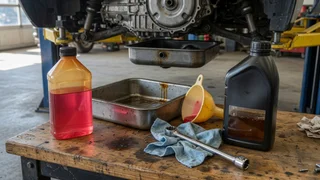
Engine oil is typically amber to dark brown or black after use. Automatic transmission fluid is commonly red, green or amber when new, and can darken with age. Color alone is not a reliable identifier because some manufacturers use similar dye colors across fluids. The labeled specification, part number and intended application are the only dependable way to distinguish them.
Next action
Use the fluid specified in the owner manual for your exact model year, powertrain and transmission type. If the manual is unavailable, use a parts lookup based on the vehicle identification number. Do not substitute engine oil for transmission fluid unless the manufacturer’s documentation explicitly permits it for that transmission.