What Is TPMS? How Tire Pressure Monitoring Systems and Sensors Work
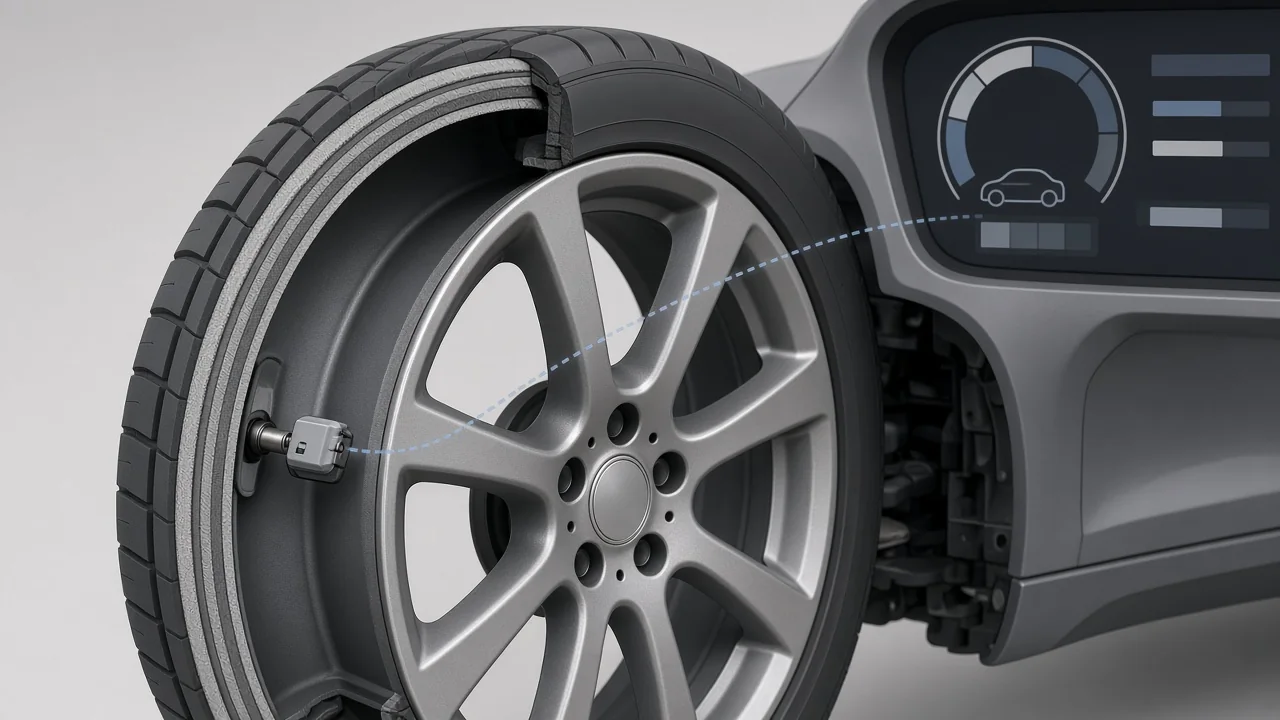
Most modern cars carry a quiet watchman inside or alongside each wheel, keeping an eye on air pressure while you drive. Knowing how that system works, where its sensors sit and what the warning actually means helps you trust it for the right things. It also keeps you from relying on it for the wrong ones. Here is how tire pressure monitoring fits together.
What TPMS Stands For and Why Cars Have It
TPMS stands for tire pressure monitoring system, a feature that alerts the driver when one or more tires fall well below the pressure the vehicle expects. Think of it as an early warning for underinflation, not a replacement for tire maintenance. The reason for it is simple. A tire can lose air slowly for weeks, or quickly after picking up a nail, and many drivers never notice until the handling feels vague. An underinflated tire flexes more, runs hotter and wears its shoulders faster. It also adds rolling resistance that quietly costs fuel.
If you check pressure only at the gas station, there can be long gaps between checks. That is why monitoring during the drive appealed to both regulators and automakers. Over time the feature went from a luxury extra to standard equipment on many passenger vehicles. Its scope is still narrow, though. The system watches inflation pressure, and some designs also report the air temperature inside the tire. It knows nothing about tread depth, alignment, uneven wear or how old the rubber is. You still have to check those yourself.
Where the Tire Pressure Sensor Lives in the Wheel
On most cars with in-wheel hardware, the tire pressure sensor is attached to the inner end of the valve stem. It sits inside the tire cavity, against the rim. From the outside you see only a valve stem and cap. Sometimes a metal stem or a distinctive retaining nut hints that a sensor is behind it. A less common design straps the sensor around the wheel's center with a metal band, keeping it separate from the valve. Either way, the sensor sits inside the sealed air chamber, where it can read the true pressure.
The sensor itself is a small sealed unit built around three parts. A pressure transducer turns air pressure into an electrical signal, a battery powers the unit, and a radio transmitter sends the data out. Because the sensor is fastened to the wheel, it travels with that wheel. When you rotate the tires or swap wheels, the sensors move with them, so the car may need to learn their new positions. Design, placement and construction vary by manufacturer, so confirm which setup your own vehicle uses.
Direct TPMS: Sensors That Measure Pressure Themselves
In a direct system, each sensor measures the actual air pressure inside its own tire. The sensor usually doesn't send data constantly. It typically transmits at intervals while the car is moving, and it may send an extra message when it detects a significant change. Every sensor also broadcasts a unique ID with each reading. The receiver uses these IDs to tell its own sensors from those on nearby cars. On vehicles that support it, the IDs also let the receiver match each reading to a specific wheel position.
The battery is sealed inside the sensor housing, so it usually can't be swapped on its own, and its capacity is limited. Every transmission uses some power, so a sensor's life depends on its battery and on how much the car is driven. Eventually the whole unit needs attention once the battery runs down. The spare tire is a separate question. Some vehicles monitor a full-size spare with its own sensor, while many compact or temporary spares have none. Check how your vehicle handles it.
Indirect TPMS: Estimating Pressure From Wheel Speed
Indirect systems work in a completely different way. Instead of putting hardware inside the tire, they use the wheel-speed sensors that the anti-lock braking system, and often stability control, already rely on. These sensors track how fast each wheel spins. The principle is simple geometry. When a tire loses air, it squats slightly and its rolling radius shrinks. It then has to turn a little faster than the others to cover the same distance. Software constantly compares the wheels and flags any one that is out of step.
Because it infers pressure from wheel rotation, an indirect system usually can't show an actual psi or kPa figure. It can only tell you that one wheel looks different from the others. That makes some situations tricky. If all four tires lose air evenly over months, the wheels still turn at matching speeds, and the system may not catch the problem. Mixing tire sizes, putting new tires on only one axle or uneven wear can also shift the baseline. That is why these systems generally need to learn a fresh baseline after tire work.
How a Reading Travels From the Tire to the Dashboard
In a direct system, a reading starts as a short radio burst from the sensor inside the tire. A receiver picks up the signal, checks the sensor ID and decodes the pressure value. The receiver may be a dedicated module or part of another control unit. The control module then compares the value against its programmed limits and sends the result to the instrument cluster or infotainment screen. What you see there varies. Some vehicles show a number for each tire. Others, including many indirect systems and some trim levels, show only a low tire pressure warning light.
Because sensors transmit at intervals rather than constantly, the display can lag. Right after startup, some readings may stay blank or out of date until the car has been moving for a few minutes. After you add air, the new figure may not appear right away. It is also normal for the dashboard number to differ slightly from a hand gauge. The two readings may have been taken at different times, the tire may have warmed up from driving, and neither instrument is perfectly exact. Small differences are expected, but large, persistent ones deserve a closer look.
What TPMS Tells You and What It Doesn't
The most important thing to understand is that the warning point is not the correct pressure. TPMS alerts you when pressure drops well below a set limit. A dashboard with no warning doesn't mean your tires are at the recommended pressure. They could be several psi low and still not trigger the alert. Temperature also plays a part. Air pressure falls as air cools, so a cold morning after a warm day can turn on the light without any leak. The light may then go out once driving warms the tires.
There is also a lot the system can't detect. It won't report a nail that hasn't let air out yet, a bulging or cut sidewall, or tread worn close to its limit. That is why a regular check with a good gauge is still the real authority. Check the tires cold and compare the reading to the pressure on the door jamb placard, not the maximum printed on the sidewall. If the system acts inconsistently, such as warning on and off or showing numbers that make no sense, have a qualified technician inspect it.