How to Reset a TPMS Light and Relearn Sensors After Tire Work
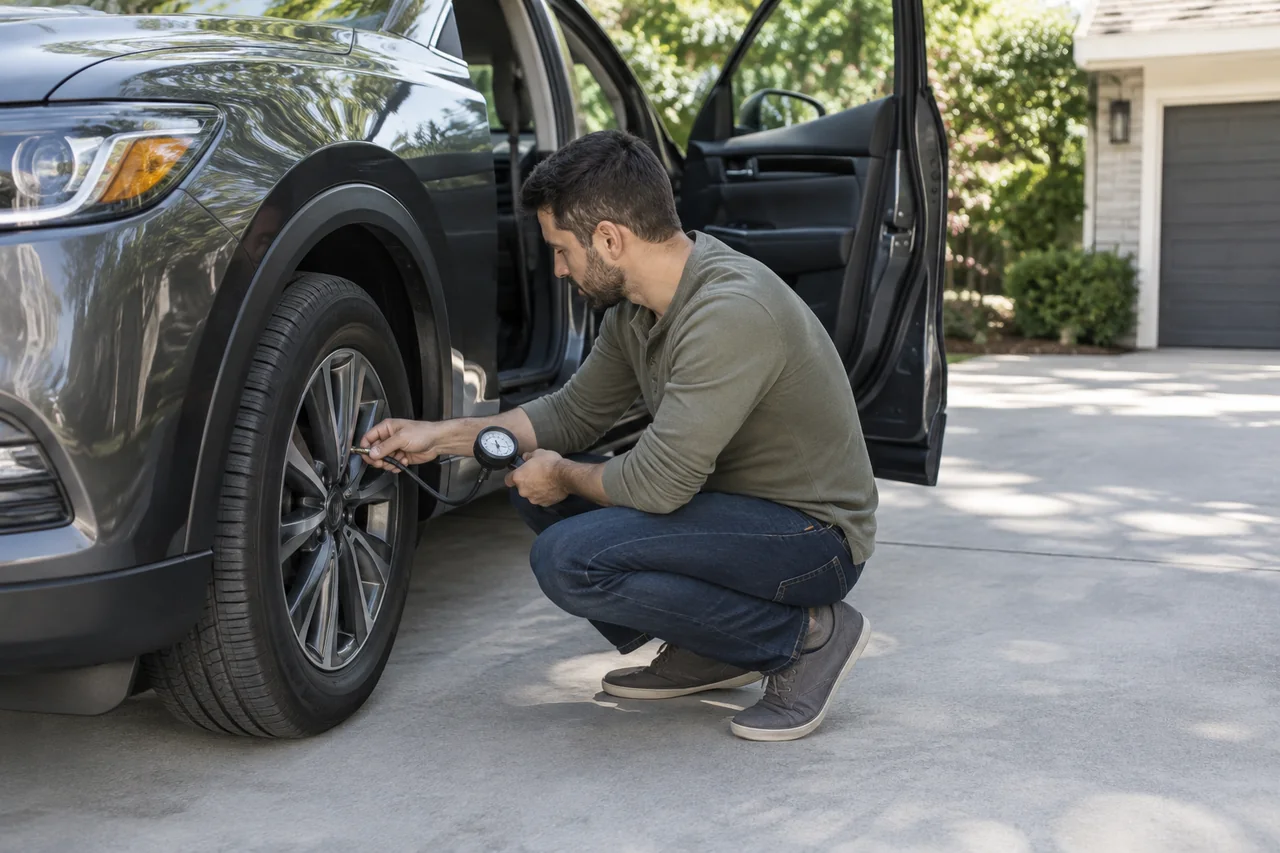
After a tire rotation, new tires, or fresh sensors, the tire pressure warning can stay on or behave unexpectedly. To reset the tire pressure monitoring system correctly, start by confirming actual pressures. Then find out whether your vehicle needs a simple reset, a calibration, a drive-cycle relearn, or sensor registration with a tool. This guide explains each path and when the job belongs with a tire shop.
Check and Correct Tire Pressure Before Starting a Reset
Before touching any reset control, park on level ground away from traffic. Check every tire with a reliable gauge while the tires are cold, meaning the vehicle has sat long enough that heat from driving isn't raising the readings. Your owner's manual explains what counts as cold. Warm tires read higher, so topping off right after a highway drive can leave them underinflated later. If your vehicle monitors the spare, check it too.
Set each tire to the pressure on the door-jamb tire placard, not the maximum molded on the sidewall. The sidewall number is the most the tire is rated to hold. The placard reflects your vehicle's load and handling needs, and front and rear targets may differ. While you're checking, look for nails, cuts, or bulges. A tire that keeps losing air needs a repair inspection first, because a reset never adds air or seals a leak. Never drive on a visibly flat or damaged tire to clear the light.
Identify the TPMS Procedure Required After Your Tire Work
Start with the owner's manual for your exact model and year. It tells you which monitoring type you have and what the vehicle expects after tire work. Direct systems put a pressure sensor in each wheel, and each sensor sends a unique sensor identification number. Depending on the vehicle, the system may need those IDs registered, or it may need to learn which position each sensor now occupies after a rotation. Some vehicles show only a general warning and need no position update at all.
Indirect tire pressure monitoring has no wheel sensors. Instead, it compares wheel-speed signals to detect when a low tire changes its rolling diameter. These systems usually need calibration after pressures are corrected or tires are replaced so they can learn a new baseline. The terms vary widely. A reset may just clear a warning, calibration teaches a baseline, a relearn matches sensor IDs to the vehicle or wheel positions, and replacement sensor programming sets up a new sensor. A rotation, new tires, and a new sensor may each need a different step.
Follow the Documented Reset Button or Dashboard Menu Sequence
If your vehicle has a reset you can do yourself, the manual will say where to find it. Some vehicles use a physical button, while many newer designs put TPMS calibration in the instrument cluster or infotainment settings menu. Find the control the manual describes instead of experimenting with unrelated buttons. Many vehicles have no owner-operated reset at all. They either learn automatically or need a service tool.
The general sequence is to correct cold pressures, park safely, and then follow the manual's instructions for ignition position, button hold time, or menu selection exactly, because these details vary by vehicle. Watch for the confirmation the manual describes, such as a blinking indicator, a chime, or an on-screen message. That confirmation often means calibration has started, not that it has finished. Many systems still need a stretch of normal driving to complete the process, so check the manual for any verification step before assuming the job is done.
Complete an Automatic Relearn When the Vehicle Supports It
Some direct systems learn new sensor IDs or positions on their own while you drive, and many indirect systems finish calibration the same way. The key is meeting the manual's prerequisites first. These can include correct pressures, a period parked, or a specific ignition sequence before you set off. Use the driving conditions and completion criteria in your owner's manual, not a speed, distance, or time you read elsewhere. Requirements differ between systems, and a drive that doesn't match them may not count.
Once you've met the manual's conditions, park safely and check the result. The TPMS warning light should be off. If your vehicle shows individual tire pressures, every wheel should have a reading, ideally in the correct position. Driving can't fix every problem, though. If a sensor isn't registered, has a dead battery, or isn't communicating, more driving won't change anything. If the manual's procedure fails once or twice, stop repeating it and move on to finding the cause.
Recognize When Sensor Relearning or Programming Needs a Tool
Some direct systems can't learn sensors without outside help. On these vehicles, a TPMS tool wakes up each sensor so it sends its ID, then registers those IDs with the vehicle, sometimes through the diagnostic port. Replacement sensors add another step. Some aftermarket or configurable sensors must be programmed with the right settings before the vehicle can recognize them at all. Not every sensor can be reprogrammed, and a sensor made for one vehicle may not work on another even if it fits the valve hole.
Whether a sensor will work, and how to set it up, depends on your specific vehicle and the sensors actually installed. Confirm both before assuming a sensor will work or can be moved to another vehicle. At a tire shop, ask them to check that every sensor responds, finish any required programming and registration, and confirm the vehicle shows each tire in the right position if your system supports that. Asking to see a pressure reading from each wheel before you leave helps catch a sensor that was missed during installation.
Investigate a TPMS Light That Stays On or Returns
How the light behaves tells you something. A steady TPMS warning light usually means one or more tires are low. A light that flashes for a while at startup and then stays on usually means a system fault, such as a sensor that isn't communicating. Warning behavior differs between vehicles, so check your manual to see what yours means. If the light comes back after a reset, recheck the cold pressures first, since a slow leak is the simplest explanation.
Note when the warning started, because a warning after a rotation, new tires, or a new sensor points to different causes. Missing readings or a failed relearn can come from unregistered IDs, communication problems, incorrect programming, or a damaged sensor. None of these symptoms alone proves a sensor needs replacing. If correct pressures and the manual's procedure don't clear the light, have a professional test the pressures, check for leaks, and test the TPMS. Resetting the system over and over only hides the problem and can leave you without a working low-pressure warning.