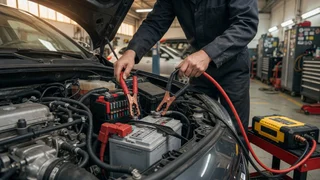
What Is Battery Bypass? Meanings, How It Works and When It Makes Sense
"Battery bypass" is not a single standardized automotive part or procedure. It is an informal term for routing electrical current around a vehicle's battery, or around one section of the battery circuit, so that power reaches the rest of the system by another path. What that means in practice depends on context. It might be an emergency-start link in a dual-battery setup, a workaround for a battery monitoring sensor, a way to run a small engine without a battery, or a temporary fix for a damaged cable or disconnect switch. This guide explains each common meaning and how it works electrically. It also covers where battery bypass is legitimate and where it creates risk. If you are trying to solve a charging or no-start problem, the final sections cover what to check before anything gets bypassed.
The Short Answer
In a conventional 12-volt vehicle, the battery does two jobs. It supplies the large burst of current needed to crank the engine, and it acts as a buffer that steadies system voltage while the alternator is running. A battery bypass gives current a path that does not pass through the battery, or through part of its normal wiring. Some bypasses are deliberate design features, such as a switch that links two batteries for emergency starting. Others are improvised workarounds. Improvised versions can remove protection the vehicle relies on, especially in modern vehicles with sensitive electronics and smart charging systems.
Common Meanings of Battery Bypass
Emergency start or isolator bypass in dual-battery systems
Trucks, RVs, off-road vehicles, boats and work vans often carry a second, auxiliary battery to run accessories without draining the starting battery. An isolator or battery management device keeps the two separated when the engine is off. Many of these systems include a manual bypass, often labeled emergency start or link. It temporarily connects the auxiliary battery to the starting circuit so a flat starting battery can be helped by the healthy one. This is probably the most legitimate and widely understood use of the term.
Bypassing a battery current sensor or monitoring module
Many newer vehicles have an intelligent battery sensor, usually mounted on the negative battery terminal or cable. It measures current, voltage and sometimes temperature, and it reports to the engine or body control module. The vehicle uses this data to manage charging output, which is often called smart or variable charging. People sometimes talk about bypassing this sensor after a battery replacement, when charging behaves oddly, or when fitting a different battery type. Doing so usually means the vehicle loses accurate information about battery state. That can trigger warning lights, disable fuel-saving features, or cause the charging system to fall back to a default strategy. On many vehicles, the correct approach after a battery change is to register the new battery with a scan tool rather than bypass anything. Whether that applies depends on the make, model year and battery type.
Running without a battery (battery eliminators)
Some motorcycles, dirt bikes, race vehicles and small engines can run without a conventional battery. They use a capacitor-based battery eliminator, or rely on a charging system designed for batteryless operation. In this sense, "battery bypass" means the electrical system runs straight from the generator or alternator output. This works only on systems designed or adapted for it. A typical road car or truck depends on the battery to absorb voltage spikes and to run electronics before the engine starts, so it is not a candidate.
Bypassing a damaged cable, terminal or disconnect switch
A corroded battery cable, a failed battery disconnect (kill) switch or a damaged main fusible link can stop current from reaching the starter or fuse box. A temporary bypass cable is sometimes used to get a vehicle moving or to confirm that the part is the fault. As a diagnostic step, this can be informative. As a permanent repair, it is risky, because the improvised path may lack the correct fuse rating, cable gauge and secure connections.
Jump-starting through remote terminals
Some vehicles mount the battery in the trunk, under a seat or beneath the floor. These vehicles provide remote jump-start posts under the hood. Using those posts is sometimes loosely called bypassing the battery, but the current still flows into the same circuit the battery feeds. It is a manufacturer-provided access point, not a true bypass.
How Battery Bypass Works Electrically
To understand what a bypass changes, think of the battery as both a reservoir and a shock absorber.
Cranking supply: The starter motor draws far more current than anything else in the vehicle. The battery delivers this current through heavy cables and the battery terminals. Any bypass meant to help starting must carry similar current without excessive voltage drop, which is the loss of voltage across a cable, connection or switch under load. Voltage stabilization: With the engine running, the alternator produces the charging output, and the battery smooths out fluctuations. If the battery is removed from the circuit, sudden load changes can produce voltage spikes, sometimes called load dump. These spikes can damage modules, sensors and lighting. Key-off power: Clocks, alarms, keyless entry and module memory draw a small amount of current when the vehicle is parked. This is normal parasitic draw. Without a battery, or with it bypassed out of the circuit, these systems lose power and some may need relearning. Monitoring and control: On vehicles with smart charging, the battery sensor tells the control module how hard to drive the alternator. Bypassing the sensor removes that feedback loop.
For reference, a fully charged 12-volt lead-acid battery commonly rests at roughly 12.6 volts. A conventional charging system running at normal load commonly holds system voltage somewhere around 13.5 to 14.5 volts. Smart charging systems deliberately vary this, so a lower or higher reading is not automatically a fault. Check the expected range for the specific vehicle.
How Battery Bypass Differs From Related Terms
Term | What it does | Battery still in circuit? Battery bypass (general) | Routes current around the battery or part of its wiring | Partly or not at all, depending on type; Isolator emergency-start bypass | Temporarily links an auxiliary battery to the starting circuit | Yes, both batteries are connected; Jump start | Adds an external power source in parallel with the battery | Yes; Remote jump posts | Provides convenient access to the battery circuit | Yes; Battery disconnect switch | Cuts the battery off from the vehicle, usually to stop drain or for safety | No, when switched off; Battery eliminator | Replaces the battery with a capacitor on systems designed for it | No conventional battery; Sensor bypass | Removes the battery monitoring sensor from the measurement path | Yes, but unmonitored
Strengths, Limitations and Who It Suits
Whether a battery bypass is sensible depends almost entirely on which kind is meant and how it is built.
Suits owners of dual-battery setups: A factory-designed or properly installed emergency-start bypass is a genuine convenience. It lets you recover from a flat starting battery without another vehicle or a jump pack. Suits batteryless-capable small vehicles: On motorcycles and race applications built for it, a battery eliminator can save weight. This applies only when the charging system supports it. Useful as a short diagnostic step: Temporarily bridging a suspect cable or switch, with appropriate fusing and care, can show whether that part is causing a no-start. Poor fit for modern passenger cars as a permanent change: Removing the battery's buffering role, or the battery sensor's feedback, can lead to warning lights, erratic charging behavior and electronic damage. Risky when improvised: An unfused or undersized bypass cable can overheat, melt insulation or start a fire if it shorts to the body or chassis.
Any permanent bypass link that carries power should be protected by a fuse or circuit breaker. The fuse rating should suit the cable size, and the fuse should be mounted close to the power source. Before changing anything in the main power path, consult a wiring diagram for the specific vehicle so you know what else shares that circuit.
Dealing With a Battery or Charging Problem: What to Check First
People often look up battery bypass while chasing a dead battery, a battery warning light or a no-start. In most of these cases, the right move is to find the fault, not to route around it. These checks help separate the usual causes.
1) Inspect the battery terminals and cables. Look for corrosion, loose clamps, swollen or damaged cables, and poor ground connections at the body and engine. A connection can look fine and still fail under cranking load. 2) Measure resting voltage. With the engine off and the vehicle settled, check voltage across the battery terminals. A low reading points to a discharged or weak battery, but it does not tell you why it went flat. 3) Measure running voltage. With the engine running, check voltage again. If it stays near resting voltage or falls, the charging output may be insufficient. If it climbs well above the normal range for that vehicle, the regulator may be at fault. Allow for smart charging behavior. 4) Check for voltage drop. While cranking, or with the engine running under load, measure voltage across each cable and connection. A noticeable drop across a cable or terminal suggests resistance at that point. 5) Check for excessive parasitic draw. If the battery repeatedly goes flat overnight, measure key-off current draw after the modules have gone to sleep. A higher-than-normal draw suggests something is staying on, such as a module, light or aftermarket accessory. 6) Have the battery load-tested. A battery can show normal voltage and still fail under load. Many parts stores and workshops can test it.
One old shortcut deserves a specific warning. Some people suggest disconnecting a battery terminal while the engine is running to see whether the alternator keeps the car alive. This is a crude form of battery bypass, and it can expose a modern vehicle's electronics to damaging voltage spikes. It also proves little about alternator health. Use a voltmeter or a proper charging-system test instead.
Treat any stored fault code related to the battery, charging system or battery sensor as a clue to investigate, not as proof that a particular part has failed. Wiring faults, poor grounds and incorrect battery registration can produce similar codes.
When to Stop and Get Professional Help
Stop driving if the battery or charging warning light comes on together with dimming lights, a burning smell or warm cables. These can indicate a short or a failing charging system that may leave you stranded. Stop work if you see a swollen, leaking or very hot battery, or smell rotten eggs near it. Do not attempt a bypass or jump start. Use a professional on hybrid and electric vehicles. Their 12-volt systems interact with high-voltage components, and the high-voltage system should only be handled by trained technicians. Use a professional on vehicles with smart charging or battery registration. Diagnosis and battery replacement may require a scan tool and model-specific procedures. Use a professional for permanent wiring changes. Installing a dual-battery system, an isolator or a disconnect switch should follow the vehicle's wiring diagram and correct fuse ratings.
Bottom Line
Battery bypass is a loose term for sending current around the battery or part of its circuit. In its best-defined form, it is the emergency-start link in a dual-battery system, a designed feature that helps you start the engine from a backup battery. Other versions, such as running without a battery, bypassing a battery sensor or bridging a damaged cable, range from situational to risky, depending on the vehicle. For most charging and battery problems, careful voltage checks, inspection of cables and terminals, and a parasitic draw test will lead to a better result than bypassing anything.