What Is an Oxygen Sensor and How Does It Work in a Car?
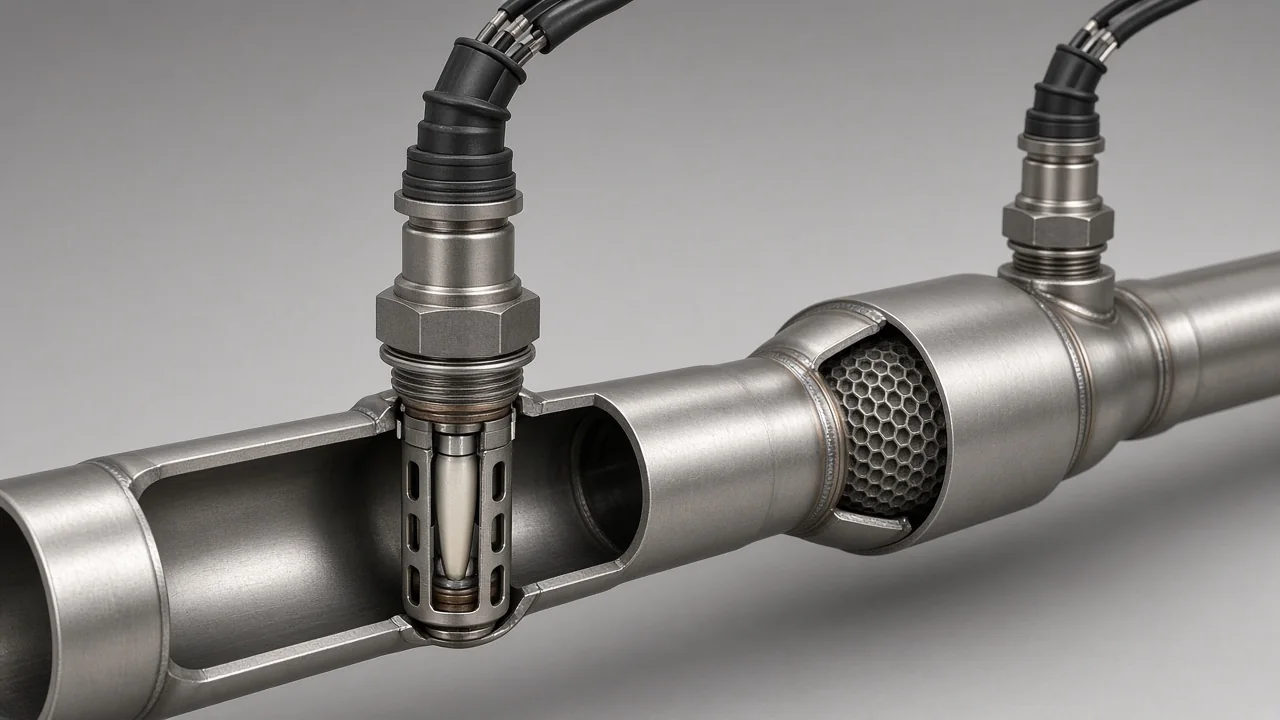
Somewhere in your car's exhaust, a small probe is constantly checking how well the engine burned its last batch of fuel. That part is the oxygen sensor, and the engine computer relies on it to keep the air-fuel mixture balanced. Here is what the sensor is, how its ceramic element produces a signal, how the main types differ, and how many sensors a typical vehicle has.
What an Oxygen Sensor Is and Where It Sits in the Exhaust
An oxygen sensor is a small probe threaded into the exhaust pipe or manifold so its tip sits directly in the stream of spent gas leaving the engine. It measures how much oxygen is left over after combustion. It does not measure oxygen in the cabin or in the air entering the intake. You will see it called an O2 sensor, a lambda sensor, or, on many newer cars, an air-fuel ratio sensor. These names all describe the same family of parts, which differ mainly in design and signal type.
Most vehicles have at least one sensor before the catalytic converter, called the upstream sensor, and another after it, called the downstream sensor. Exact locations vary by engine and exhaust layout. The tip only works when it is very hot, so modern units usually have an internal heater powered by the vehicle's electrical system. That is where the name heated oxygen sensor comes from. This article covers only what the part is and how it works. Testing, symptoms, and replacement are separate subjects.
What the Oxygen Sensor Actually Does for the Engine
The sensor's core job is to report whether the exhaust points to a rich mixture or a lean one. A rich mixture has more fuel than the air can fully burn, and a lean mixture has extra air. The reference point is the stoichiometric ratio, the chemically ideal balance at which fuel and oxygen are used up together. For pure gasoline, that is roughly 14.7 parts air to one part fuel by mass. Leftover oxygen in the exhaust is a direct clue to which side of that balance the engine is running on.
The process works as a loop. The engine burns fuel, the sensor reads the leftover oxygen, the engine control unit adjusts how long the injectors stay open, and the sensor reads the result again, many times per second. The sensor never controls anything itself. It only supplies information, and the ECU makes every decision. For the driver, this constant correction helps keep the idle steady, fuel economy consistent, and tailpipe emissions low as temperature, load, and fuel quality change.
How the Zirconia Element Generates a Signal
Most oxygen sensors are built around a thimble-shaped or flat element made of zirconium dioxide, a ceramic that conducts oxygen ions once it reaches operating temperature. Thin, porous platinum electrodes coat both sides. One side faces the exhaust gas, and the other is exposed to reference air, which has a known and much higher oxygen content. Oxygen ions move from the oxygen-rich side toward the oxygen-poor side, so the difference in concentration creates a small voltage across the electrodes. That voltage is the signal.
Engineers describe the mixture using a value called lambda. Lambda equals 1 at the stoichiometric ratio. Values above 1 are lean, and values below 1 are rich. A zirconia element's output swings sharply as the exhaust crosses lambda 1, which makes it very good at detecting that crossover point. A less common titania design works differently: its electrical resistance changes with oxygen content instead of generating a voltage. What a normal signal looks like depends on the sensor type and the vehicle, so raw readings need proper context.
Narrowband and Wideband Sensors: The Two Basic Types
The traditional narrowband, or switching, sensor tells the ECU essentially one thing: whether the mixture is rich or lean. Its signal flips back and forth around lambda 1, and the computer keeps nudging fuel delivery the opposite way, which produces a typical up-and-down pattern. This works well for holding an engine near stoichiometric. However, it shows little about how far the mixture has drifted, because the output levels off once the exhaust is clearly rich or clearly lean.
A wideband sensor, often called an air-fuel ratio sensor, adds a pumping cell that actively moves oxygen into or out of a small measuring chamber. The current needed to keep that chamber balanced shows how far rich or lean the mixture is across a broad range. Tighter emissions standards and strategies such as direct injection and lean-burn operation need that extra precision. The two types use different wiring and signal formats, so check your vehicle's service documentation to see which type it uses instead of assuming.
Why the Engine Computer Depends on the Sensor for Fuel Trim and Emissions
After a cold start, the engine runs in open loop. In this mode it uses pre-programmed fuel tables based on other inputs, such as airflow, coolant temperature, and throttle position. Once the oxygen sensor is warm and conditions allow, the ECU switches to closed-loop fuel control and uses the sensor's readings to fine-tune fuel delivery continuously. The engine can also return to open loop during heavy acceleration, when the computer deliberately richens the mixture for power and to protect components. So the sensor does not steer fuel delivery at every moment.
The ECU keeps a running record of its corrections, known as fuel trim. Short-term fuel trim reacts quickly to the sensor's moment-to-moment feedback. Long-term fuel trim is a slower, lasting adjustment that the ECU learns over time and uses as the new starting point on the next drive. Keeping the mixture near lambda 1 matters because the three-way catalytic converter works best there. At that point it can cut nitrogen oxides while also burning off carbon monoxide and unburned hydrocarbons. If the mixture drifts too far either way, one group of pollutants is treated less effectively.
How Many Oxygen Sensors a Typical Vehicle Has and What Each One Does
The general pattern is at least one upstream sensor per exhaust bank for mixture control, plus one downstream sensor per catalytic converter for monitoring. An inline four-cylinder engine has a single bank and commonly has two sensors. A V6 or V8 with two separate banks commonly has four. Designs vary, though, and some layouts add extra converters or sensors, so confirm the count for your car rather than guessing. Scan-tool data identifies each sensor by bank and sensor number.
Bank 1 is the side of the engine that contains cylinder number one, and Sensor 1 is the position closest to the engine. So Bank 1 Sensor 1 is the upstream sensor on that side. Downstream sensors have a different role. When the converter is working properly, the downstream signal should look fairly steady next to the constantly changing upstream signal, and the ECU compares the two to judge converter efficiency. The vehicle's service information or the emissions label under the hood is the reliable way to confirm your car's sensor layout.