Zirconia, Narrowband and Wideband Oxygen Sensors Explained
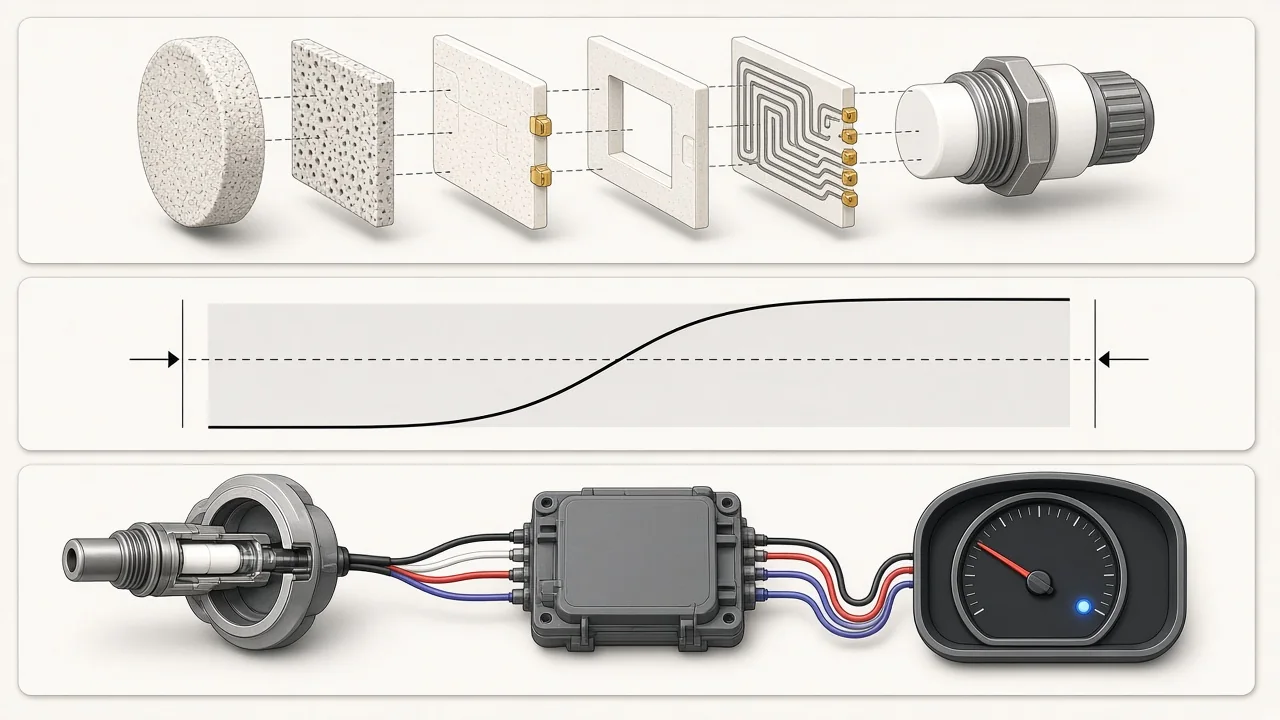
Most engines use exhaust oxygen sensing to manage the fuel mixture, but these sensors differ more than their similar look suggests. A narrowband oxygen sensor reports whether combustion is rich or lean of stoichiometric. A wideband oxygen sensor measures how far the mixture is from that point. Knowing how the zirconia ceramic inside both types works, and how each turns oxygen into a usable signal, makes their readings much easier to interpret.
How Zirconia Cells Produce an Oxygen-Sensing Signal
Zirconia is the common name for zirconium dioxide, chemically ZrO2. This ceramic is the core of most automotive exhaust oxygen sensors. Terms such as zirconia oxygen sensor, zirconium oxide oxygen sensor, ZrO2 oxygen sensor and the informal zirconium oxygen sensor usually mean the same thing: a sensor built around this ceramic element, not metallic zirconium. The ceramic is typically stabilized with other oxides so it stays structurally sound through repeated heating and cooling.
When hot, zirconia acts as a solid electrolyte that lets oxygen ions move through the ceramic. One electrode faces the exhaust and the other faces a reference. When the oxygen concentration differs between the two sides, oxygen ions move through the ceramic and create a voltage. Conduction is weak at low temperature, so a built-in sensor heater brings the element to working temperature faster than exhaust heat alone. Warm-up time varies with design and conditions. Zirconia names only the sensing material. It doesn't tell you whether the finished sensor works as a narrowband or a wideband device.
What a Narrowband Switching Signal Reveals
A conventional zirconia narrowband oxygen sensor produces a voltage that changes sharply as the mixture crosses stoichiometric combustion. On the lean side, the exhaust still contains leftover oxygen and the output stays low. On the rich side, oxygen is scarce and the output rises steeply. Once the sensor is warm and the engine is in suitable closed-loop operation, the engine computer uses these transitions to shift fueling back and forth. That's why a healthy upstream signal usually switches instead of holding steady.
Switching is useful, but it has limits. Away from the transition the voltage curve is nearly flat, so a narrowband sensor can't tell a slightly rich mixture from a very rich one. It also can't report a precise air-fuel ratio across a broad operating range. A steady signal can be normal during open-loop warm-up, deceleration fuel cutoff or heavy load, but the same pattern at a warm idle may be worth investigating. You need to know how the engine was running before a reading can support a diagnosis.
How a Wideband Sensor Measures Lambda
A common wideband oxygen sensor design uses the same ceramic in a more complex arrangement. A sensing cell, similar in principle to a narrowband element, monitors oxygen inside a small diffusion chamber. Exhaust enters that chamber through a controlled gap. Next to it, an oxygen pump cell can move oxygen ions into or out of the chamber when current is applied. Both cells still work on zirconia principles: oxygen ions move through the ceramic, and differences in oxygen concentration produce a voltage. The assembly simply puts those principles into its own internal feedback loop.
A dedicated air-fuel ratio controller adjusts the pump current to hold the sensing cell at a fixed target. The controller may be inside the engine computer or in an aftermarket unit. Lean exhaust means oxygen must be pumped out of the chamber, and rich exhaust means it must be pumped in. The direction and size of that pump current tell the controller the lambda value. Raw sensor circuits, controller outputs and scan-tool values may show this as current, voltage, lambda or ratio. You need the matching documentation to read any of them correctly.
Reading Lambda and Displayed Air-Fuel Ratio
Lambda compares the actual mixture with the chemically correct mixture for the fuel being burned. Lambda 1 means stoichiometric. Values below 1 mean a rich mixture with excess fuel, and values above 1 mean a lean mixture with excess oxygen. Because lambda is measured relative to stoichiometric, it stays meaningful whether the engine burns gasoline, an ethanol blend or another fuel. That's why many technicians and tuners treat it as the main wideband reading.
Many gauges also show an air-fuel ratio. That number is usually calculated by multiplying lambda by a configured stoichiometric value, such as roughly 14.7:1 for pure gasoline. If the gauge is set for gasoline but the engine burns a high-ethanol blend, the displayed ratio can look alarming or reassuring for the wrong reasons, even though lambda is correct. Readings also depend on engine operating state. Idle, cruise, acceleration and deceleration each produce different mixtures, so no single target number fits every situation.
What a Wideband Oxygen Sensor Kit Provides
A wideband oxygen sensor kit usually includes a sensor, a matched controller, a wiring harness and either a gauge or a logging interface, though contents vary between products. Some kits provide an analog output for an engine management system or data logger, some use a digital connection, and some offer both. The kit's job is to display and record mixture information continuously. That supports diagnostic work, checking repairs and professionally supervised calibration, all situations where a narrowband signal shows too little.
Before buying, check that the manufacturer documents the sensor and controller as compatible, because wideband sensors don't work with every controller. Also check which output formats the kit provides, whether the fuel setting for the air-fuel ratio display can be changed to match your fuel, and whether the kit suits your vehicle and logging equipment. Calibration requirements depend on the kit. Some run a free-air calibration routine, while others rely on sensors trimmed at the factory. Mounting the sensor in the exhaust and doing the electrical installation are best left to qualified personnel who know the vehicle.
When Oxygen Readings Need Professional Testing
An oxygen reading shows what reaches the sensor, not necessarily what the injectors delivered. An upstream exhaust leak can pull in outside air. Coolant, oil or silicone contamination can dull the sensing element, and heater or wiring faults can delay or distort the signal. Misfires are especially misleading. Unburned air and fuel pass into the exhaust, and the sensor reports that leftover oxygen as lean even when fuel delivery is adequate. A lean reading or fault code is evidence to interpret, not proof that a sensor or fuel component has failed.
Owners can safely record useful details: how long readings take to settle after a cold start, any warning lights or gauge error messages, the conditions when odd values appear, and any stored diagnostic information read with a scan tool while the vehicle is parked. Code meanings can vary by manufacturer, so they need confirmation for the specific vehicle. Persistent implausible readings, rough running, hesitation or poor fuel economy call for professional testing. If readings are monitored while driving, a passenger should do it, not the driver. Avoid touching hot exhaust parts or probing sensor circuits.