What Is a Wheel Alignment and How Is It Done?
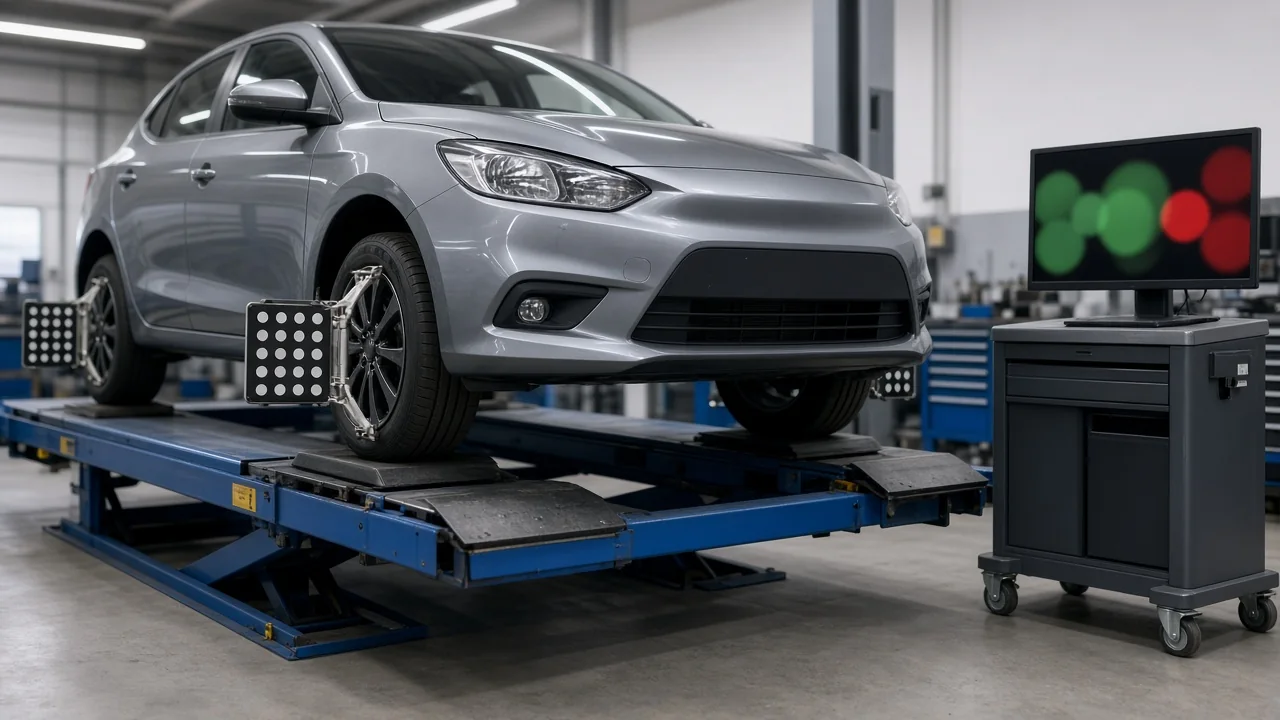
A wheel alignment is one of the most common services a car receives, yet few drivers know what the technician actually changes. Put simply, the job returns your suspension and steering geometry to the angles the manufacturer intended. Knowing those angles, the symptoms of misalignment and the shop procedure helps you judge when the service is needed and whether it was done well.
What a Wheel Alignment Actually Adjusts on Your Car
Despite the name, a wheel alignment does not straighten or reshape the wheels themselves. It sets the suspension and steering geometry so each tire meets the road at the angles the manufacturer specifies. Those angles are published as alignment specifications, usually a target value with an acceptable range. The shop's job is to measure your car against them and bring anything outside the range back into tolerance. The wheels are simply the reference point the equipment reads.
Alignment is often confused with tire balancing and tire rotation because all three involve tires. Balancing corrects uneven weight distribution around a tire and wheel to prevent vibration, while rotation moves tires between positions to even out wear. Alignment is different because it is a suspension adjustment. Nearly every passenger vehicle can be aligned, though the adjustable points vary by make and model, so an angle a technician can change on one car may be fixed on another.
Camber, Caster and Toe Explained in Plain Language
Camber is the inward or outward tilt of the tire when you look at the car from the front. A tire leaning in at the top has negative camber, and one leaning out has positive camber. Too much either way puts extra load on one shoulder of the tread. Caster is the forward or backward tilt of the steering axis viewed from the side. It has little effect on tire wear, but it helps the steering wheel return to center and keeps the car stable in a straight line.
Toe describes whether the fronts of the tires point slightly toward or away from each other when viewed from above. A tire with too much toe gets dragged sideways as it rolls, so toe usually has the biggest effect on tire wear. Thrust angle compares the direction the rear axle points with the vehicle's centerline. Even when the rear suspension has no adjustment, the technician measures thrust angle and sets front toe relative to it so the car tracks straight. Detailed tuning of each angle is a separate subject.
How Alignment Affects Tire Wear, Steering and Fuel Use
When toe is off, each tire scrubs across the pavement instead of rolling cleanly, and tread life can drop noticeably. The classic sign is feathering: when you run a hand across the tread blocks, they feel smooth in one direction and sharp in the other. Too much camber tends to wear one shoulder of the tire. Misalignment also adds rolling resistance, which can slightly reduce fuel economy, although faster tire wear is usually the more noticeable consequence.
Handling symptoms include a car that pulls to one side, a steering wheel that sits off center while driving straight, or a wandering feel at highway speed. Steering alignment is part of the same job because the technician centers the steering wheel while setting toe. Still, a symptom alone does not prove misalignment. Uneven tire pressures, a tire with a built-in pull, dragging brakes or worn suspension parts can all feel like misalignment, which is why a careful shop checks those causes first.
The Pre-Alignment Inspection: What the Technician Checks First
Before measuring anything, the technician makes sure the tires will give accurate readings. Pressures are set to the placard value, because an underinflated tire changes ride height and camber readings. The technician checks that tire sizes match side to side and inspects the tread for wear patterns that hint at the underlying problem. Many manufacturers also specify ride height or loading conditions for measurement, such as a full fuel tank or an empty trunk, so those get checked as well.
Next comes the steering and suspension check. Tie rod ends, ball joints, control arm bushings and wheel bearings are tested for play, often by rocking the wheel with the vehicle raised. A loose component lets the wheel shift under load, which makes any measurement meaningless and any adjustment temporary. If the technician finds worn parts, expect the shop to recommend replacing them first and postpone the alignment. That isn't automatically an upsell, because it's the only way the alignment will hold.
On the Rack: How the Alignment Machine Measures the Angles
The alignment rack is a lift with turn plates under the front wheels and slip plates under the rear. These let the tires move and turn freely, so the suspension settles naturally instead of binding against the floor. Targets or sensor heads clamp onto each wheel. Camera-based systems read reflective targets, while other designs use sensors or lasers. In either case, the software calculates each wheel's position relative to the others and to the vehicle's centerline.
Before real measurements begin, the system performs runout compensation, which cancels errors from a slightly bent wheel or an imperfectly seated clamp, often by rolling the car a short distance. The technician then turns the steering left and right so the software can calculate caster from how the wheels move. During adjustments, the steering wheel is locked straight and a pedal depressor holds the brakes. The machine compares live readings against its manufacturer database and guides the technician toward the target in real time.
How Adjustments Are Made and Reset Steps After Alignment
On most cars, toe is adjusted by lengthening or shortening the tie rods, which is why tie rod adjustment is part of nearly every alignment. Camber and caster vary more by design and may be set with eccentric cams, shims, slotted mounts or aftermarket correction kits. Some vehicles have little or no factory adjustment for certain angles. In that case, the technician should tell you when a specification can't be reached and whether a bent part might be the reason.
The final step is centering the steering wheel so it sits level when the car travels straight. That matters for comfort, and on newer vehicles it matters for electronics too. Stability control and driver-assistance features rely on the steering angle sensor, and many models need a sensor reset or camera calibration afterward, which the shop performs with a scan tool or dedicated equipment. Because the work requires a lift, precise instruments and vehicle data, it belongs in a properly equipped shop.
How to Read Your Alignment Printout
A good shop gives you an alignment printout showing before-and-after readings for each wheel, with the manufacturer's acceptable range next to every value. Most machines color-code the results, with green for within specification and red for outside it. If a value is still red in the after column, ask about it, since it may be an angle that can't be adjusted or a sign of a damaged component. Angles are shown in degrees or in degrees and minutes, and toe often appears for each wheel plus a combined total.
Keep the printout with your service records. It gives you a baseline for comparing future readings after a pothole or curb impact, and it documents the vehicle's condition if you raise a tire or suspension warranty concern. If the after column is all green but the car still pulls or wears tires unevenly, alignment is probably not the cause. The problem more likely lies in the tires, brakes or other components, and the next step is further diagnosis rather than another alignment.